
China's Rare Earth Dominance and Its Emerging Impact on Bitcoin Mining Economics
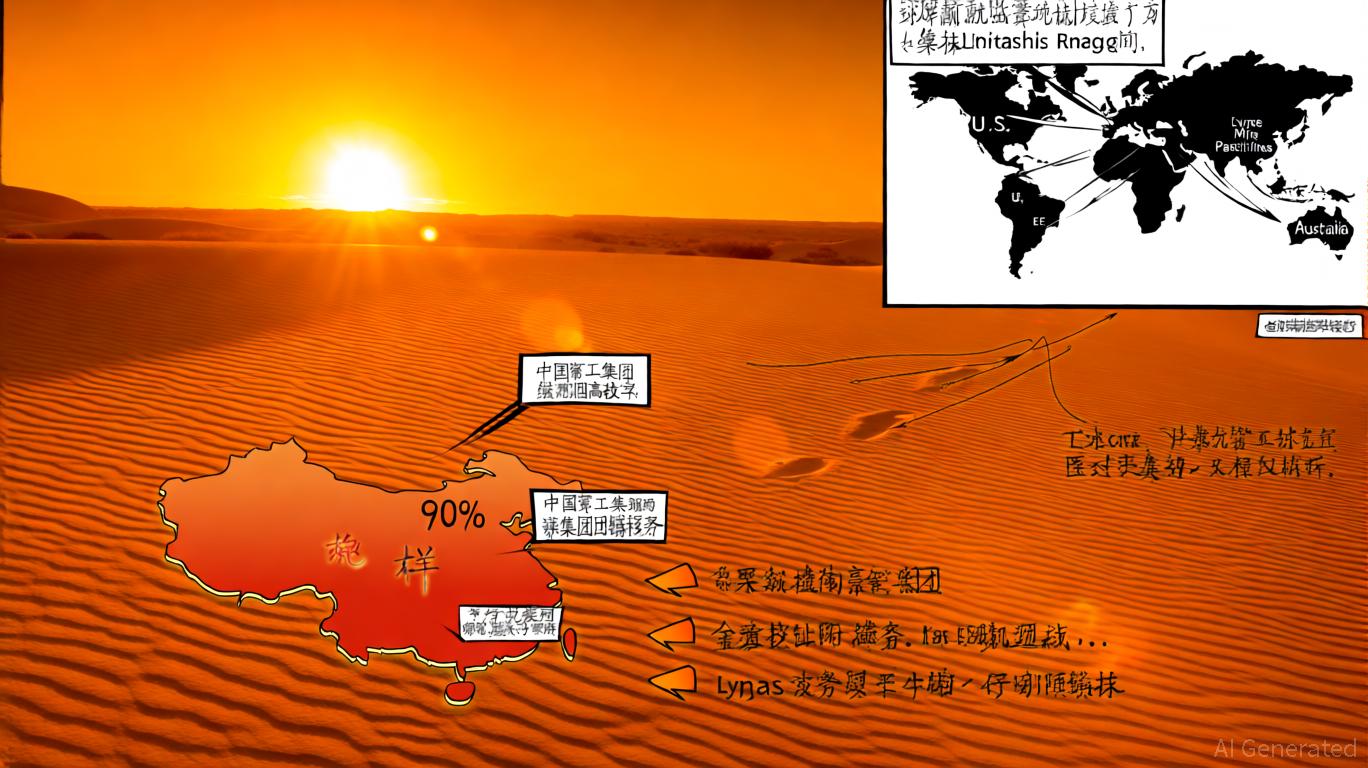
China's near-total control over the rare earth elements (REEs) supply chain has long been a strategic lever in global geopolitics. By 2025, the country's dominance has deepened, with state-led consolidation reducing the sector to just two major entities—China Rare Earth Group and China Northern Rare Earth Group High-Tech—operating under strict government quotas, according to Rare Earth Processing 2025. These entities now control nearly 90% of global refining capacity and a near-monopoly on heavy rare earth elements (HREEs) like dysprosium and terbium, as noted in a Discovery Alert report. This structural advantage extends to downstream processing, with China commanding 82% of global rare earth refining and 91% of permanent magnet production, per a BusinessCraft analysis.
![]https://cdn.ainvest.com/aigc/hxcmp/images/compress-qwen_generated_1760551408552.jpg.png
The implications for BitcoinBTC-- mining are profound. Rare earth elements are critical to the production of neodymium-iron-boron (NdFeB) magnets, which are indispensable in high-performance ASICs and cooling systems used in Bitcoin mining hardware, as explained by Deutsche Welle. For instance, the latest-generation Antminer S23 Hydro and SEAL03 chips achieve energy efficiencies of 9.5 J/TH and 9.7 J/TH, respectively, according to a Terahash analysis, but these gains rely on access to REE-based components. China's export restrictions—such as the 2025 licensing system for seven HREEs—threaten to disrupt this supply, raising hardware costs and stifling innovation, per a Discovery Alert export strategy.
Geopolitical Leverage and Market Volatility
China's strategic export controls now extend to superhard materials, rare-earth processing equipment, and lithium battery-related materials, effectively blocking competitors from building their own refining capacities, according to a Taylor Wessing briefing. This has created a dependency crisis: the U.S. produces only 1,000 tons of NdFeB magnets annually, compared to China's 300,000 tons (see Rare Earth Processing 2025), while the EU relies on China for 98% of its rare earth magnets, as reported in the New York Times. The auto industry has already felt the pinch, with companies like Ford scaling back production due to supply chain constraints, according to an Invezz report.
Bitcoin mining, however, is uniquely vulnerable. Post-2024 halving, energy costs have become the primary determinant of profitability, per a Cointelegraph analysis. A 10% increase in J/TH due to REE shortages could erase thin margins, as seen in 2025 when Bitcoin's price dropped 3.11% following China's export restrictions, reported by the uMiners blog. Historical precedents suggest even sharper declines: previous REE restrictions triggered 5–7% price drops in Bitcoin, according to a Coinfomania analysis.
Energy Efficiency and the Green Transition
The energy transition further complicates the equation. Bitcoin mining now sources 52.4% of its energy from renewables, including hydro and wind power, based on a LokaMining report, both of which rely on REEs for turbines and grid infrastructure, as detailed in a ScienceDirect study. If China's export controls delay the deployment of green energy technologies, Bitcoin miners may face higher energy costs and regulatory scrutiny. For example, Kazakhstan's mining operations already consume 997.9 gigaliters of water annually, straining local resources, according to a PMC article.
Investment Implications
Investors must weigh three key risks:
1. Supply Chain Disruptions: Delays in Western rare earth projects (e.g., Mountain Pass Mine's 1,000-ton NdFeB target by 2025) will prolong China's dominance, as outlined in a piece from the Canadian Mining Journal.
2. Energy Inefficiency: A 10–15% rise in J/TH could force miners to exit unprofitable regions, reducing network hash rates and increasing volatility.
3. Geopolitical Escalation: The U.S.-China trade war has already triggered a 3.2% drop in global crypto market cap, according to a 99Bitcoins analysis, with gold surging to $4,200 per ounce as a safe haven (Invezz).
Conversely, opportunities exist for firms developing REE recycling technologies (e.g., flash joule heating), as covered by IEEE Spectrum, or alternative magnet materials (e.g., tetrataenite), highlighted in a Northeastern report. These innovations could mitigate supply chain risks while aligning with ESG mandates.
Conclusion
China's rare earth dominance is no longer a distant threat but an active force reshaping Bitcoin's economics. As geopolitical tensions and energy transitions collide, the sector's resilience will depend on diversifying supply chains and accelerating technological innovation. For investors, the stakes are clear: REEs are notNOT-- just a commodity—they are a linchpin of the digital age.






Comentarios
Aún no hay comentarios