
China's Post-Holiday Market Rebound and AI-Driven Sectors: Contrarian Opportunities in Tech Amid Soft Consumer Demand
China's post-holiday economic landscape in 2025 reveals a striking duality: while consumer demand remains tepid, the AI-driven technology sector is surging with momentum. This divergence presents a compelling case for contrarian investors to pivot from underperforming consumer markets to high-growth tech infrastructure, where policy tailwinds and capital reallocation are reshaping the investment narrative.
Post-Holiday Retail: Cautious Recovery, Persistent Caution
China's post-holiday retail sales in Q3 2025 grew 5% year-on-year, driven by resilient categories like food, beverages, and electric vehicles (EVs), as found in McKinsey's mid-2025 update. The 618 Shopping Festival's 15.2% gross merchandise value (GMV) increase further signaled a cautious return to spending, particularly in appliances and health products, according to the McKinsey update. However, underlying consumer sentiment remains fragile. The Consumer Confidence Index (CCI) hovers near historic lows, with household savings rates exceeding 30% since 2020, a pattern highlighted in the McKinsey report. This reflects lingering anxieties about employment and the property market slump, which continue to dampen discretionary spending.
The Shanghai Composite Stock Market Index, meanwhile, has defied these headwinds. As of September 10, 2025, the index stood at 3,812 points, up 40.06% year-on-year, fueled by robust fund inflows and policy stimulus, according to Trading Economics data. Notably, Apple's supply chain firms, such as Foxconn, have benefited from new product cycles, while retail investors are increasingly reallocating capital from real estate to equities, per Trading Economics. Yet, the market's volatility-driven by regulatory uncertainty and profit-taking-suggests a fragile equilibrium.
AI-Driven Sectors: A Contrarian's Goldmine
While consumer demand lags, China's AI-driven sectors are accelerating at an unprecedented pace. Goldman Sachs analysis estimates that generative AI could boost China's GDP by 0.2–0.3 percentage points by 2030, with the AI industry projected to surpass $140 billion by 2030. Key enablers include semiconductors, cloud computing, and advanced AI models like DeepSeek, which are redefining productivity and cost efficiency.
Investment in AI infrastructure is surging. Goldman Sachs reports that China's four largest AI model developers plan to increase capital expenditures by 38% in 2025, while cloud infrastructure spending is forecast to reach $46 billion by 2025 and Alibaba's $52.4 billion three-year investment plan to enhance computing resources underscores this trend, as detailed in an OpenTools projection. Government policies, including the 14th Five-Year Plan's emphasis on AI and the "Made in China 2025" initiative, are further accelerating adoption, according to the China AI strategy overview. See the China AI strategy for policy context.
Contrarian opportunities lie in the sector's structural advantages. Unlike the U.S., where AI investment focuses on semiconductors and high-end chips, China is prioritizing energy-efficient data centers and green infrastructure to address computing demands - a dynamic noted in a TechWireAsia report - and this approach, coupled with state-led funding (for example, $56 billion in 2025 AI investments from government sources), positions China to outpace global competitors in cost innovation and scalability (TechWireAsia report).
The Tension Between Tech and Consumer Demand
The disconnect between tech-sector optimism and consumer-market caution is stark. While AI adoption is raising productivity in healthcare, finance, and manufacturing, as described in the Goldman Sachs analysis, labor market concerns persist. China's reliance on physical jobs in agriculture and construction makes it less vulnerable to AI-driven displacement than the U.S., but deflationary pressures and weak labor demand remain risks noted by Goldman Sachs.
For investors, this tension highlights a strategic inflection point. The AI sector's growth is underpinned by structural factors-government support, corporate R&D, and global export ambitions-while consumer demand remains hostage to cyclical and demographic headwinds. Tencent's $64 billion 2023 R&D investment in AI and cloud computing and Xiaomi's foray into EVs and IoT ecosystems, both discussed in an IMD analysis, exemplify the shift toward tech-driven value creation.
Conclusion: Reallocating Capital for the Long Game
China's post-holiday market rebound is a mixed bag: retail sales are recovering, but consumer sentiment remains fragile. In contrast, AI-driven sectors are experiencing a structural boom, supported by policy, capital, and innovation. For contrarian investors, the case is clear: while consumer markets offer limited upside amid persistent caution, the AI and tech infrastructure sectors present a high-conviction opportunity to capitalize on China's next phase of growth.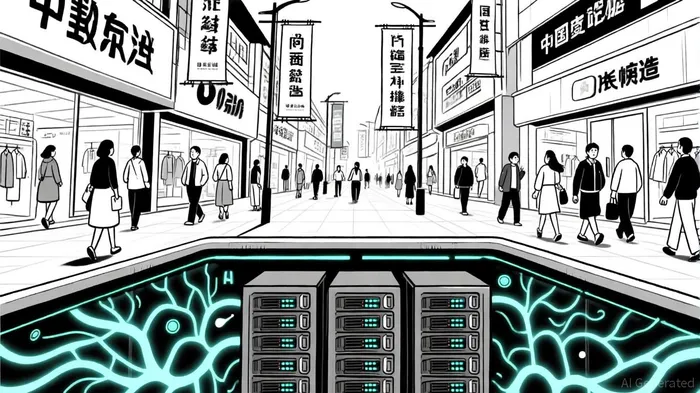





Comentarios
Aún no hay comentarios