
China's Pharma Revolution: How Innovent's Mazdutide is Reshaping the Global Weight-Loss Drug Landscape
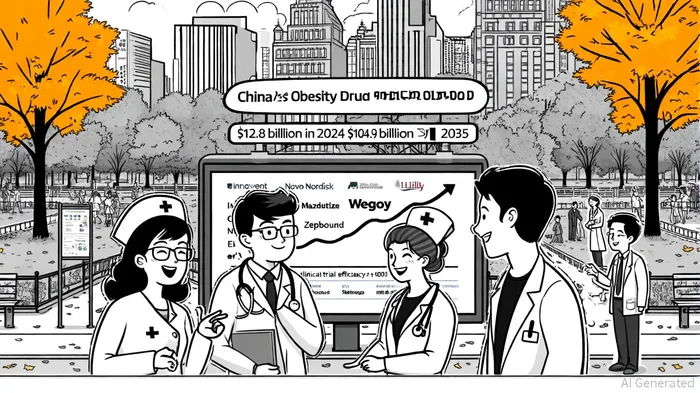
The global weight-loss drug market is undergoing a seismic shift, driven by China's rapid ascent as a biopharma innovation hub. At the center of this transformation is Innovent Biologics' mazdutide, a dual glucagon (GCG)/glucagon-like peptide-1 (GLP-1) receptor agonist that has secured regulatory approval in China for chronic weight management and type 2 diabetes (T2D) treatment[1]. This breakthrough, coupled with China's evolving regulatory environment and aggressive market expansion strategies, is challenging the long-standing dominance of global giants like Novo NordiskNVO-- and Eli LillyLLY--.
Mazdutide: A Dual-Action Disruptor
Mazdutide's clinical performance has been nothing short of remarkable. In the GLORY-1 Phase 3 trial, the 6 mg dose group achieved a 14.84% average weight loss over 48 weeks, with 50.6% of patients losing at least 15% of their body weight[2]. These results, published in the New England Journal of Medicine, position mazdutide as a formidable competitor to NovoNVO-- Nordisk's Wegovy and Lilly's Zepbound, though it trails slightly behind Lilly's tirzepatide, which has demonstrated 20-26% weight reductions[4]. Beyond weight loss, mazdutide reduced liver fat content by up to 80.24% in patients with baseline liver fat ≥10%, addressing obesity-related comorbidities like metabolic dysfunction-associated steatotic liver disease (MASLD)[3].
The drug's dual mechanism—activating GLP-1 to suppress appetite and GCG to boost energy expenditure—offers a novel approach to obesity management[1]. This innovation has not gone unnoticed: Innovent's shares have surged by over 150% since early 2025, outperforming both Novo and LillyLLY--, as investors bet on its potential to become a blockbuster in China's $104.9 billion obesity market by 2035[2].
Global Giants on the Defensive
Novo Nordisk and Eli Lilly, long dominant in the GLP-1 space, are now grappling with the dual threats of mazdutide and impending patent expirations. Novo's Wegovy, which generated $158 million in China's obesity care segment in Q2 2025 (down from $704 million in Q1), faces stiff competition as Innovent expands partnerships with online platforms, retail pharmacies, and private clinics to enhance mazdutide's accessibility[2]. Novo's management attributes the sales dip to “channel mix changes,” but the broader trend—declining global GLP-1 diabetes market share by 4.2 percentage points in H1 2025—signals growing competitive pressure[5].
Eli Lilly, meanwhile, is leveraging its collaboration with Innovent to maintain a foothold in China. While Lilly's tirzepatide has secured regulatory approval for both diabetes and obesity, the company is also advancing mazdutide's global development, including a Phase 2 U.S. trial for obesity[3]. This strategy reflects Lilly's recognition of China's role in accelerating R&D pipelines, particularly with regulatory reforms like the 2015 and 2020 drug approval overhauls, which have streamlined pathways for novel therapeutics[6].
Strategic Implications for the Biopharma Landscape
China's regulatory and policy shifts are reshaping the competitive dynamics. The 2015 reforms, which reduced clinical trial timelines and encouraged foreign collaboration, have enabled domestic firms like Innovent to fast-track approvals[6]. Additionally, initiatives like Healthy China 2030 are driving demand for innovative therapies, creating a fertile ground for dual-agonist drugs like mazdutide.
For global players, the stakes are high. Novo Nordisk is investing heavily in next-generation therapies, including subcutaneous and oral amycretin, to counter pricing erosion and Wegovy's looming patent expiry in 2026[5]. Lilly, by contrast, is doubling down on China's biotech ecosystem through shared platforms like the Lilly Gateway Labs in Beijing, fostering partnerships in oncology, AI-driven drug discovery, and ADCs[6]. These moves underscore a broader trend: global pharma firms are no longer just competing in China—they are collaborating with it to stay ahead.
The Road Ahead
Innovent's success hinges on navigating pricing and reimbursement hurdles. While mazdutide's inclusion in China's National Reimbursement Drug List would boost adoption, it would likely require steep price concessions[2]. Conversely, the drug's commercial potential is vast: with obesity prevalence in China exceeding 40% among adults[4], and a growing middle class prioritizing health, mazdutide could capture a significant market share.
For investors, the key takeaway is clear: China's biopharma innovation is no longer a peripheral story. It is a central force redefining global markets. As Innovent's mazdutide challenges Novo and Lilly's dominance, the industry's next chapter will be written not just in Copenhagen or Indianapolis, but in Beijing.







Comentarios
Aún no hay comentarios