
China's Nvidia Ban: A Catalyst for AI Resilience and Strategic Stock Rotation
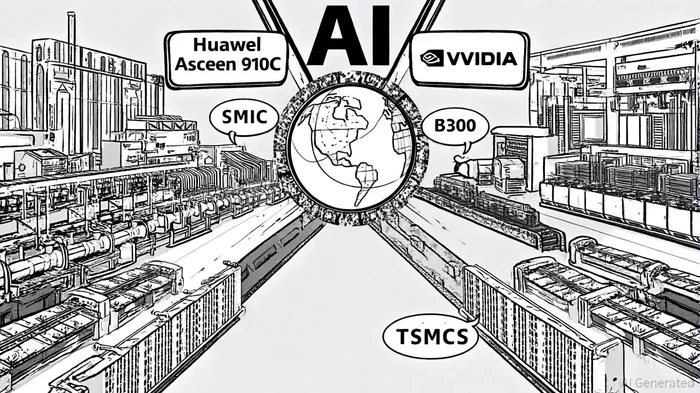
The recent ban on advanced NVIDIANVDA-- GPUs in China marks a pivotal moment in the global tech landscape. Announced on June 17, 2025, this move is part of Beijing's broader strategy to achieve technological self-sufficiency, driven by geopolitical tensions and U.S. export controls[4]. For investors, the ripple effects of this ban—and the resulting shift toward domestic chip alternatives—present both risks and opportunities. This analysis explores how the China-Nvidia standoff is reshaping the AI industry and identifies strategic stock rotation opportunities in the emerging era of AI resilience.
The Financial Toll on Nvidia and U.S. Tech
Nvidia's dominance in AI and high-performance computing has been severely tested. The company reported $5.5 billion in costs from canceled H20 chip orders and faces potential annual losses of $8–16 billion due to trade restrictions[5]. Compounding this, the Trump administration imposed a 15% tax on Nvidia's China AI chip sales[5], while the Biden administration forced the company to halt H20 production under export controls. In response, Nvidia is developing the B30A, a chip compliant with U.S. regulations but offering only half the performance of its flagship B300[5]. These challenges highlight the vulnerability of U.S. tech firms reliant on the Chinese market.
China's Domestic Chip Renaissance
The ban has accelerated China's pivot to homegrown solutions. Huawei's Ascend 910C and upcoming 920 chips now outperform the H20[4], while Semiconductor Manufacturing International Corporation (SMIC) has seen an 8.3% stock surge as demand for local alternatives grows[6]. Cambricon Technologies, a key player in AI chips, saw its stock explode 125% in August 2025[3], reflecting investor confidence in domestic innovation. AlibabaBABA-- and BaiduBIDU-- are also advancing self-developed chips, with the Hang Seng Tech Index rising 4.2% in mid-September[2].
China's state-backed semiconductor fund, prioritizing AI-related chips, underscores its commitment to a full supply chain[2]. Meanwhile, stockpiling of older Nvidia H20 chips—over a million units acquired in 2024—provides a temporary buffer while domestic alternatives mature[6]. However, analysts caution that capacity and performance gaps remain[1], suggesting the transition will be gradual.
Global Implications and Investment Opportunities
The China-Nvidia standoff is deepening the bifurcation of the global AI ecosystem. While U.S. firms like AMDAMD-- and TSMCTSM-- benefit from the AI boom—AMD's MI300X and TSMC's $31 billion Q2 sales[3]—the focus on self-sufficiency is reshaping investment flows.
Strategic Stock Rotation Recommendations
1. Chinese Domestic Alternatives:
- Huawei and SMIC: Huawei's chip bundling strategy aims to rival Nvidia's performance[6], while SMIC's manufacturing scale positions it as a critical player.
- Cambricon and Alibaba: These firms are leading the charge in AI-specific chip design, with Cambricon's stock surging on demand[3].
- Global AI Resilience Plays:
- AMD (MI300X): With data center GPU revenue projected to exceed $4.5 billion in 2024[3], AMD is a key beneficiary of the AI shift.
- TSMC: As the largest foundry, TSMC's role in manufacturing advanced AI chips ensures continued demand[3].
Broadcom (AVGO): AI-related revenue jumped 63% in Q3 to $5.2 billion[3], reflecting its diversified tech portfolio.
Emerging Markets and Diversification:
- India and Japan: These regions are scaling semiconductor production, with global demand for chips expected to hit $1 trillion by 2030[3].
Conclusion: Navigating the New AI Landscape
The China-Nvidia chip ban is more than a regulatory hurdle—it's a catalyst for a restructured global tech ecosystem. For investors, the key lies in strategic stock rotation toward companies positioned to thrive in this bifurcated world. While U.S. firms face near-term headwinds, the rise of domestic Chinese alternatives and global diversification efforts present long-term opportunities. As the AI race intensifies, resilience—not dominance—will define the next era of tech investing.





Comentarios
Aún no hay comentarios