
China's Monetary Policy Easing and Liquidity Management: Implications for Market Confidence and Fixed-Income Strategies
The People's Bank of China (PBOC) has continued to signal a dovish monetary policy stance in 2025, with recent actions underscoring its commitment to easing financial conditions and stabilizing economic growth. On September 18, 2025, the central bank injected 487 billion yuan into the market via a 7-day reverse repo operation at a stable rate of 1.4%, maintaining the rate unchanged since May 2025, according to Trading Economics. This followed a broader trend of rate cuts earlier in the year, including a 20-basis-point reduction in September 2024 to 1.5%, as reported by Reuters, and a 10-basis-point cut in May 2025 (Trading Economics data). The PBOC's decision to hold rates steady in September 2025 reflects a balance between supporting liquidity and avoiding excessive stimulus amid weak inflationary pressures.
The central bank's liquidity management has also expanded in scale. On October 9, 2025, the PBOC executed a massive 1.1-trillion-yuan outright reverse repo operation with a 91-day tenor, marking the fourth consecutive month of significant liquidity injections, according to YuanTrends. This move, coupled with a net 300 billion yuan increase in outstanding three-month repos, highlights the PBOC's proactive approach to addressing seasonal cash flow demands and supporting government bond issuance, as YuanTrends noted. The operation occurred against a backdrop of China's year-on-year inflation rate at 0.1% and a monthly deflationary trend of -0.1%, reinforcing the case for accommodative policy, according to Trading Economics indicators.
Implications for Market Confidence
The PBOC's consistent rate cuts and liquidity injections have bolstered market confidence in China's financial system. By maintaining the 7-day reverse repo rate at 1.4%-a historically low level-the central bank has signaled its intent to keep borrowing costs low for businesses and households, which is critical for sustaining consumption and investment. Trading Economics data show the 1.4% rate has become the economy's main policy anchor, influencing broader market rates such as the Loan Prime Rate (LPR) and interbank lending. This stability reduces uncertainty for investors, particularly in fixed-income markets, where predictable policy rates allow for better yield curve management.
Moreover, the PBOC's October 2025 liquidity injection demonstrates its willingness to counteract external risks, such as global economic slowdowns and U.S. Federal Reserve rate cuts. The Fed's dovish pivot, including a 25-basis-point cut in September 2025, was noted by Investopedia, and has created a more favorable environment for emerging markets. By aligning its easing cycle with the Fed, the PBOC is likely aiming to prevent capital outflows and support the yuan's stability. The PBOC's managed approach to the USD/CNY reference rate-fixing it at 7.1048 on October 10, 2025-further underscores its dual focus on export competitiveness and financial stability.
Fixed-Income Strategy Considerations
For fixed-income investors, the PBOC's policy trajectory presents both opportunities and challenges. The 1.4% 7-day reverse repo rate has kept short-term yields compressed, with the interbank rate hovering near 1.56% (Trading Economics indicators). This environment favors strategies that prioritize liquidity and duration management, such as investing in short-dated government bonds or high-quality corporate debt. Additionally, the PBOC's recent 5-year LPR of 3.5% (Trading Economics indicators) suggests that long-term credit conditions remain supportive, making longer-duration instruments attractive for investors seeking yield in a low-inflation environment.
However, the central bank's reliance on large-scale liquidity injections-such as the October 9, 2025, 1.1-trillion-yuan operation-introduces volatility into the money market. Investors must remain vigilant about potential rate hikes if inflationary pressures resurge or if the PBOC shifts focus to curbing speculative lending. For now, the stable 1.4% rate and active liquidity management provide a favorable backdrop for fixed-income strategies, but monitoring PBOC announcements and inflation data will be critical for adjusting portfolios.
Conclusion
The PBOC's 2025 monetary policy easing, characterized by rate cuts and aggressive liquidity injections, has reinforced market confidence and provided a supportive environment for fixed-income strategies. While the 1.4% 7-day reverse repo rate remains a key policy anchor, the central bank's October 2025 actions highlight its readiness to adapt to seasonal and external challenges. Investors should capitalize on the current low-rate environment while remaining attuned to potential shifts in policy as economic conditions evolve.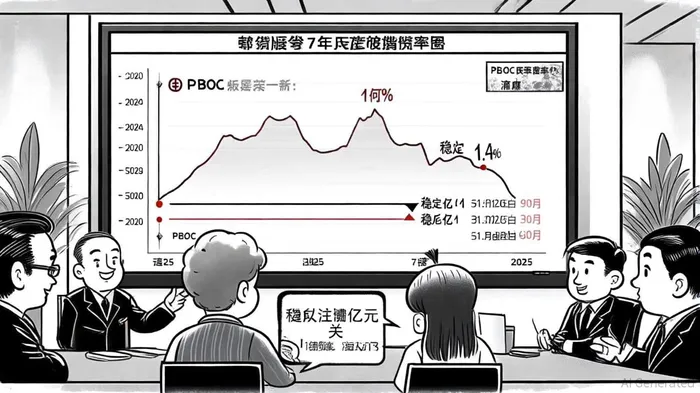







Comentarios
Aún no hay comentarios