
China's Green Power Surge: Renewable Infrastructure and Supply Chain Supremacy Reshape Global Emissions Trajectory
Renewable Energy Infrastructure: A BRI-Driven Green Expansion
China's Belt and Road Initiative (BRI) has evolved into a vehicle for green energy diplomacy, with renewable infrastructure at its core. In the first half of 2025 alone, Chinese investments in green energy under the BRI reached USD 9.7 billion, contributing to an installed capacity of 11.9 GW of renewable energy projects, including wind, solar, and waste-to-energy facilities, according to a Green FDC report. This surge reflects a strategic pivot toward high-tech renewable solutions, such as solar photovoltaic (PV) manufacturing and green hydrogen development, which are now central to BRI partnerships.
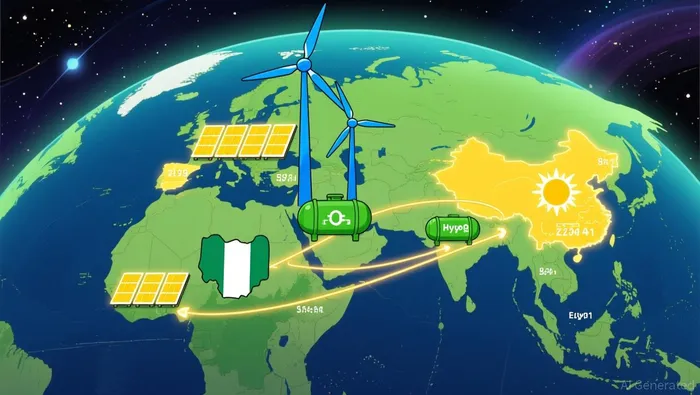
For instance, Longi Green Energy's green hydrogen projects in Nigeria exemplify how Chinese firms are leveraging BRI corridors to deploy cutting-edge technologies in emerging markets, according to the Green FDC report. Similarly, Xinyi Glass Holding's USD 700 million investment in a solar PV glass production base in Egypt underscores the integration of local manufacturing with global supply chains, according to the Green FDC report. These projects not only advance host countries' energy security but also align with China's domestic goals to achieve carbon neutrality by 2060.
Supply Chain Supremacy: Solar PV and Green Hydrogen Dominance
China's grip on the global solar PV supply chain remains unchallenged, with its share of production in polysilicon, ingots, wafers, cells, and modules exceeding 95% in 2025, according to the IEA Executive Summary. Xinjiang province alone accounts for 40% of global polysilicon manufacturing, a critical input for solar panels, according to the IEA Executive Summary. This dominance is reinforced by aggressive industrial policies and economies of scale, enabling China to maintain a USD 30 billion annual trade surplus in solar PV exports, according to the IEA Executive Summary.
The green hydrogen sector is witnessing a similar trajectory. Chinese firms are now leading pilot projects in countries like Nigeria, where green hydrogen is positioned as a bridge to decarbonize heavy industries and transportation, according to the IEA Executive Summary. However, this dominance raises concerns about supply chain resilience. For example, trade tensions-such as the U.S.-China tariff war-have already impacted firms like Cheetah Net Supply Chain Service Inc., which reported a 31.5% revenue decline in Q3 2025 due to disrupted partnerships, according to a TradingView report.
Economic Impacts and Geopolitical Risks
China's renewable energy supply chain has catalyzed economic growth in partner countries, particularly in Southeast Asia. Malaysia and Vietnam, for instance, have become major PV product exporters, with trade surpluses accounting for 10% and 5% of their respective energy trade volumes since 2017, according to the IEA Executive Summary. Yet, this model is not without vulnerabilities. Over-reliance on Chinese manufacturing and geopolitical tensions could disrupt supply chains, as evidenced by the global Supply Chain Management Software (SCMS) market's projected growth to USD 22.9 billion by 2030-a response to the need for real-time visibility and predictive analytics in complex renewable energy logistics, according to a Yahoo Finance report.
Investors must also weigh the environmental and social risks of China's energy transition. While the BRI's green projects reduce emissions in host countries, the reliance on Xinjiang's polysilicon production-linked to human rights controversies-could attract regulatory scrutiny and reputational damage.
Conclusion: Strategic Opportunities and Systemic Challenges
China's energy transition presents a paradox: it is both a catalyst for global decarbonization and a source of systemic risk. For investors, the opportunities lie in high-growth sectors like solar PV manufacturing, green hydrogen, and supply chain technologies. However, the concentration of production in China-and the geopolitical tensions it invites-demands a diversified approach.
The coming years will test whether China's renewable energy ambitions can coexist with a more resilient, multipolar global supply chain. For now, the data is clear: China's green power surge is not just reshaping its own economy but redefining the rules of the global energy game.







Comentarios
Aún no hay comentarios