
China's Export Resilience Amid U.S. Tariff Uncertainty: A Strategic Buy Opportunity in Undervalued Export-Linked Sectors
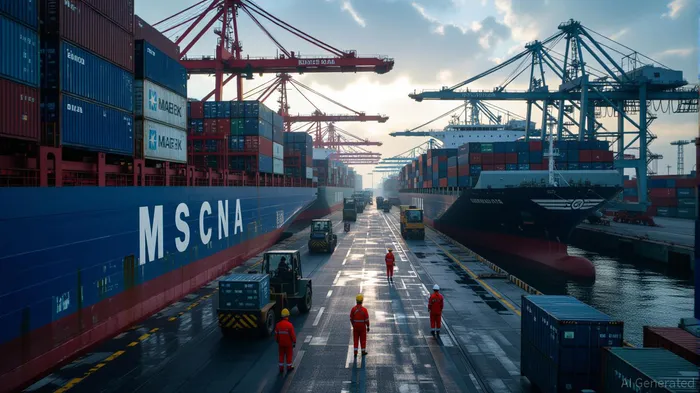
In 2025, China's export sector has demonstrated remarkable resilience amid escalating U.S. tariffs and geopolitical headwinds. The return of former President Trump in January 2025 triggered a 145% tariff spike on certain goods, yet Chinese exporters swiftly adapted through front-loading, trade diversification, and supply-chain reconfiguration. April 2025 data revealed an 8.1% year-on-year (YoY) export growth, driven by machinery, electronics, and logistics sectors. This adaptability, coupled with strategic pivots to emerging markets and currency tailwinds, has created a compelling investment case for high-conviction stocks in these industries.
Machinery and Electronics: High-Tech Manufacturing as a Growth Engine
China's shift toward high-tech manufacturing has insulated its export sector from U.S. trade pressures. In May 2025, mechanical and electrical products grew 9.5% YoY, while integrated circuits surged 14.7%. This trend is underpinned by state-backed innovation and a focus on value-added goods.
Zhejiang Leapmotor Technology (SEHK:9863), a leader in new energy vehicles (NEVs), exemplifies this shift. With 15.6% insider ownership and a 60.1% annual earnings growth forecast, the company is trading at a 44.1% discount to its estimated fair value. Its NEV components cater to both domestic and international markets, benefiting from China's export diversification into Southeast Asia and the Middle East.
Similarly, Suzhou Sunmun Technology (SZSE:300522), a supplier of NEV components, is positioned to capitalize on global EV demand. With 35.4% insider ownership and 77.7% projected earnings growth, the firm's alignment with the NEV supply chain makes it a strategic play. Recent insider buying activity underscores management's confidence in long-term growth.
Logistics and Supply-Chain Reconfiguration: Navigating Tariff Risks
Logistics has emerged as a critical enabler of China's export resilience. The expansion of bonded logistics and processing trade—growing 22.3% and 14.2% in April 2025, respectively—reflects a strategic pivot to regional hubs in Vietnam, Thailand, and Mexico.
China Merchants Port Holdings and Adani Group (India) are expanding infrastructure in key nodes like Ho Chi Minh City and Vishakhapatnam, facilitating smoother export flows. For investors, logistics firms with exposure to these hubs offer long-term upside.
iSoftStone Information Technology (SZSE:301236), a digital transformation services provider, is another key player. Despite a Q1 2025 net loss, the company raised CNY 3.38 billion via private placement to fund strategic expansion. With 23.8% insider ownership and 37.2% earnings growth projections, its role in enabling e-commerce and direct-to-consumer exports positions it to benefit from China's digital trade surge.
Currency Tailwinds and Valuation Opportunities
The RMB's strategic use in trade and bilateral agreements has mitigated dollar volatility, enhancing export competitiveness. Meanwhile, the MSCIMSCI-- China index trades at an 11x P/E, a 47% discount to the S&P 500, offering attractive entry points.
Quzhou Xin'an Development (SHSE:600208), a real estate and technology firm, trades at a 21x P/E—well below the Chinese market average of 37.6x. Despite a recent sales dip, its net income surged to CNY 423.95 million, and 17.4% insider ownership signals strong alignment with shareholders.
CanSino Biologics (SEHK:6185), though primarily domestic, is a high-growth biopharma play with 107.5% earnings growth projections. Recent vaccine approvals, including Recombinant Poliomyelitis, position it to expand into emerging markets, leveraging China's export networks.
Investment Rationale and Strategic Outlook
The interplay of trade diversification, high-tech manufacturing, and currency dynamics creates a robust framework for long-term gains. While U.S. tariffs remain a near-term risk, the structural shift toward Southeast Asia, BRI countries, and India offers a buffer.
Key Takeaways for Investors:
1. Machinery and Electronics: Prioritize firms like Zhejiang Leapmotor and Suzhou Sunmun, which combine insider alignment with export exposure to high-growth regions.
2. Logistics: Target infrastructure players in Vietnam, Thailand, and Mexico, as well as IT enablers like iSoftStone.
3. Currency and Valuation: Leverage the MSCI China index's undervaluation and RMB tailwinds to secure entry points in fundamentally strong companies.
In conclusion, China's export sector is not merely surviving but strategically evolving. For investors with a medium-term horizon, the combination of policy support, sectoral innovation, and undervalued assets presents a compelling opportunity to capitalize on the next phase of global trade realignment.







Comentarios
Aún no hay comentarios