
China's Export Headwinds and the Sustainability of Its Growth Model
The Dual Circulation Strategy: A Structural Rebalancing
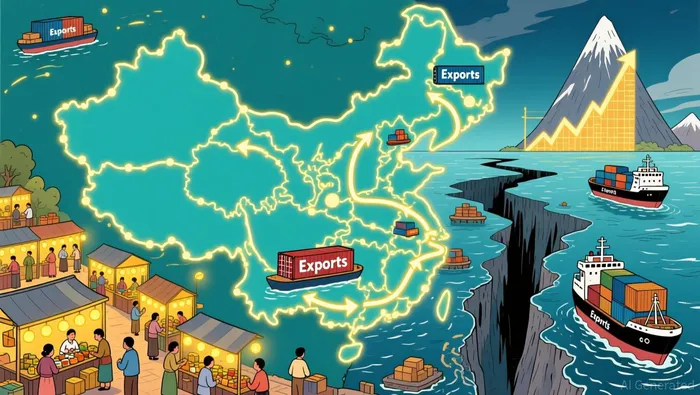
China's Dual Circulation Strategy (DCS), introduced in 2020, aims to address these vulnerabilities by prioritizing domestic demand while maintaining global trade engagement. The 15th Five-Year Plan, as outlined in a China Briefing analysis, crystallizes this approach, emphasizing technological self-reliance in semiconductors, green energy, and advanced manufacturing. For instance, China Energy's $520 million investment in Brazilian solar plants, reported by AgriLand, exemplifies the DCS's global-local duality: leveraging international markets to scale renewable energy expertise while fortifying domestic supply chains.
However, the strategy's success hinges on resolving structural imbalances. Q3 2025 domestic consumption growth of 4.5%, according to the China Briefing analysis, though modest, reflects cautious optimism. E-commerce sales surged 9.8% year-on-year, but consumer sentiment remains fragile due to property market woes and stagnant real incomes. The government's subsidy programs, while temporary fixes, highlight the challenge of stimulating demand in a middle-class market still grappling with debt and uncertainty.
Investor Implications: Navigating the New Normal
For foreign investors, the DCS creates a paradox of opportunity and risk. On one hand, China's focus on high-tech sectors and green energy opens avenues for collaboration in areas like electric vehicles and renewable infrastructure. On the other, domestic firms-now more competitive and state-supported-are crowding out foreign players. Apple's $80MW Australian solar farm, reported by AlCircle, and China's own tech giants illustrate this duality: global firms are investing in China's strategic sectors even as the country tightens control over sensitive industries.
The U.S.-China trade truce, while easing some immediate pressures, as reported by the CNBC report, does not resolve deeper structural issues. Tariffs on semiconductors and EVs persist, and geopolitical risks remain elevated. Investors must weigh these factors against China's long-term strengths, including its R&D spending (up 10% annually since 2021, according to a ResearchGate overview) and its role as a global manufacturing hub.
Sustainability: A Test of Resilience
The DCS's sustainability depends on two critical factors: the ability to rebalance growth toward consumption and the capacity to innovate without relying on foreign technology. While Q3 2025 data shows progress in high-tech exports, as noted in the China Briefing analysis, domestic consumption remains underdeveloped. Tax cuts and urbanization programs, as discussed in the ResearchGate overview, aim to address this, but structural reforms-such as reducing property sector leverage and improving social safety nets-are equally vital.
For investors, the path forward requires a nuanced strategy. Sectors aligned with the DCS-renewable energy, advanced manufacturing, and digital services-offer long-term potential but demand patience and adaptability. Conversely, traditional industries and sectors exposed to trade tensions (e.g., textiles, low-end electronics) face diminishing margins.

Conclusion
China's economic transformation is neither a sudden pivot nor a guaranteed success. The DCS represents a calculated attempt to hedge against global volatility, but its effectiveness will depend on execution. For investors, the key is to align with China's strategic priorities while mitigating risks from trade wars, regulatory shifts, and domestic economic headwinds. As the 15th Five-Year Plan unfolds, the focus must shift from short-term gains to long-term resilience-a recalibration that mirrors the broader challenges of a world economy in flux.







Comentarios
Aún no hay comentarios