
China's Evolving Import Dynamics and the Strategic Implications for U.S. Tech Exporters
A Dual-Track Strategy: Escalation and Conciliation
The U.S. and China have weaponized trade policy as a tool of economic statecraft, but recent moves suggest a recalibration. While Trump's tariffs remain in place, China's decision to lift export bans on U.S. firms like BoeingBA-- and Raytheon reflects a pragmatic shift, according to a Phillips Lyle update. This duality-punishing and placating-has created a fragmented playing field for U.S. tech exporters. For instance, China's Ministry of Commerce has added 28 U.S. defense technology companies to its dual-use export control list, including Lockheed MartinLMT-- and General DynamicsGD--, according to a Coinotag report, while simultaneously easing restrictions on non-defense entities. The result is a bifurcated market: sectors deemed critical to national security face heightened scrutiny, while others see limited relief.
Sector-Specific Impacts: Semiconductors and Aerospace
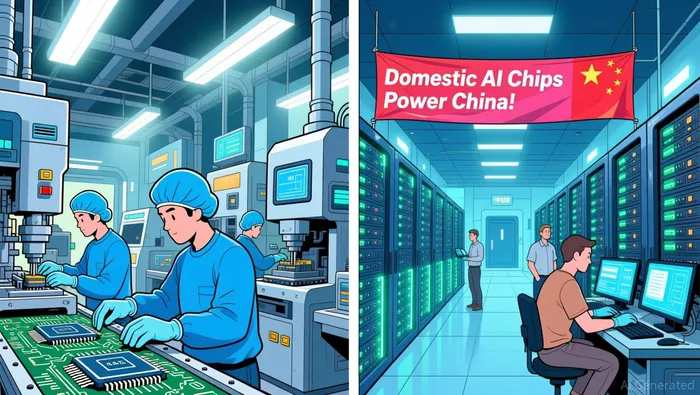
The semiconductor industry remains a flashpoint. China's mandate for domestically produced AI chips in state-funded data centers has directly impacted firms like NVIDIA, which now faces a shrinking market in China, according to a China Briefing analysis. Local governments in Gansu and Guizhou have even introduced electricity subsidies to offset the inefficiency of Chinese-made chips, a clear signal of Beijing's intent to reduce reliance on U.S. technology, according to a Lee Ham News piece. Meanwhile, aerospace firms like Boeing are grappling with export restrictions on aircraft parts to China, a market that accounts for 3-5% of their deliveries, according to a Lockheed Martin Q3 report. The risk of being "held hostage" by U.S. trade policies has pushed Chinese airlines to consider Airbus as a more reliable partner, according to a RTX Q3 report.
Lockheed Martin, however, has demonstrated resilience. The company's Q3 2025 results-$18.6 billion in sales and a $1.6 billion net profit-highlight the strength of its defense-focused business model, according to a Bloomberg report. Its recent STAR.OS™ platform, designed to unify AI systems for national security applications, underscores a strategic pivot toward domestic demand, according to the Bloomberg report. By contrast, Raytheon Technologies Corporation (RTX) has leveraged supply-chain adjustments and tariff exemptions to mitigate trade risks, boosting its full-year profit forecast to $6.10–$6.20 per share, according to the Bloomberg report.
Investment Considerations: Balancing Risk and Opportunity
For investors, the key lies in distinguishing between firms that are insulated from trade tensions and those exposed to geopolitical volatility. Defense contractors like LockheedLMT-- Martin and Raytheon appear better positioned, given their reliance on domestic contracts and less exposure to Chinese markets. Their Q3 2025 performances-Lockheed's $3.7 billion in operating cash flow and Raytheon's 12% revenue growth-underscore this resilience, according to the Bloomberg report.
Conversely, firms like Boeing face a more precarious outlook. While its China deliveries represent a small portion of total revenue, the indefinite postponement of a potential $500 aircraft order could erode long-term competitiveness, according to the Lee Ham News piece. Similarly, NVIDIA's warnings about U.S. export controls inadvertently aiding China's AI ambitions highlight the unintended consequences of protectionist policies, according to the China Briefing analysis.
The Path Forward: Strategic Flexibility
The recent easing of trade restrictions suggests that both nations are prioritizing economic stability over maximalist demands. For U.S. tech firms, the challenge is to balance compliance with China's evolving regulations while maintaining access to its vast market. This may involve dual strategies: deepening partnerships with regional allies in Southeast Asia and investing in domestic innovation to offset lost Chinese demand.

Conclusion
The U.S.-China trade war is far from over, but its contours are shifting. For investors, the focus should be on firms that can navigate this duality-leveraging geopolitical tensions to secure domestic contracts while adapting to China's conciliatory gestures. As the Trump-Xi framework deal demonstrates, trade policy is as much about diplomacy as economics. Those who can read the signals and act accordingly will find opportunities in the chaos.





Comentarios
Aún no hay comentarios