
China's Ethylene Surge Reshapes Global Chemicals Landscape: Margin Pressures and Supply Chain Shifts
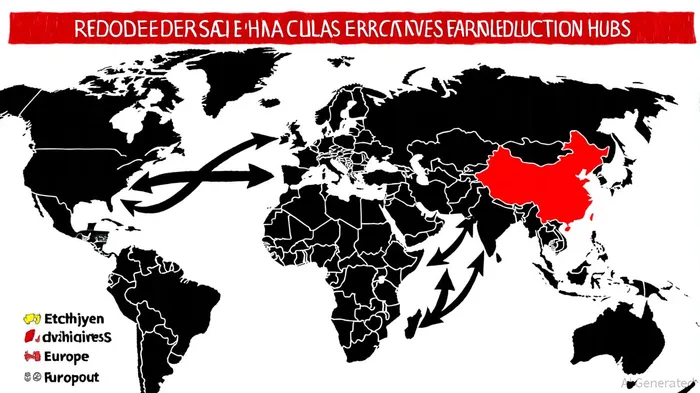
The global ethylene industry is undergoing a seismic shift as China's production surge threatens to redefine competitive dynamics for U.S. and European chemical firms. With ethylene capacity projected to exceed 62 million metric tons annually by 2025—up 121% from 2024—China's dominance in the sector is intensifying supply-demand imbalances and reshaping global trade patterns[3]. This expansion, driven by state-backed infrastructure investments and the “Made in China 2025” policy, is creating a dual challenge: domestic oversupply and indirect export pressures that could erode margins for Western producers[4].
Production Growth Outpaces Demand
China's ethylene capacity additions have outstripped domestic consumption, creating a surplus that could reach 11.5 million metric tons in 2025[4]. While the country's operating rates are expected to fall to 83%—a sign of underutilized capacity—this overproduction is not translating into robust exports. Instead, China's ethylene exports plummeted to 25 metric tons in May 2025, a 99.42% drop month-on-month, while imports rose 39.20% year-on-year to 1.081 million metric tons[4]. This paradox reflects a strategic pivot toward domestic consumption and a focus on downstream applications, such as polyolefin elastomer (POE) production for solar films and automotive materials[5].
The disconnect between production and demand is further exacerbated by weak real estate investment and sluggish retail sales, which have dampened demand for ethylene-dependent sectors like packaging and construction[5]. Yet, China's aggressive capacity expansion—adding nearly 10 million tons of ethylene annually—ensures it will account for over 40% of global ethylene derivative demand by 2024, up from 6% in 1992[3]. This growth is not merely quantitative but structural, as China's petrochemical infrastructure increasingly prioritizes self-sufficiency over export competitiveness.
Global Supply Chain Reallocation and Margin Pressures
The ripple effects of China's ethylene surge are already evident in global markets. According to a Reuters analysis, the oversupply risks delaying price recovery and exacerbating margin pressures for U.S. and European producers, who are already grappling with aging infrastructure and rising production costs[1]. While China's direct ethylene exports remain minimal, its indirect influence is growing through ethylene-based derivatives. For instance, China's POE capacity is projected to hit 900,000 tons/year by 2025, feeding into downstream industries that export to Europe and North America[5].
This shift is forcing Western firms to contend with a dual threat: cheaper Chinese feedstock for downstream products and a global oversupply that suppresses ethylene prices. Data from ICIS shows that China's ethylene capacity is expected to surpass U.S. and European combined output by 2030, further consolidating its role as a pricing anchor for the global market[2]. Meanwhile, geopolitical tensions, such as the EU's anti-subsidy tariffs on Chinese electric vehicles, add uncertainty to export channels for ethylene-derived materials[5].
Sustainability and Strategic Risks
The industry's pivot toward sustainability introduces another layer of complexity. While China is investing in bio-based ethylene to meet environmental regulations, its reliance on coal-based feedstock remains a hurdle for green certification in export markets[6]. This could limit the competitiveness of Chinese ethylene derivatives in regions prioritizing carbon-neutral supply chains, such as the EU under its Carbon Border Adjustment Mechanism (CBAM).
For investors, the key risks lie in margin compression and supply chain reallocation. U.S. and European firms with high-cost, legacy assets are particularly vulnerable, as they lack the scale or feedstock advantages to compete with China's low-cost production. Conversely, companies with integrated downstream capabilities or access to premium markets for sustainable chemicals may find opportunities in this evolving landscape.
Conclusion
China's ethylene surge is not just a regional phenomenon but a catalyst for global market realignment. As the country's capacity outpaces demand and reshapes trade flows, U.S. and European chemical firms face a critical juncture: adapt to a low-margin, oversupplied world or risk obsolescence. For investors, the imperative is clear: scrutinize exposure to ethylene-intensive sectors and prioritize firms with agility in cost management and sustainability innovation.







Comentarios
Aún no hay comentarios