
China's Dominance in the Global EV Supply Chain: Resilient to Political Shifts
China's electric vehicle (EV) supply chain has emerged as a cornerstone of global energy and industrial transformation, with its dominance in battery production and infrastructure development defying geopolitical headwinds. As of 2024, China controls over 75% of global lithium-ion battery manufacturing capacity and produces 70% of all EVs worldwide, according to the IEA's Global EV Outlook 2025. This structural advantage, underpinned by technological innovation, supply chain integration, and strategic infrastructure investments, positions China as a resilient force in the EV sector-even amid rising political tensions and competition from the U.S., EU, and Japan.
Battery Production: A Fortress of Scale and Innovation
China's grip on the EV battery market is rooted in its mastery of lithium-iron phosphate (LFP) technology, which accounts for 98% of global LFP battery production, according to a ScienceDirect study. Companies like Contemporary Amperex Technology (CATL) and BYD have leveraged economies of scale and cost efficiency to outcompete rivals in Europe and North America. For instance, CATL's LFP batteries now cost 20% less than their nickel-based counterparts, enabling Chinese automakers to price EVs 30% lower than Western competitors, TrendForce reports.
Government policies have further cemented this dominance. The Chinese Ministry of Industry and Information Technology has prioritized R&D in next-generation technologies, including all-solid-state batteries (ASSBs), which promise higher energy density and safety. By 2030, China's lithium-ion battery cell manufacturing capacity is projected to reach 4.65 terawatt-hours (TWh), a 380% increase from 2024 levels, according to Mordor Intelligence. This expansion is not merely quantitative but qualitative: Chinese firms are already testing ASSB prototypes, with SAIC and NioNIO-- leading trials for commercialization by 2030, the IEA commentary notes.
EV Infrastructure: A Geopolitical Chessboard
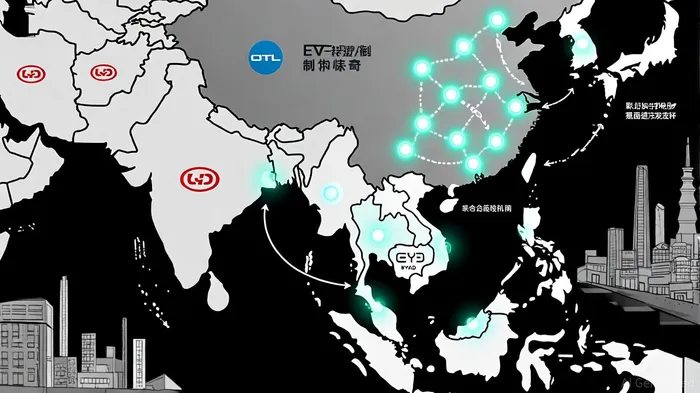
China's infrastructure investments are reshaping global EV adoption patterns, particularly in Southeast Asia. Through the Belt and Road Initiative (BRI), Chinese firms like Charge+ and XpengXPEV-- are deploying high-powered DC supercharging hubs across Malaysia, Thailand, and Indonesia. For example, Charge+'s 350kW ultra-fast chargers in Kuala Lumpur and Singapore are enabling cross-border EV travel, while BYD's $6 billion battery ecosystem in Indonesia integrates raw material processing, manufacturing, and recycling, according to the Indo-Pacific Studies Center.
These projects are not just commercial ventures but strategic tools. Southeast Asia's projected $2.8 trillion infrastructure investment needs by 2030, per a ScienceDirect analysis, align with China's surplus manufacturing capacity and BRI objectives. In Thailand, CATL's $100 million investment in a local battery assembly plant has accelerated the country's goal of producing 30% EVs by 2030, the New Security Beat reports. Meanwhile, pilot programs in Liuzhou, China, are testing vehicle-grid integration (VGI) to enhance renewable energy absorption, a model likely to be replicated in partner nations, according to AIECO EV.
Geopolitical Resilience: Navigating Tensions and Competition
Despite U.S. and EU efforts to counter China's influence-such as the Inflation Reduction Act (IRA) and EU tariffs on Chinese EVs-structural trends favor Beijing. Chinese EVs now account for 40% of global exports, with 1.25 million units shipped in 2024 alone, according to McKinsey. This growth is driven by affordability: Chinese EVs cost 40% less than Tesla models, making them accessible to middle-income consumers in ASEAN and the Visegrád Four (V4) countries, The Diplomat notes.
Political pushback has redirected Chinese investments from North America to Europe and the Middle East. For instance, CATL's gigafactories in Hungary and Slovakia are part of a broader strategy to localize supply chains and avoid U.S. regulatory scrutiny, RHG Research reports. While Western nations invest in ASSB technology, China's dual focus on refining existing liquid-state batteries and advancing solid-state R&D ensures it remains competitive, according to ITIF.
Long-Term Investment Opportunities
For investors, China's EV ecosystem offers three key opportunities:
1. Battery Technology: CATL and BYD's R&D pipelines in ASSBs and LFP variants present high-growth potential.
2. Infrastructure Partnerships: Joint ventures in Southeast Asia and Europe, such as Charge+'s charging networks, offer scalable returns.
3. Grid Integration: VGI projects in China and ASEAN could redefine energy markets, with Chinese firms leading the transition.
Conclusion
China's EV supply chain is a masterclass in industrial policy and strategic foresight. While geopolitical tensions and technological shifts pose challenges, the country's control over critical nodes-from raw materials to end-user infrastructure-ensures its dominance remains resilient. For long-term investors, the key lies in aligning with Chinese firms and partners that are not only adapting to global dynamics but actively shaping them.







Comentarios
Aún no hay comentarios