
China's Dominance in the Global EV Market and the Implications for Investors
The global electric vehicle (EV) market has become a battleground for industrial supremacy, with China firmly entrenched as the uncontested leader in 2025. As the U.S. market stumbles under policy delays and infrastructure gaps, China's strategic ecosystem-bolstered by state-backed supply chains, technological innovation, and aggressive global expansion-has reshaped the competitive landscape. For investors, the implications are stark: China's EV ecosystem offers a high-conviction opportunity, while the U.S. market's waning momentum raises red flags.
China's Strategic Edge: Policy, Supply Chains, and Global Reach
China's dominance is not accidental but the result of a meticulously engineered industrial strategy. By 2025, new energy vehicles (NEVs) accounted for 50% of total car sales in China, a milestone achieved through a combination of favorable VII emission standards, tax incentives, and a $520 billion four-year tax relief package for NEVs. This policy stability has created a predictable environment for manufacturers, enabling companies like BYD and CATL to scale production at unprecedented rates.
The backbone of China's success lies in its supply chain. The country controls over 70% of global lithium-ion battery production and dominates processing of critical materials like lithium, cobalt, and graphite. This vertical integration has slashed battery costs by 20% compared to Western markets, allowing Chinese automakers to price EVs aggressively. For instance, BYD's Blade Battery technology and CATL's 5-minute fast-charging innovations have redefined consumer expectations, while lithium iron phosphate (LFP) batteries offer a cost-effective alternative to nickel-based chemistries.
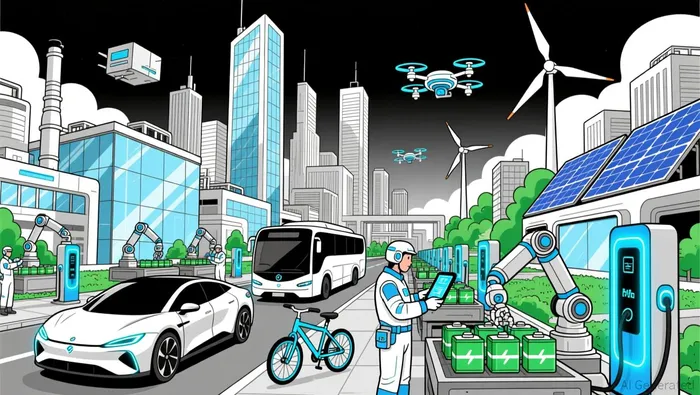
China's global ambitions are equally formidable. Despite trade barriers-such as 100% U.S. tariffs and 35.3% EU tariffs-Chinese automakers have pivoted to emerging markets. BYD exported 1.7 million EVs in 2025, with localized production hubs in Southeast Asia and Latin America shielding the company from geopolitical headwinds. This strategy has enabled China to capture over 70% of global EV production, outpacing even its domestic sales.
The U.S. Market's Stagnation: Policy Gaps and Structural Weaknesses
In contrast, the U.S. EV market lags behind, with battery electric vehicles (BEVs) accounting for just 7.5% of new car sales in 2025. Analysts attribute this stagnation to a combination of factors: expired tax credits, legislative uncertainty, and a lack of infrastructure investment. The EY Mobility Lens Forecaster now projects U.S. BEV adoption to reach 50% by 2039-five years later than previously expected.
The U.S. also struggles with cost competitiveness. Entry-level EVs priced below $45,000 remain underserved, a segment where Chinese automakers have carved out a dominant position. Meanwhile, U.S. automakers like General Motors and TeslaTSLA-- are racing to reduce reliance on Chinese components, with deadlines set for eliminating Chinese-sourced parts by 2027 and 2030, respectively. However, these efforts face headwinds, as China's supply chain efficiencies are difficult to replicate.
Investor Implications: Capitalizing on China's Ecosystem, Hedging U.S. Risks
For investors, the divergent trajectories of China and the U.S. EV markets demand a nuanced approach. China's ecosystem offers direct exposure to a maturing industry with global scale. The MSCI China Index surged 27% in 2025, driven by a cultural shift from cash savings to equities and government rate cuts. BYD, now a global player, exemplifies this trend: its export volumes have surged, and its focus on profitability over pure volume growth signals a more sustainable business model.
Conversely, U.S. investors face a fragmented landscape. While the Global X Autonomous & Electric Vehicles ETF (DRIV) gained 33% in 2025, its performance is tied to speculative bets on U.S. tech firms like NVIDIA and Qualcomm. These gains mask structural weaknesses, such as the U.S. Department of Commerce's 2025 Connected Vehicles Rule, which restricts imports of vehicles linked to "foreign adversaries".
The risks for U.S. investors are twofold: first, the domestic market's slow adoption rate, and second, the global dominance of Chinese firms. As Chinese automakers expand into Europe and Southeast Asia, U.S. automakers risk being sidelined in price-sensitive markets.
Conclusion: A Tectonic Shift in EV Leadership
The EV revolution is no longer a race between Tesla and legacy automakers-it's a geopolitical contest between China's state-backed industrial strategy and the U.S.'s fragmented policy approach. For investors, the data is clear: China's EV ecosystem offers a compelling value proposition, while the U.S. market's structural challenges demand caution. As the world hurtles toward an electrified future, those who ignore China's dominance do so at their peril.





Comentarios
Aún no hay comentarios