
China's Cyber Espionage and the Implications for U.S. Cybersecurity Stocks
The escalating cyber warfare between the United States and China has reached a critical inflection point. In 2025, China's state-sponsored cyber espionage activities surged by 150% compared to 2024, with targeted attacks in financial services, media, and industrial sectors rising by up to 300%. These operations, characterized by AI-powered deception, social engineering, and disruptive "Typhoon" campaigns like Volt Typhoon and Salt Typhoon, now threaten not just espionage but the stability of U.S. critical infrastructure. For investors, this geopolitical risk has become a catalyst for surging demand in cybersecurity infrastructure and services, reshaping the U.S. tech sector's financial landscape.
The Escalation of Chinese Cyber Threats
China's cyber operations have evolved from mere data exfiltration to strategic disruption. The "Typhoon" campaigns, as detailed by the McCrary Institute, embed disruptive capabilities within U.S. critical infrastructure, targeting energy, water, telecommunications, and healthcare systems. These campaigns combine espionage, battlefield preparation, and criminal tactics, signaling a shift toward large-scale disruption during potential conflicts. For instance, the BRICKSTORM malware, attributed to Chinese state-sponsored actors, has infiltrated Linux, VMware, and Windows environments, enabling persistent access to U.S. networks.
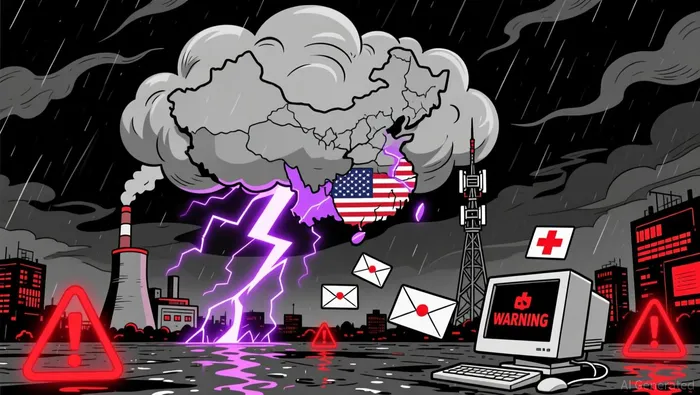
The sophistication of these attacks is further amplified by AI-driven tools. GenAI-powered vishing attacks increased by 442% between H1 and H2 2024, with stolen credentials used to bypass traditional security measures. Meanwhile, Chinese groups like Flax Typhoon and Salt Typhoon exploit vulnerabilities in telecommunications infrastructure, maintaining long-term access to networks.
U.S. Policy Responses and Market Implications
The U.S. government has responded with a dual strategy of legislative action and market-driven investment. In 2025, the House passed the PILLAR Act and the Strengthening Cyber Resilience Against State-Sponsored Threats Act. The PILLAR Act reauthorizes the State and Local Cybersecurity Grant Program until 2033, expanding funding to cover operational technology and AI use. The second bill establishes an interagency task force led by CISA and the FBI to address Chinese threats, with a mandate to submit annual classified reports to Congress.
These policies have directly fueled growth in the U.S. cybersecurity market. The North America cybersecurity market is projected to reach $95.75 billion in 2025, growing at a 10.80% CAGR to $159.90 billion by 2030. This expansion is driven by mandatory breach disclosure laws, cloud migration, and zero-trust architectures. Cybersecurity stocks have mirrored this trend: ZscalerZS-- (ZS) surged 74%, and CloudflareNET-- (NET) climbed 77% in 2025, reflecting investor confidence in the sector's resilience.
Financial Impact on Cybersecurity Firms
Government contracts have become a cornerstone of growth for U.S. cybersecurity firms. The Department of Treasury's PROTECTS blanket purchase agreement, a $20 billion contract, includes 10 cybersecurity recipients such as 1CyberForce, Delviom, and Zermount, tasked with bolstering Treasury's defenses against Chinese intrusions. Similarly, CISA's Industry Engagement Platform (IEP) fosters collaboration with private firms to develop AI-driven solutions for threat detection.
The financial stakes are immense. Global cybercrime costs are projected to reach $10.5 trillion annually by 2025, with U.S. data breaches averaging $10.22 million in 2025. Ransomware attacks, which accounted for 44% of breaches in 2025, further underscore the need for advanced defenses. For firms like CrowdStrikeCRWD--, whose Falcon® platform leverages AI-powered protection, the surge in demand has translated into robust revenue growth.
Geopolitical Risks as a Catalyst for Investment
The U.S.-China tech rivalry has also reshaped investment dynamics. Export controls on Chinese firms like Huawei and Tencent have cost U.S. semiconductor companies over $33 billion in sales since 2021. However, these restrictions have spurred innovation in China, with firms like Huawei developing self-sufficient AI ecosystems. For U.S. investors, the risk-reward calculus now hinges on balancing exposure to Chinese markets with the need to secure domestic infrastructure.
The U.S. investment ban on China, effective January 2025, further complicates this landscape. By restricting investments in Chinese AI, semiconductors, and quantum computing, the policy aims to prevent the transfer of U.S. capital to industries that could bolster China's military capabilities. While this limits market access for U.S. firms, it has redirected capital toward domestic cybersecurity solutions, accelerating the sector's growth.
Conclusion
China's cyber espionage represents a defining geopolitical risk of the 21st century, with profound implications for U.S. cybersecurity stocks. The combination of legislative action, market expansion, and AI-driven innovation has positioned the sector as a critical pillar of national defense. For investors, the surge in government contracts, coupled with the escalating costs of cybercrime, underscores the sector's long-term viability. As the U.S. and China navigate this high-stakes rivalry, cybersecurity will remain a linchpin of economic and strategic resilience.





Comentarios
Aún no hay comentarios