
China's Copper Smelting Industry Under Strain: Sulfuric Acid Price Declines and Investment Risks
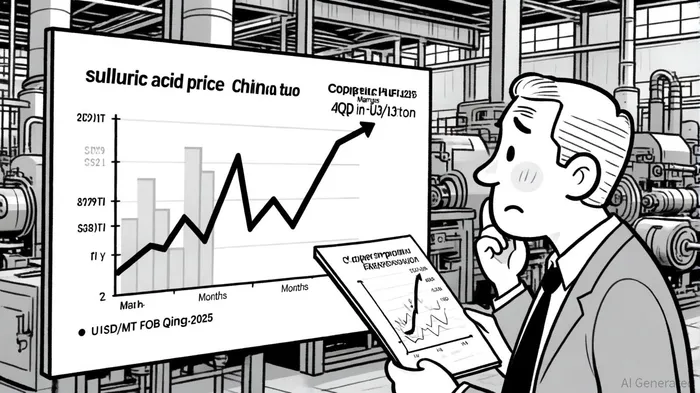
China's copper smelting industry, long reliant on sulfuric acid byproduct revenues to offset weak treatment charges (TC/RC), now faces mounting pressure as sulfuric acid prices decline in late 2025. This shift, driven by weakening fertilizer demand and seasonal industrial slowdowns, threatens to erode the margins that have temporarily shielded smelters from broader market headwinds. For investors, the interplay between sulfuric acid price volatility, policy-driven cost structures, and global copper demand trends underscores a complex risk landscape.
Sulfuric Acid Price Trends: A Double-Edged Sword
Sulfuric acid prices in China surged to three-year highs in early 2025, peaking at USD 86/MT FOB Qingdao in March as demand from the mining and battery sectors tightened supply[1]. However, by September 2025, prices had fallen to USD 78/MT, reflecting a sharp decline in fertilizer demand and reduced operating rates among industrial compound fertilizer producers[2]. This reversal is critical for copper smelters, which generate 3–4 tons of sulfuric acid per ton of electrolytic copper produced. At peak prices, smelters earned profit margins of approximately 500 RMB/ton (USD 70) on acid sales, effectively offsetting USD 43/ton of metal equivalent TC/RC losses[3]. Now, with prices declining, this revenue buffer is evaporating.
Margin Compression and Policy-Driven Vulnerabilities
The erosion of sulfuric acid profits coincides with persistently low TC/RC rates, which remain depressed due to global concentrate shortages and China's aggressive smelting capacity expansion[4]. While government policies like Policy Document 770 initially transformed sulfuric acid into a strategic asset—streamlining approvals and subsidizing electricity costs for smelters—the recent price slump has exposed vulnerabilities[5]. For instance, smelters reliant on acid revenue to maintain high operational rates now face margin compression as fertilizer demand wanes and seasonal maintenance reduces output in September and October[6].
Compounding these challenges, the National Development and Reform Commission's “Dual Carbon” targets, while promoting renewable energy growth, have also tightened raw material costs for smelters. Subsidized electricity access (USD 0.04/kWh vs. global averages of USD 0.14/kWh) and preferential financing terms have historically cushioned smelters, but these advantages may not offset the dual pressures of falling acid prices and rising copper concentrate costs[7].
Copper Demand and Sulfuric Acid's Long-Term Outlook
While sulfuric acid demand is projected to grow at a 3.38% CAGR through 2030, driven by fertilizers and industrial applications[8], near-term risks dominate. Fertilizer demand, which accounts for 60% of global sulfuric acid consumption, has already weakened in China due to government-mandated reductions in agricultural chemical use[9]. Meanwhile, the copper smelting industry's reliance on acid revenue—now contributing less than half of its peak offset—leaves smelters exposed to further margin compression. Analysts warn that without a rebound in TC/RC or a sustained recovery in acid prices, smelters may be forced to curtail operations or seek alternative feedstocks, further destabilizing the supply chain[10].
Investment Risk Assessment: Short-Term Volatility vs. Structural Resilience
For investors, the immediate risks are twofold: 1) Short-term margin compression from sulfuric acid price declines and 2) policy-driven cost inflation from China's push to secure domestic copper supply for electric vehicles and renewables. While the government's focus on expanding smelting capacity (e.g., Jinchuan and Jiangxi Copper projects) suggests long-term structural support, the near-term outlook remains fragile.
Key risks include:
- Seasonal demand cycles: Fertilizer and industrial demand are expected to remain weak through Q4 2025[11].
- Policy uncertainty: Regulatory shifts, such as stricter environmental controls or changes to electricity subsidies, could further strain margins[12].
- Global competition: Indonesian concentrate exports, which temporarily boosted smelter availability in 2025, may not persist as regional production normalizes[13].
However, sulfuric acid's role in high-purity applications (e.g., electronics, batteries) offers a potential long-term tailwind. If demand for these niche markets accelerates, it could stabilize prices and provide smelters with a more diversified revenue stream[14].
Conclusion: Navigating a Tenuous Transition
China's copper smelting industry stands at a crossroads. While sulfuric acid prices have historically provided a lifeline for smelters, their recent decline—coupled with weak TC/RC and policy-driven cost pressures—has created a precarious environment. Investors must weigh the short-term risks of margin compression against the long-term potential of structural reforms and technological advancements. For now, the sulfuric acid market's volatility remains a critical barometer for the sector's resilience—and a stark reminder of the delicate balance between industrial byproducts and global supply chain dynamics.







Comentarios
Aún no hay comentarios