
China's Coal Sector Contraction and the Emerging Renewable Energy Transition: Strategic Opportunities and Risks
China's energy landscape is undergoing a profound transformation as regulatory interventions, production caps, and surging renewable energy adoption reshape the nation's path toward climate goals. While coal remains a critical component of the energy mix, the accelerating shift toward clean energy is creating both opportunities and risks for investors. This analysis examines the investment implications of coal curbs, stranded assets, and the rapid expansion of renewables, offering insights into the sectors best positioned for long-term, climate-aligned growth.
Regulatory Interventions and Coal Sector Contraction
China's coal sector has faced increasingly stringent regulatory measures since 2023, with the Ministry of Ecology and Environment (MEE) implementing production caps and updated emissions benchmarks for coal-fired power generators. These policies, part of the power sector's allocation plan, have tightened emissions standards compared to 2022, with further restrictions anticipated in 2024. Despite these efforts, new coal mine approvals in 2024 fell to a 10-year low, while coal power projects continued to be approved at a decade-high rate in the first half of 2025, with 25 GW of new capacity. This paradox-reduced mine approvals but expanded power generation-reflects the tension between short-term energy security and long-term decarbonization goals.
The MEE's policies have also accelerated the retirement of inefficient coal plants, reducing coal's share of electricity production to a nine-year low of 51% in 2025. However, the continued approval of coal projects risks locking in carbon-intensive infrastructure for decades, creating stranded asset risks estimated at 532 billion RMB by 2025 under current policies.
Renewable Energy Surge and Emissions Stabilization
China's renewable energy adoption has been a key driver of emissions stabilization, with solar and wind power meeting 84% of electricity demand growth in 2024. By 2025, solar power generation had surged by 46% year-on-year, while wind power rose by 11% according to analysis. Renewables now supply nearly 40% of China's power generation, with solar alone accounting for all electricity demand growth. This shift has kept CO₂ emissions flat or below 2023 levels for much of 2024–2025, despite rising industrial demand.
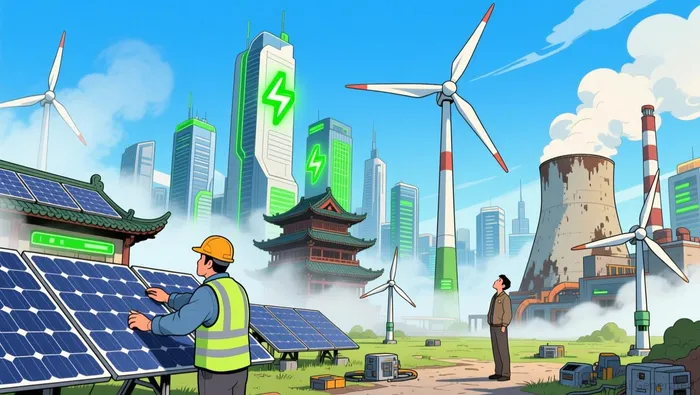
However, coal consumption in sectors like coal-to-chemicals has accelerated, and coal power capacity increased by 80–100 GW in 2025. This expansion threatens to slow the growth of renewables and reduce the profitability of clean energy projects according to reports. China's 14th Five-Year Plan (2021–2025) aimed for an 18% reduction in carbon intensity, but progress has lagged, with only a 12% reduction achieved according to analysis. The next five-year plan (2026–2030) will be critical in determining whether the country can align with its 2060 carbon neutrality target.
Investment Opportunities in Renewable Sub-Sectors
China's renewable energy investment reached USD 625 billion in 2024, with solar and wind leading the charge according to data. The country added 360 GW of wind and solar capacity in 2024 alone, surpassing half of global additions. Battery storage investment surged by 69% in H1 2025 compared to H1 2024, while grid investment rose by 22% according to analysis. By 2025, China's energy storage market is expected to exceed 100 gigawatt hours (GWh), driven by government targets to reach 100 GW of storage capacity by 2030.
Solar and wind energy remain the most promising sub-sectors, with Chinese companies dominating global clean energy patent applications (75% of the total). Energy storage, particularly battery technologies, is another high-growth area, supported by policies emphasizing market-driven innovation and private investment. Grid infrastructure upgrades and pumped hydro storage projects are also critical, with plans to construct 200 pumped hydro stations by 2025.
Stranded Assets and Mitigation Strategies
The transition away from coal poses significant stranded asset risks, particularly for coal-dependent regions. A 2022 study estimated that without stricter policies, China's power sector could face economic losses of 532 billion RMB from stranded coal assets by 2025. Under a 1.5°C scenario, coal plant operators in China alone could incur losses exceeding USD 1.9 trillion due to shortened lifespans and operational costs according to analysis. Smaller state-owned and private enterprises, which often operate less efficient plants, are expected to bear the brunt of these losses according to research.
Mitigation strategies include imposing moratoriums on new coal plant construction and accelerating the phase-out of existing plants. Financial institutions, which hold significant loans to coal power companies, will play a key role in managing these risks according to reports. Additionally, China's upcoming Five-Year Plan is expected to establish binding targets and implementation mechanisms to align with carbon neutrality goals. Without a coherent strategy, recent coal investments may remain vulnerable to stranded asset risks according to analysis.
Grid Integration and Market Challenges
Integrating renewables into China's grid remains a technical and economic challenge. The variability of solar and wind output requires increased flexibility through storage, gas, and AI-driven forecasting tools according to analysis. Grid congestion and voltage instability have also led to renewable curtailment, highlighting the need for long-distance transmission upgrades and two-way interactive grid systems according to research. Market reforms, including capacity markets and ancillary services, are addressing these issues by promoting distributed generation and storage participation according to analysis.
Conclusion: Balancing Risks and Opportunities
China's energy transition presents a dual narrative: a coal sector in contraction and a renewable energy boom. For investors, the most promising opportunities lie in solar, wind, and energy storage, supported by robust policy frameworks and technological leadership. However, the persistence of coal approvals and stranded asset risks in coal-dependent regions underscore the need for caution. The success of China's climate goals will depend on the coherence of its next Five-Year Plan and the ability to balance energy security with long-term decarbonization. Investors who align with this transition-while hedging against coal-related risks-will be well-positioned to capitalize on the opportunities ahead.







Comentarios
Aún no hay comentarios