
China's Agricultural Revolution: High-Yield Opportunities in Agribusiness, Rural Finance, and Food Security Infrastructure
China's 10-year agricultural strategy, anchored by the 2025 No. 1 Central Policy Document and the 14th Five-Year Plan, is reshaping the global agribusiness landscape. With a focus on food security, rural revitalization, and technological innovation, the government is deploying over ¥100 billion in funding to modernize agriculture, expand high-standard farmland, and reduce reliance on imported staples. For investors, this represents a unique window to capitalize on high-impact opportunities in agribusiness, rural finance, and food security infrastructure.
Agribusiness: Biotech and Digital Agriculture as Growth Engines
The cornerstone of China's strategy is boosting domestic grain production, with a 55-million-tonne increase target by 2030. To achieve this, the government is fast-tracking the commercialization of genetically modified (GM) crops, including soybeans and corn. In late 2024, 12 GMGM-- crop varieties were granted safety certifications, signaling a pivotal shift toward biotech-driven agriculture. Companies like Hangzhou RFGene, whose GM soybeans were recently approved for commercial use, are set to benefit from this policy pivot.
Parallel to biotech, digital agriculture is gaining momentum. The National Smart Agriculture Implementation Plan (2024–2028) is driving investments in IoT, AI, and low-altitude drone operations for precision farming. Domestic tech giants Dahua Technology and Hikvision are supplying surveillance and automation solutions, while startups in AI-driven analytics are receiving government grants. For investors, this sector offers exposure to both hardware and software innovations, with the potential for recurring revenue models.
Rural Finance: Bridging the Credit Gap with Blended Models
Smallholder farmers, who manage 70% of China's farmland, face persistent credit gaps. Despite a 2023 government subsidy of ¥10 billion to boost incomes, 18.87% of family farms still struggle with funding. To address this, the government is promoting blended finance and digital banking solutions.
Fintech platforms like WeBank and Ant Group are expanding mobile banking and microloan services in rural areas, while the National Agricultural Credit Guarantee System provides risk mitigation for lenders. Additionally, the “one province, one policy” approach to rural credit cooperatives is enabling localized financial tools, such as livestock-backed mortgages. Investors should monitor the rollout of rural financial bonds and the performance of agritech startups offering blockchain-based loan platforms.
Food Security Infrastructure: Building Resilience Through Logistics and Storage
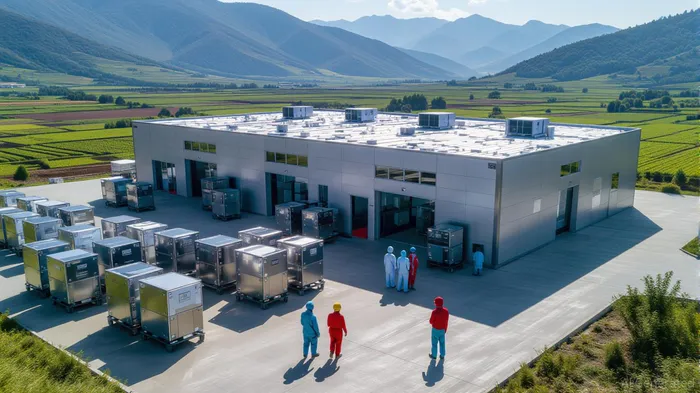
China's Hundred Billion Program is prioritizing infrastructure to reduce post-harvest losses and enhance supply chain efficiency. Key projects include high-standard farmland development, water-saving irrigation systems, and the New Land Grain Corridor—a railway terminal at the China-Russia border that cuts grain transport times by 75%.
Logistics firms like JD Logistics and SF Express are expanding cold chain networks to support perishable agricultural goods, while infrastructure developers are building emergency food storage hubs. By October 2024, China had established 59,000 emergency supply nodes under the National Food Security Law, creating a robust distribution network. Investors in logistics automation and rural infrastructure contractors stand to gain as these projects scale.
Trade Dynamics and Global Partnerships
China's reliance on agricultural imports—$235.9 billion in 2022—has spurred strategic partnerships with Brazil, the U.S., and Thailand. However, the government is also promoting joint ventures in processing and manufacturing to add value to imported raw materials. For example, Chinese agribusinesses are collaborating with Brazilian soybean producers to establish processing plants in China, reducing dependency on global commodity swings. Investors in cross-border agri-tech ventures and supply chain integration could benefit from this trend.
Actionable Insights for Investors
- Biotech and Seed Engineering: Target companies with GM crop approvals or partnerships with state-backed research institutions. Monitor policy updates on GM crop commercialization.
- Digital Agriculture Platforms: Invest in firms developing AI-driven farm management tools or IoT-enabled irrigation systems. Look for recurring revenue models and government contracts.
- Rural Finance Startups: Prioritize fintechs offering blockchain-based lending or mobile insurance solutions tailored to smallholder farmers.
- Logistics and Cold Chain: Position in logistics firms expanding into rural markets or infrastructure developers building high-standard farmland.
- Global Agri-Partnerships: Consider joint ventures or investments in overseas agribusinesses that align with China's import diversification goals.
China's agricultural transformation is not just about food security—it's a $1.5 trillion opportunity for investors willing to navigate the intersection of policy, technology, and rural finance. As the government accelerates its 10-year push, early movers in agri-tech, rural credit, and infrastructure will likely reap outsized rewards.







Comentarios
Aún no hay comentarios