
China's 2025 Mining Expansion: Geopolitical Reconfiguration and the Critical Mineral Scarcity Challenge
In 2025, China's overseas mining investments have become a linchpin of its strategy to secure dominance in the global energy transition and reshape critical mineral supply chains. With geopolitical tensions intensifying and Western economies scrambling to counter China's influence, the race for resources like gold, lithium, cobalt, and rare earth elements has taken center stage. This analysis examines how Beijing's dual focus on gold as a strategic asset and energy transition metals as enablers of clean technology is redefining global supply chains, while also exposing vulnerabilities in a world increasingly defined by resource scarcity.
Gold: A Strategic Hedge Against Geopolitical Uncertainty
China's 2025 gold mining expansion reflects a calculated effort to diversify its resource base and insulate its economy from Western financial pressures. Chinese firms, including Zijin Mining and Chifeng Gold, have executed over ten overseas acquisitions exceeding $100 million in 2023 alone, targeting gold-rich regions in Central Asia, South America, and Africa, according to a DiscoveryAlert report. This surge is driven by both economic and geopolitical imperatives: the People's Bank of China (PBOC) has acquired gold for 11 consecutive months as of September 2025, pushing global prices to record highs near $3,976.94 per ounce, according to an Oregon Group analysis.
The PBOC's gold accumulation is part of a broader strategy to reduce reliance on the U.S. dollar and hedge against potential devaluation or weaponization of the dollar. By offering custody services through the Shanghai Gold Exchange, China is also positioning itself as a hub for non-aligned and emerging economies seeking to store gold outside Western financial systems, as noted in an Equiti article. Domestically, a major gold discovery in Shandong's Laizhou-Zhaoyuan belt has reinforced Beijing's resource security goals, though operationalization remains years away due to regulatory and environmental hurdles, according to an NAI 500 blog post.
Energy Transition Metals: The New Frontier of Global Competition
China's dominance in refining and processing energy transition metals-such as lithium, cobalt, and rare earth elements-has made it indispensable to the global clean energy transition. By 2025, the country controls over 90% of global refining capacity for rare earths and graphite, and 60% for lithium and cobalt, the Oregon Group reports. These metals are critical for technologies like solar panels, wind turbines, and electric vehicles (EVs), with solar power plants requiring 4,000 tonnes of copper per gigawatt of installed capacity and onshore wind farms demanding nine times more chromium, molybdenum, and zinc than gas-fired alternatives, DiscoveryAlert notes.
However, China's reliance on imported raw materials-over 50% for many critical minerals-has prompted strategic export controls on gallium and germanium, often framed as responses to Western export restrictions, according to NAI 500. This duality-controlling refining while depending on raw material imports-has led to a multifaceted strategy combining domestic industrial reforms, international joint ventures, and investments in circular economies, as explored in a World Economic Forum story.
Geopolitical Supply Chain Reconfiguration: A Zero-Sum Game?
China's mining investments are not occurring in a vacuum. The U.S. and European Union have accelerated efforts to onshore critical mineral supply chains, with initiatives like the Inflation Reduction Act and the Critical Raw Materials Act aiming to reduce dependency on Beijing. Yet, these efforts face significant challenges: high costs, slow permitting, and fragmented global markets, the Oregon Group warns. The International Energy Agency (IEA) has warned that without coordinated action, China's dominance in refining could perpetuate global supply chain vulnerabilities for decades, per the Oregon Group's analysis.
Meanwhile, China's investments in Africa and Latin America have sparked debates about neocolonialism and environmental degradation. While Chinese firms often emphasize partnerships and technology transfer, critics argue that these projects deepen resource dependencies and exacerbate local inequalities, DiscoveryAlert contends.
The Path Forward: Collaboration or Fragmentation?
The 2025 landscape underscores a paradox: China's role as both a driver of the global energy transition and a potential disruptor of its supply chains. For investors, the key lies in navigating this duality. Opportunities exist in Chinese-backed mining projects in politically stable jurisdictions, but risks-geopolitical, regulatory, and environmental-remain acute.
A globally coordinated approach, as advocated by the World Economic Forum, could mitigate fragmentation by integrating China into multilateral frameworks for mineral security. However, with Western economies prioritizing asymmetric resilience and China doubling down on strategic autonomy, the path to collaboration remains uncertain.
Conclusion
China's 2025 mining expansion is a masterclass in strategic resource management, blending economic pragmatism with geopolitical ambition. For investors, the stakes are high: the energy transition cannot proceed without access to critical minerals, yet the global supply chain is increasingly polarized. As the race for resources intensifies, the ability to balance China's dominance with diversification will define the next decade of global energy and economic security.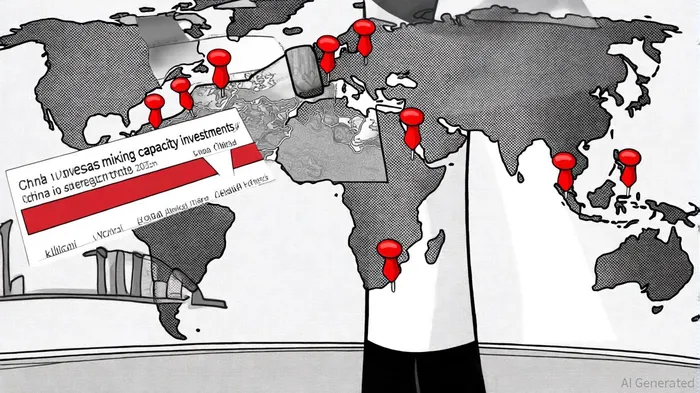







Comentarios
Aún no hay comentarios