
Chewy's Q3 Earnings: A Case for Strategic Buy-In Amid E-Commerce Shifts
In a rapidly evolving e-commerce landscape, Chewy's Q3 2025 earnings report underscores its resilience and strategic agility, positioning the pet care leader as a compelling investment opportunity. With net sales surging 8.3% year-over-year to $3.12 billion, ChewyCHWY-- outperformed peers like Petco and Walmart in revenue growth, while demonstrating robust margin expansion and cash flow generation. This analysis evaluates Chewy's operational and financial outperformance against its online retail counterparts, highlighting why investors should consider a strategic buy-in amid shifting e-commerce dynamics.
Revenue Growth: Outpacing Peers in a Niche Market
Chewy's Q3 revenue growth of 8.3% was driven by unit volume expansion and its Autoship program, which saw a 13.6% increase to $2.61 billion in sales. This recurring revenue model, which accounts for over 80% of the company's total sales, provides a stable cash flow and customer retention rate that rivals like Petco, which reported a 3.1% year-over-year sales decline, struggle to match. Walmart, while growing its Q3 revenue by 5.8% to $179.5 billion, saw e-commerce growth of 28% in the U.S., a figure that pales in comparison to Chewy's niche-driven momentum.
Chewy's ability to capitalize on the pet care sector's tailwinds-driven by rising pet ownership and discretionary spending-positions it as a beneficiary of long-term demographic trends. Unlike Amazon, which reported a 13% revenue increase in Q3 but operates in a broader, more competitive market, Chewy's focused vertical strategy allows it to leverage customer loyalty and higher-margin services.
Profitability Metrics: Margin Expansion and EBITDA Growth
Chewy's Q3 net margin of 1.9% marked a 180-basis-point improvement year-over-year, reflecting disciplined cost management and operational efficiencies. Gross margin expanded 50 basis points to 29.8%, outpacing Petco's 38.9% gross margin but demonstrating meaningful progress in reducing logistics and inventory costs. Adjusted EBITDA surged to $180.9 million, a $42.7 million increase from the prior year, with a margin of 5.8%-a 100-basis-point improvement according to the financial results.
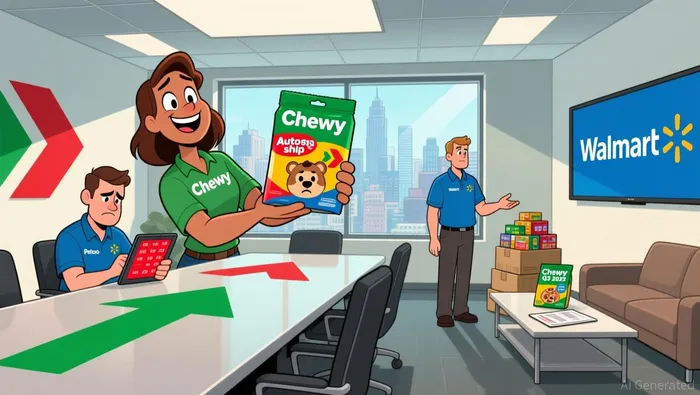 While Petco's adjusted EBITDA margin of 6.7% appears stronger, its overall financial health is constrained by declining sales and a narrower net income of $9.3 million compared to Chewy's $59.2 million according to the financial report. Walmart, despite its $10.87 billion in adjusted EBITDA, operates in a lower-margin retail environment, with a gross margin of 24.5% versus Chewy's 29.8% according to corporate earnings. Amazon's AWS segment, though highly profitable with a 34.6% operating margin, operates in a distinct cloud services market, making direct comparisons less relevant according to the earnings presentation.
Cash Flow and Operational Efficiency: A Foundation for Resilience
Chewy's Q3 free cash flow of $176 million highlights its ability to generate liquidity despite reinvesting in growth initiatives like AI-driven customer insights and supply chain automation according to the earnings report. This contrasts with Petco's $61 million in free cash flow, which, while positive, is insufficient to offset its sales decline according to the financial results. Walmart's $8.8 billion in free cash flow, though impressive, reflects its massive scale rather than agility in niche markets according to corporate earnings.
Operational metrics further underscore Chewy's efficiency. Its Autoship program not only drives revenue but also reduces customer acquisition costs, with a 90% retention rate for subscribers. Meanwhile, Amazon's e-commerce growth-bolstered by AI tools like Rufus-remains constrained by its need to compete across multiple sectors, according to the earnings presentation diluting focus on high-margin verticals.
E-Commerce Trends and Strategic Positioning
The shift toward e-commerce has amplified the importance of recurring revenue models and customer-centric innovation. Chewy's Autoship program, which delivers 80% of its sales, aligns with the growing demand for convenience and personalization in pet care. In contrast, Petco's reliance on brick-and-mortar stores and its 2.2% decline in comparable sales highlight vulnerabilities in its omnichannel strategy according to the financial results.
Walmart's 28% U.S. e-commerce growth, driven by store-fulfilled delivery and advertising, is commendable but faces challenges in maintaining margins amid price competition according to corporate earnings. Amazon's 13% revenue growth, fueled by AWS and Prime subscriptions, remains dependent on macroeconomic conditions and regulatory risks according to the earnings presentation. Chewy's niche focus, however, insulates it from broader retail volatility while tapping into a sector with durable demand.
Conclusion: A Strategic Buy-In Opportunity
Chewy's Q3 performance demonstrates its ability to outperform peers through a combination of niche expertise, margin discipline, and recurring revenue innovation. While Amazon and Walmart dominate broader markets, Chewy's pet care vertical offers a unique value proposition with higher margins and customer retention. With free cash flow generation and a clear path to EBITDA expansion, Chewy is well-positioned to capitalize on e-commerce shifts and deliver long-term value to investors.





Comentarios
Aún no hay comentarios