
Chewy's Q2 Earnings Outperformance and Optimistic Outlook Signal a Reversal in Pet Retail E-Commerce
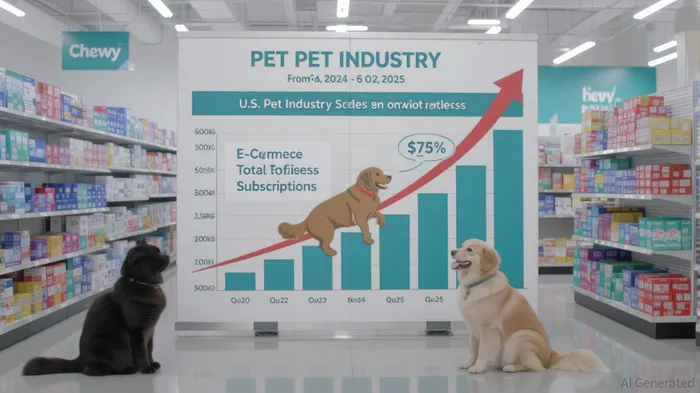
The pet retail e-commerce sector, long shadowed by inflationary pressures and shifting consumer priorities, appears to be experiencing a pivotal inflection pointIPCX--. Chewy's Q2 2025 earnings report, released on September 9, 2025, underscores this shift, revealing a 8.6 percent year-over-year revenue increase to $3.10 billion and an adjusted EBITDA margin of 5.9 percent [1]. These figures not only outpace broader industry normalization trends but also signal a strategic recalibration that aligns with the evolving dynamics of consumer discretionary spending and digital retail execution.
Consumer Discretionary Spending: A Delicate Rebalance
The U.S. pet industry's 2025 performance reflects a nuanced recovery. While overall sales are projected to reach $157 billion—a compound annual growth rate (CAGR) of 8.2 percent since 2018—consumer behavior remains fragmented. Inflationary pressures, particularly in pet food and supplies, have tempered demand for discretionary items like premium toys and wet dog food [2]. However, subscription-based models, such as Chewy's Autoship program, have emerged as a stabilizing force. Autoship now accounts for 83 percent of Chewy's net sales, growing 15 percent year over year [1]. This resilience highlights a broader consumer shift toward convenience and cost predictability, as pet owners prioritize recurring deliveries over sporadic, high-cost purchases.
The normalization of petflation—defined as the rate of price increases in the pet industry—also reveals a mixed picture. While pet food prices declined slightly in April 2025, annual petflation rose to 1.9 percent compared to 2024 [3]. This suggests that consumers are adapting to higher costs by trading down to private-label products or optimizing their budgets through digital platforms. Chewy's record net sales per active customer (NSPAC) of $591, up 4.5 percent year over year, further illustrates this trend, as the company's 21 million active customers increasingly rely on personalized, value-driven offerings [1].
Strategic Digital Retail Execution: The New Competitive Edge
Chewy's success in Q2 2025 is inextricably linked to its digital-first strategy. The company's mobile app redesign, which drove a 15 percent year-over-year increase in app orders, exemplifies the growing importance of user experience in e-commerce [1]. This aligns with industry-wide shifts toward AI-driven personalization and first-party data utilization. For instance, Petco and Canada Pooch are leveraging AI to refine product recommendations and sustainability messaging, while Chewy's advanced recommendation systems are enhancing customer retention [4].
The expansion of ChewyCHWY-- Vet Care clinics—now six locations—also reflects a strategic pivot toward pet wellness, a category projected to grow significantly by 2030 [5]. This move taps into the “humanization of pets” trend, where 97 percent of pet owners view their animals as family members and are willing to invest in health and wellness services [6]. By integrating veterinary care with its e-commerce platform, Chewy is not only diversifying revenue streams but also deepening customer relationships in a sector where trust and convenience are paramount.
A Path Forward: Sustaining Momentum in a Fragmented Market
While Chewy's Q2 results are encouraging, the path to sustained growth remains complex. The pet industry's projected $112 billion pet services market by 2030 hinges on overcoming lingering post-pandemic hesitancy around discretionary spending [7]. Younger consumers, who face financial constraints like student loan debt and housing costs, are reevaluating their budgets for pet-related services such as grooming and daycare [8]. However, Chewy's focus on digital innovation—such as AI-powered customer segmentation and optimized mobile UX—positions it to capture this demographic by offering scalable, cost-effective solutions.
Conclusion
Chewy's Q2 2025 performance is more than a quarterly victory—it is a harbinger of a broader reversal in pet retail e-commerce. By capitalizing on the normalization of consumer discretionary spending and executing a digital strategy that prioritizes convenience, personalization, and wellness, the company is redefining its role in a sector poised for long-term growth. As the U.S. pet industry navigates the delicate balance between affordability and premiumization, Chewy's ability to adapt to these dual imperatives may well determine its position in the next phase of the market's evolution.







Comentarios
Aún no hay comentarios