
Chewy's Autoship-Driven Growth: A Sustainable Path to EBITDA Expansion and Customer Retention
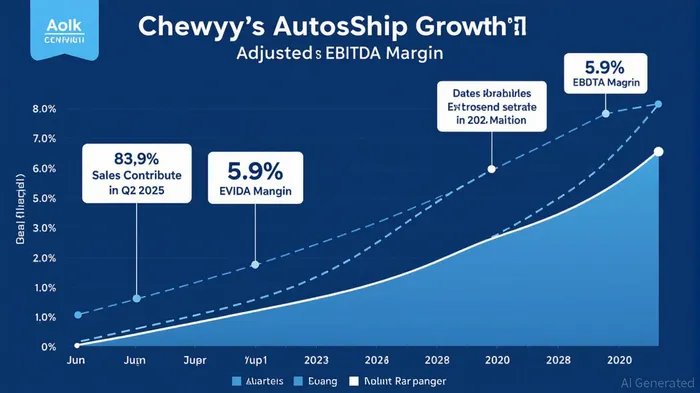
Chewy's Autoship subscription program has emerged as a linchpin of its financial resilience and strategic differentiation in 2025. By leveraging recurring revenue, operational efficiencies, and customer-centric innovations, the program has driven both EBITDA expansion and robust customer retention, positioning the company as a compelling case study in sustainable e-commerce growth.
Autoship: The Engine of Recurring Revenue and Margin Stability
According to a report by BusinessWire, Chewy's Autoship program accounted for $2.58 billion in sales during Q2 2025, representing 83% of total net sales and a 14.9% year-over-year increase[1]. This growth far outpaced overall revenue growth of 8.6% to $3.10 billion, underscoring the program's role in stabilizing cash flows and reducing volatility[1]. The shift toward recurring revenue has also enhanced customer lifetime value, with active customers rising to 20.9 million in Q2 2025—a 4.5% year-over-year increase[1].
The program's dominance reflects a broader consumer trend toward subscription-based convenience. As noted in a Nasdaq analysis, Autoship's success stems from its ability to offer “discounts, priority access, and seamless ordering,” fostering habitual purchasing and reducing churn[3]. This stickiness has allowed ChewyCHWY-- to convert 82% of its sales into predictable revenue streams, a critical advantage in a competitive retail landscape[3].
EBITDA Margin Expansion: Operational Discipline and Gross Margin Gains
Chewy's Q2 2025 financial results highlight the program's contribution to profitability. Adjusted EBITDA reached $183.3 million, with a margin of 5.9%—an 80-basis-point improvement year over year[1]. This margin expansion was driven by two key factors: gross margin growth and operational cost control.
Gross margin widened to 30.4% in Q2 2025, up 90 basis points from the prior year[1]. While the Autoship program's cost structure remains opaque, the company attributes these gains to “inventory lifecycle management” and a shift toward higher-margin categories like private-label products[3]. Additionally, operating expenses were tightly managed, with SG&A costs held at 18.5% of net sales in Q1 2025[3].
The Autoship model itself amplifies these efficiencies. By enabling predictable delivery schedules, it reduces logistics costs and inventory waste. As a Monexa.ai blog post explains, the program's scalability allows Chewy to “leverage economies of scale in procurement and fulfillment,” further compressing unit costs[2].
Strategic Diversification and Long-Term Sustainability
Beyond direct cost savings, Autoship serves as a gateway to broader revenue streams. For instance, Chewy's paid membership program, Chewy+, and its veterinary care services have seen heightened adoption among Autoship users[3]. These initiatives not only diversify income but also deepen customer relationships, creating a flywheel effect where retention in one segment fuels growth in others.
Moreover, Chewy's technology investments—such as AI-driven personalization and data analytics—have enhanced the Autoship experience. A Q1 2025 earnings call transcript notes that these tools have improved “product assortment and availability,” directly boosting enrollment and retention rates[3]. Such innovations reinforce the program's sustainability, even as the broader pet care market matures.
Risks and the Road Ahead
Despite these strengths, challenges persist. The company's reliance on a single revenue driver (Autoship) exposes it to risks like shifting consumer preferences or supply chain disruptions. Additionally, while gross margins have improved, they remain below historical peaks, suggesting room for further optimization[1].
However, management's guidance for FY2025—projecting adjusted EBITDA margins of 5.4–5.7%—signals confidence in navigating these headwinds[3]. Strategic bets on veterinary clinics and digital advertising also hint at a long-term vision to diversify beyond core pet supplies, mitigating concentration risk.
Conclusion: A Model for E-Commerce Resilience
Chewy's Autoship program exemplifies how a well-executed subscription model can drive both top-line growth and margin expansion. By combining recurring revenue, operational efficiency, and strategic diversification, the company has created a sustainable path to EBITDA improvement. For investors, the key takeaway is clear: in an era of retail uncertainty, businesses that prioritize customer retention and scalable cost structures—like Chewy—are best positioned to thrive.





Comentarios
Aún no hay comentarios