
Chevron's Venezuela License Play: A Tactical Setup for the First-Mover
The catalyst is a sudden, high-impact geopolitical event. Over the weekend of January 4-5, U.S. military forces captured Venezuelan President Nicolás Maduro and extradited him to New York, where he faces charges. This dramatic action sent shockwaves through energy markets, with investors immediately pricing in the potential for a seismic shift in Venezuela's oil sector.
The market's reaction was swift and decisive. On January 5, ChevronCVX-- stock surged more than 5% on the news. Energy stocks broadly led the gains, but Chevron stood out as the clear beneficiary. This move wasn't just a sector-wide pop; it was a direct bet on the company's unique position. As the evidence notes, Chevron surged 5.1% and was seen as the biggest beneficiary because of its current presence in Venezuela.
President Donald Trump amplified this bullish sentiment, pledging that U.S. oil firms would have a central role in reconstructing Venezuela's energy infrastructure. This creates a clear, if distant, investment thesis: a regime change could lift crippling sanctions, unlock billions in past debts, and open the door to the world's largest proven oil reserves. For Chevron, this means a potential path to reclaim market share and revenues previously blocked.
Yet the setup is defined by a stark contrast between immediate opportunity and long-term risk. The stock's pop reflects pure event-driven anticipation. The path to realizing any value is fraught with uncertainty. The regime change is a real catalyst creating a temporary mispricing, but the mechanics of a "safe, proper and judicious transition" remain unclear. The key point is that Chevron is the only major U.S. oil company with an active operating footprint in Venezuela. That unique first-mover advantage is the core of the tactical play, but it is a long and risky journey from a military raid to a profitable asset.
The Mechanics: From License Talks to Production Growth
The event-driven setup is now translating into concrete operational steps. Chevron is moving from a position of unique presence to one of active negotiation and accelerated action. The first tangible mechanic is a direct push to expand its operating license. According to sources, the company is in talks with the U.S. government to expand a key license to increase crude exports to its own refineries and other buyers. This isn't just about lifting sanctions; it's about securing the specific permissions needed to monetize the asset immediately.
This push aligns with a high-level roadmap. U.S. Energy Secretary Chris Wright stated that Chevron sees a pathway to grow their production by 50% within the next 18 to 24 months. That target is a direct outcome of the new political reality and signals the administration's intent to fast-track U.S. oil company involvement. It frames the first-mover advantage established by Chevron's current authorization into a clear, near-term growth trajectory.
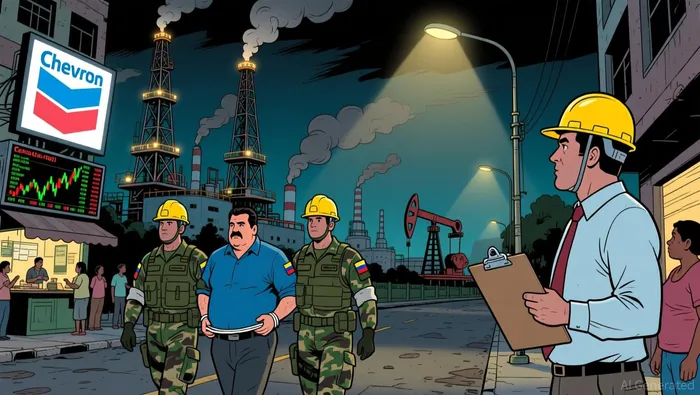
The most immediate sign of acceleration is in the physical movement of oil. In the first week of January, Chevron loaded 1.68 million barrels of Venezuelan oil onto tankers-the highest weekly volume in seven months. This surge, which was almost five times the volume from the same week last year, shows the company is already pulling barrels out of storage and onto the market. The cargoes are flowing to U.S. refiners like Phillips 66 and Valero, and to Chevron's own Pascagoula plant, demonstrating the rapid reintegration of Venezuelan crude into the Western supply chain.
Together, these mechanics define the tactical play. The license talks are the permission slip, the 50% growth target is the promised payoff, and the tanker loadings are the first cash flow. For a stock that popped on a geopolitical headline, this is the evidence of the business model restarting. Chevron is leveraging its first-mover status not for a distant future, but for a measurable, accelerated ramp-up in the coming quarters.
The Valuation Setup: Opportunity vs. Risk Premium
The stock's post-coup pop has created a clear tension between potential upside and tangible risk. On one side, valuation screens suggest a significant gap. Chevron trades at roughly 11% below the average analyst price target and some models flag a potential intrinsic discount above 50%. This implies the market may not yet be fully pricing in the transformative potential of the Venezuela opportunity. The setup hinges on that gap narrowing as the company executes its accelerated plan.
The core of that potential is a structural downstream advantage. Chevron's Gulf Coast refining system is uniquely suited to process heavy Venezuelan crude. This isn't just a logistical fit; it's a margin engine. As the company ramps up crude imports, its refineries will be able to convert that heavy, low-cost feedstock into high-value products more efficiently than competitors. This creates a durable, on-the-ground edge that could materially boost earnings per share as volumes grow.
Yet the counter-arguments are stark and grounded in reality. Analysts caution that production recovery is a multiyear process, with impacts likely to be "more measured in years." The post-Maduro landscape is also viewed as fraught. One comparison frames it as resembling post-Gaddafi Libya, highlighting the security, governance, and infrastructure challenges that could derail even the best-laid plans. These are not hypotheticals; they are the high above-ground risks that could delay the promised 50% production growth and pressure the timeline for realizing the valuation gap.
The bottom line is a classic event-driven trade. The stock has already priced in the geopolitical catalyst and the first-mover narrative, as shown by its 5% surge. The remaining opportunity is for the valuation to catch up to the operational execution. The risk is that the long, complex path to unlocking Venezuela's reserves proves more turbulent and time-consuming than the initial market optimism suggests. For now, the setup offers a clear mispricing if you believe Chevron can navigate the risks and capture its downstream advantage. But the premium you pay is for a bet on execution, not just a headline.
Catalysts and Watchpoints: What to Monitor
The tactical setup now hinges on a series of near-term milestones. The initial market pop priced in the geopolitical catalyst and Chevron's first-mover status. The coming weeks will test whether the company can translate that narrative into concrete, verifiable progress. Three specific triggers will confirm or invalidate the thesis.
First, watch for the formal expansion of Chevron's license. The company is in talks with the U.S. government to expand a key license to increase crude exports. A public announcement of expanded permissions would be the first concrete step toward unlocking the promised production growth. Equally important is any public commitment from other majors. Exxon's CEO said the company could hit the ground running and evaluate a return, but no firm investment plans have been announced. The absence of a clear commitment from Exxon or others would signal that Chevron's advantage remains unique but also that the broader industry may be moving cautiously, waiting for more clarity.
Second, monitor the pace of production growth against the 50% target. U.S. Energy Secretary Chris Wright stated Chevron sees a pathway to grow its Venezuela production by 50% within 18 to 24 months. This is the core validation metric. The company's recent surge in tanker loadings-1.68 million barrels in one week-shows initial momentum. However, the real test will be whether monthly volumes consistently ramp up toward that ambitious target. Any delay or deviation from this timeline would directly challenge the bullish valuation case.
Third, track the risk premium embedded in Brent crude. Venezuela's output recovery is a multiyear process, with analysts noting impacts will be "more measured in years." The current market is pricing in a rapid windfall, but the risk premium for geopolitical instability and infrastructure collapse remains high. As the post-Maduro landscape unfolds, a sustained increase in Brent volatility or a widening of the risk premium could pressure Chevron's stock, regardless of its operational progress. The thesis assumes the risk premium will narrow as stability improves; if it holds or expands, the valuation gap may not close.
In short, the mispricing is real only if Chevron executes its license expansion and production ramp. The watchpoints are tactical: a license deal, a major competitor's commitment, and the first quarterly production figures against the 50% goal. Until these milestones are hit, the trade remains a bet on a promise.





Comentarios
Aún no hay comentarios