
Chevron's Strategic Resilience in Venezuela: A High-Risk, High-Reward Bet for Energy Investors?
Chevron's operations in Venezuela represent one of the most audacious and politically charged investments in the global energy sector. As the sole major U.S. oil company maintaining a presence in the country amid U.S. sanctions and geopolitical volatility, ChevronCVX-- has positioned itself as both a lifeline for Venezuela's oil industry and a strategic counterweight to Chinese and Russian influence in Latin America. This article examines Chevron's unique geopolitical and operational positioning, its compliance with U.S. sanctions, and its long-term value creation potential in a high-stakes environment.
A Calculated Geopolitical Gambit
Chevron's continued operations in Venezuela are underpinned by a special U.S. Treasury license that allows it to collaborate with Petróleos de Venezuela, S.A. (PDVSA) while avoiding direct financial transfers to the Maduro regime. As of November 2025, Chevron produces approximately 200,000 barrels of oil per day from joint ventures in the Orinoco Belt, contributing roughly a quarter of Venezuela's total output. This production is critical for U.S. Gulf Coast refineries, which are optimized to process heavy crude-a commodity Chevron's Venezuela operations supply in abundance.
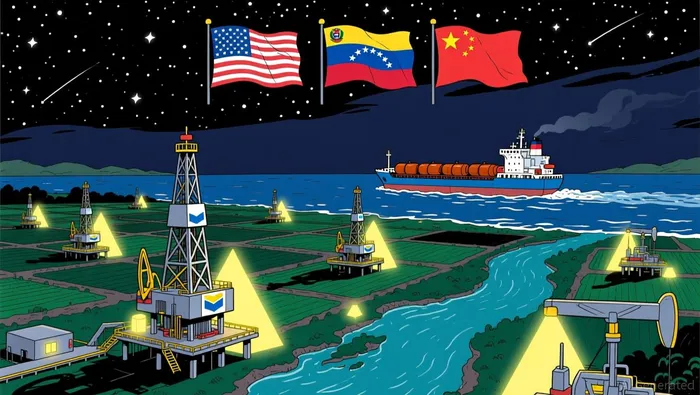
The company's strategy is framed as a long-term bet on Venezuela's eventual political transition. Chevron CEO Mike Wirth has emphasized that the firm is "playing the long game", with the assumption that a democratic shift in Venezuela could unlock the country's vast oil reserves for global markets. This positioning aligns with U.S. foreign policy objectives to counter Chinese and Russian influence in the region, as Chevron's operations provide a U.S.-aligned alternative to Beijing's growing investments in Venezuela's energy sector.
Navigating Sanctions and Sanctions Risk
Chevron's ability to operate under U.S. sanctions is a testament to its compliance rigor. The company adheres to strict monitoring of oil shipments and avoids direct financial ties to the Maduro government, as mandated by its Treasury license. However, this arrangement is precarious. In May 2025, the Trump administration revoked Chevron's license to drill and export, forcing the company to scale back operations to basic maintenance. By August 2025, a renewed license allowed Chevron to resume exports, but the precedent underscores the fragility of its legal standing according to recent analysis.
The U.S. government's aggressive enforcement of sanctions-such as the December 2025 naval blockade and the seizure of sanctioned tankers-has further complicated the landscape. While Chevron remains exempt from these measures, the broader disruption to Venezuela's oil exports has reduced the country's production to 860,000 barrels per day, down from over 1 million earlier in 2025. This decline highlights the interconnected risks Chevron faces: any escalation in U.S. pressure could destabilize Venezuela's oil sector, indirectly impacting Chevron's operations.
Financial Resilience Amid Volatility
Despite the risks, Chevron's Venezuela operations have demonstrated financial resilience. In Q4 2025, the company exported 1 million barrels of crude under its renewed license, generating significant revenue while maintaining compliance. Analysts note that Chevron's disciplined capital allocation model and 4% dividend yield have insulated it from short-term volatility, even as Venezuela's economy falters.
The long-term financial upside is equally compelling. Wood Mackenzie estimates that $15–20 billion in investment could add 500,000 barrels per day to Venezuela's output over a decade-a potential windfall for Chevron if it retains its operational foothold. However, such a scenario hinges on geopolitical stability, a variable Chevron cannot control.
Risks and Reputational Challenges
Chevron's Venezuela strategy is not without controversy. Critics accuse the company of indirectly propping up the Maduro regime and violating human rights norms. U.S. lawmakers like Marco Rubio have condemned Chevron's presence, arguing it undermines sanctions objectives. Meanwhile, Venezuela's reliance on black-market oil buyers-such as China, which now accounts for 80% of its exports-creates an uneven playing field for Chevron, which must navigate both U.S. regulatory constraints and the realities of a shadow oil trade.
The geopolitical risks are further amplified by Venezuela's deteriorating infrastructure and workforce shortages. Without sustained investment, Chevron's ability to maintain production levels is uncertain. A military escalation or regime change could also force the company to exit abruptly, eroding its long-term value proposition.
Conclusion: A High-Risk, High-Reward Proposition
Chevron's Venezuela operations epitomize the delicate balance between geopolitical strategy and financial pragmatism. While the company's compliance with U.S. sanctions and strategic alignment with U.S. energy security goals provide a degree of protection, the volatile environment in Venezuela remains a double-edged sword. For investors, Chevron's position offers a unique opportunity to capitalize on the world's largest oil reserves-if political stability returns. However, the risks of sanctions blowback, reputational damage, and operational disruptions cannot be overstated.
In the short term, Chevron's resilience in maintaining production amid sanctions is a testament to its operational acumen. In the long term, its success will depend on whether the U.S. and Venezuela can find a path to cooperation-or whether the current geopolitical standoff persists. For energy investors, Chevron's Venezuela bet is a high-stakes gamble with the potential to redefine the global oil landscape-or to become a cautionary tale of overreach in a politically charged arena.







Comentarios
Aún no hay comentarios