
Chevron's Strategic Position in a Geopolitical Shift: A Buy Opportunity in a Turbulent Energy Market
The geopolitical landscape in Venezuela has undergone a seismic shift in late 2025 and early 2026, with the removal of Nicolás Maduro and the Trump administration's aggressive pivot to revitalize the country's oil sector. For ChevronCVX--, the sole major U.S. oil company still operating in Venezuela, this represents a rare confluence of geopolitical leverage, U.S. policy support, and long-term strategic upside. While the risks remain significant, the potential for Chevron to capitalize on Venezuela's energy renaissance-coupled with its financial resilience-makes it a compelling case for investors seeking exposure to high-conviction, event-driven opportunities.
A Unique Position in a Sanctioned Market
Chevron's continued operations in Venezuela, despite U.S. sanctions targeting PDVSA, underscore its strategic importance to both the Trump administration and the company's own long-term goals. The firm holds a special license from the U.S. Treasury, allowing it to export 150,000 barrels per day of heavy crude through joint ventures with PDVSA, accounting for 23% of Venezuela's current production. This position is not accidental: Chevron's presence has been a deliberate tool for the U.S. to maintain leverage over Caracas while preserving a foothold in one of the world's largest oil reserves.
The removal of Maduro has accelerated this dynamic. President Trump has explicitly positioned Chevron as a cornerstone of the U.S. plan to rebuild Venezuela's oil infrastructure, with promises of billions in investments to repair pipelines, refineries, and export facilities. According to a report, the Trump administration has signaled that Chevron could lead a production recovery to pre-sanctions levels of 3.5 million barrels per day, a goal that hinges on infrastructure rehabilitation and sanctions relief.
Financial Resilience Amid Declining Revenue
Chevron's Venezuela operations have faced headwinds, with revenue declining at a 6.2% annualized rate since 2022 and contributing just 2% of the company's total revenue. However, the firm's broader financial health remains robust. In 2025, Chevron reported $4.84 billion in free cash flow and $7.73 billion in cash and short-term investments, providing a buffer against geopolitical volatility. Its 2025 capital expenditure budget of $14.5–$15.5 billion also reflects disciplined allocation, with $1.5 billion earmarked for decarbonization and new energy ventures.
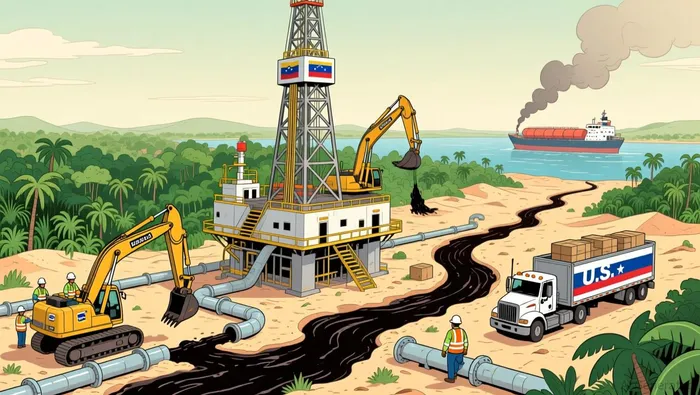 The key to unlocking value lies in debt recovery and infrastructure investment. PDVSA owes Chevron billions in unpaid bills and expropriated assets, a claim that could be settled as Venezuela's oil sector is restructured. A former Chevron executive revealed a $2 billion fund is being mobilized for Venezuelan projects, targeting 20,000–50,000 barrels per day of production and 500,000 barrels of reserves. While these figures are modest compared to Chevron's global scale, they represent a critical first step in a potential multi-decade revival of Venezuela's oil industry.
Geopolitical Risks and the Path to Recovery
The road to profitability is fraught with challenges. Venezuela's oil infrastructure requires $50–$100 billion in investment to restore production, a burden that will require sustained political stability and multilateral coordination. Delcy Rodríguez's interim leadership has signaled resistance to U.S. control, complicating efforts to secure legal reforms and sanctions relief. Additionally, Chevron's exposure to heavy crude-a costly and technically complex resource-means even a production rebound will take years to translate into meaningful earnings growth.
Yet these risks are not insurmountable. The Trump administration's willingness to subsidize oil companies for infrastructure projects and its emphasis on recovering expropriated assets suggest a long-term commitment to reshaping Venezuela's energy sector. For Chevron, this creates a unique window to secure low-cost acreage and operational control ahead of broader industry re-entry. As Reuters notes, U.S. courts have already recognized arbitration awards against Venezuela, including claims from ConocoPhillips and Crystallex, which could pave the way for Chevron to recover its own debts through asset seizures or restructuring.
A Buy Thesis Rooted in Strategic Patience
Chevron's Venezuela exposure is a high-risk, high-reward proposition. The company's current valuation discounts the potential for a production rebound, with shares trading at a discount to peers despite its strong cash flow and balance sheet. For investors with a multi-year horizon, the key variables to monitor are:
1. Sanctions relief and legal clarity: A formal restructuring of PDVSA's debts and a clear regulatory framework will be critical for large-scale investment.
2. Infrastructure progress: Early wins in pipeline repairs or refinery upgrades could signal broader industry confidence.
3. Political stability: A return to authoritarian governance or renewed violence would derail recovery efforts.
While these uncertainties persist, Chevron's strategic position-coupled with U.S. policy support-positions it as a potential winner in a sector where few competitors are willing to take on the risk. For those who can stomach the volatility, Chevron offers a rare opportunity to participate in the re-emergence of one of the world's most strategically important oil markets.





Comentarios
Aún no hay comentarios