
Chevron's Strategic Position in a Fractured Venezuelan Oil Market: Geopolitical and Economic Implications
The geopolitical and economic landscape of the global oil market has been profoundly reshaped by U.S. sanctions on Venezuela's oil sector, with ChevronCVX-- emerging as the sole U.S. major oil company maintaining operations in the country. As of late 2025, Chevron exports approximately 140,000 to 150,000 barrels per day from Venezuela under a U.S. government license, a critical lifeline for a nation whose oil production has plummeted from over 3 million barrels per day in the early 2000s to less than 1 million today. This unique position underscores Chevron's strategic importance in a fractured market, where U.S. sanctions have crippled Venezuela's oil industry and redirected global supply chains.
Operational Resilience Amid Sanctions
Chevron's continued operations in Venezuela are a testament to its ability to navigate complex regulatory environments. The company's joint ventures with Petróleos de Venezuela (PDVSA) account for 23% of the country's current production, with exports primarily directed to U.S. Gulf Coast refineries optimized for heavy crude. Despite a brief pause in early 2026, Chevron resumed shipments, leveraging its U.S. sanctions license to maintain a steady flow of oil while avoiding direct financial ties to the Maduro regime. This operational resilience has positioned Chevron as the only stable exporter from Venezuela, contrasting sharply with the collapse of Asian imports, which have stalled due to U.S. naval interdictions and geopolitical risks.
The Trump administration's selective enforcement of sanctions-allowing Chevron to operate while blocking other U.S. companies-reflects a broader strategy to maintain leverage over Caracas. Analysts suggest that Chevron's existing infrastructure and technical expertise in Venezuela's Orinoco Belt, a region rich in heavy crude, make it a natural candidate for expanded production if political stability returns. However, the scale of investment required to restore Venezuela's oil output to historical levels-estimated at tens of billions of dollars-remains a significant barrier.
Asian Demand Shifts and Market Reallocation
The U.S. sanctions-driven export restrictions have forced Asian countries to rethink their oil import strategies. Previously reliant on Venezuela's discounted heavy crude, nations like China and India now face a diminished supply of politically sensitive but economically attractive oil. According to a report by The Asia Times, U.S. control over Venezuela's oil exports has transformed the resource into a conditional supply, dependent on regulatory permissions and diplomatic considerations. This shift reduces the strategic value of Venezuelan oil for Asian importers, who previously balanced Middle East dependence with high-risk, high-reward purchases from Caracas.
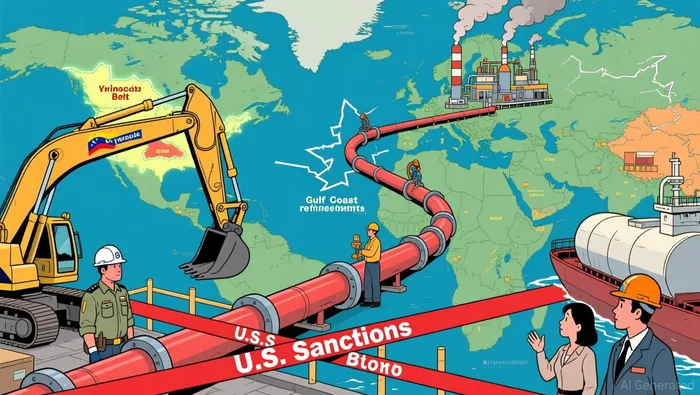
Chevron's focus on U.S. markets has further entrenched this reallocation. By redirecting Venezuelan crude to American refineries, the company capitalizes on its infrastructure and long-standing partnerships, while Asian buyers turn to alternative suppliers such as Saudi Arabia and Russia. This realignment highlights Chevron's ability to adapt to geopolitical constraints, leveraging its U.S. authorization to secure a dominant position in a market where others are excluded.
Geopolitical Implications and U.S. Foreign Policy
Chevron's operations are inextricably linked to U.S. foreign policy objectives in Venezuela. The Trump administration has framed its military and economic actions as a counter-narcotics effort, but the broader goal of reasserting control over Venezuela's oil sector is evident. By maintaining Chevron's presence, the U.S. ensures a foothold in a country with the world's largest oil reserves, while signaling to other nations that access to Venezuelan crude is contingent on alignment with Washington's interests.
Regionally, the U.S. intervention has sparked debate about the precedent it sets for Latin American affairs. While some analysts caution against destabilizing the region, others argue that Chevron's role could catalyze a more transparent and investment-friendly environment in Venezuela. The potential return of U.S. companies like ExxonMobil and ConocoPhillips, which were expropriated in 2007, hinges on political stability and guarantees against future asset seizures. For now, Chevron's operations serve as a test case for whether U.S. policy can balance geopolitical influence with economic pragmatism.
Strategic Partnerships and Long-Term Viability
Chevron's joint ventures with PDVSA, though strained by unpaid costs and infrastructure decay, remain a cornerstone of its strategy. The company's historical presence in Venezuela-dating back to the 1920s-and its technical expertise in heavy oil production provide a foundation for future expansion. The Trump administration has signaled that U.S. companies must invest in Venezuela's oil infrastructure to recover seized assets, a proposition that could unlock significant value for Chevron if political conditions stabilize.
However, the path to recovery is fraught with challenges. Analysts estimate that rebuilding Venezuela's oil sector would require annual investments of up to $10 billion, with no assurance of returns in a country marked by political volatility. Chevron's recent investments in social and economic development programs-contributing over $115 million to local initiatives-suggest a long-term commitment to fostering stability, but these efforts alone cannot offset the risks of operating in a fractured market.
Conclusion
Chevron's strategic position in Venezuela's oil sector is a product of both operational resilience and geopolitical calculus. As the sole U.S. major operating under sanctions, the company has capitalized on its infrastructure, regulatory exemptions, and technical expertise to maintain a foothold in a market where others have withdrawn. While the immediate future remains uncertain, Chevron's ability to adapt to shifting demand patterns and geopolitical dynamics positions it as a key player in any potential recovery of Venezuela's oil industry. For investors, the company's success will depend on a delicate balance of political stability, sustained investment, and the U.S. government's willingness to prioritize economic interests over ideological objectives.





Comentarios
Aún no hay comentarios