
Chevron's Strategic Duality: Balancing U.S. Shale Dominance with Energy Transition Commitments
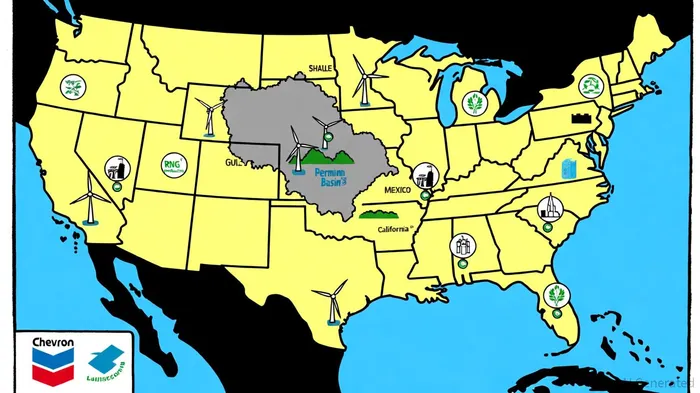
In an era where energy transition pressures are reshaping global markets, Chevron CorporationCVX-- (CVX) stands at a crossroads. The company's strategic positioning in the U.S. shale sector—coupled with its aggressive investments in renewable energy and carbon reduction—reflects a calculated effort to navigate the dual imperatives of profitability and sustainability. For investors, understanding Chevron's approach requires dissecting its operational efficiency in traditional energy, its financial discipline, and its alignment with long-term climate goals.
U.S. Shale: The Core of Operational Excellence
Chevron's U.S. shale operations, particularly in the Permian Basin, remain the backbone of its near-term financial resilience. In 2025, the company allocated $4.5–$5 billion for Permian development, prioritizing free cash flow over aggressive production growth[1]. This shift underscores a broader industry trend toward cost optimization. Chevron's adoption of advanced technologies—such as triple-frac techniques, which reduce well completion time by 25% and costs by 12%[4]—highlights its commitment to operational efficiency. Additionally, automation and AI-driven analytics are streamlining drilling precision, further enhancing margins[6].
The Permian Basin's contribution to Chevron's U.S. oil-equivalent production (1.646 million barrels per day in 2024) is a testament to its strategic importance[6]. However, the company is not relying solely on production volume. It is integrating carbon capture and storage (CCS) solutions into its shale operations and investing in midstream infrastructure, such as water recycling systems, to mitigate environmental impacts[6]. These measures align with Chevron's broader goal of reducing methane emissions intensity by 50% from 2016 levels by 2030[1].
Energy Transition: Scaling Renewables and Carbon Innovation
While Chevron's U.S. shale operations anchor its current profitability, its energy transition initiatives are shaping its long-term sustainability. The company has committed $10 billion through 2028 to lower-carbon projects, including a $3.15 billion acquisition of Renewable Energy Group (REG) in 2022 and a $45 million investment in ION Clean Energy for carbon capture technology[1]. These moves position ChevronCVX-- as a leader in renewable diesel and RNG production, with ambitions to scale to 100,000 barrels per day of renewable fuels and 40,000 MMBtu/day of RNG by 2030[2].
Chevron's offshore wind ambitions further illustrate its diversification strategy. A 2023 milestone—validating a Chevron-backed turbine design in Norway—signaled entry into Europe's mature market[1]. By 2025, the company deepened partnerships with Moreld Ocean Wind and Ocergy to develop floating wind projects, signaling a strategic pivot toward commercial-scale renewable energy[1].
Financial Performance and Third-Party Validation
Chevron's 2024–2025 financial results underscore its ability to balance energy transition investments with shareholder returns. Despite a 40% decline in first-quarter 2025 earnings compared to 2024, the company returned $6.9 billion to shareholders and maintained a net debt ratio of 14%[1]. Its $27 billion shareholder payout in Q4 2024 and 5% dividend increase further highlight financial discipline[3].
Third-party validations bolster Chevron's sustainability narrative. The company's carbon abatement projects—such as 250 methane-reducing retrofits in Colorado—have cut CO2e emissions by 1.2 million tonnes annually[3]. Meanwhile, its renewable diesel expansion in Louisiana and partnerships in direct air capture (DAC) technology, including a $500 million Future Energy Fund III, demonstrate tangible progress[1].
ESG Ratings and Industry Comparisons
Chevron's ESG strategy has earned mixed reviews. MSCIMSCI-- rates the company an “A” (Average), praising its carbon reduction targets but critiquing its fossil fuel dependence[5]. Sustainalytics, however, lacks a current rating, suggesting gaps in third-party scrutiny[5]. Industry comparisons reveal Chevron trailing ShellSHEL-- and ExxonMobil in ESG risk ratings (ranked 63 out of 276 in its sector[2]), though its focus on technological innovation—such as intelligent hydraulic fracturing with Halliburton—sets it apart[2].
Investment Outlook: Risks and Opportunities
Chevron's dual strategy presents both risks and opportunities. On one hand, its shale operations face regulatory and environmental scrutiny, as seen in Angola's safety incident[3]. On the other, its $10 billion annual investment in clean energy and carbon capture positions it to capitalize on decarbonization trends[2]. For investors, the key question is whether Chevron can maintain profitability while meeting its 2050 net-zero goal—a challenge shared by peers like Shell and ExxonMobil[2].
Conclusion
Chevron's strategic duality—anchoring its near-term success in U.S. shale while pivoting toward renewables—reflects a pragmatic approach to energy transition. While its ESG performance lags behind some peers, its technological investments and financial resilience offer a compelling case for long-term investors. As global markets demand cleaner energy, Chevron's ability to balance these priorities will determine its success in the decades ahead.





Comentarios
Aún no hay comentarios