
Chevron Greenlights $3 Billion Gorgon Expansion to Sustain LNG Output
Chevron Australia and its joint venture partners, including Exxon MobilXOM-- and ShellSHEL--, have approved a $3 billion (A$3 billion) investment to expand the Gorgon natural gas project in Western Australia. The project, known as Gorgon Stage 3, involves connecting two new offshore gas fields to existing infrastructure on Barrow Island. This development aims to sustain the facility's current production capacity of 15.6 million tons of liquefied natural gas annually and support both domestic supply and exports to Asia according to Petroleum Australia.
The Gorgon project is the largest resource development in Australia's history and has been a cornerstone of the country's energy infrastructure since its first LNG cargoes were shipped nearly a decade ago. The expansion includes drilling six new wells and utilizing off-the-shelf designs for modifications, with work expected to be completed by early 2030. 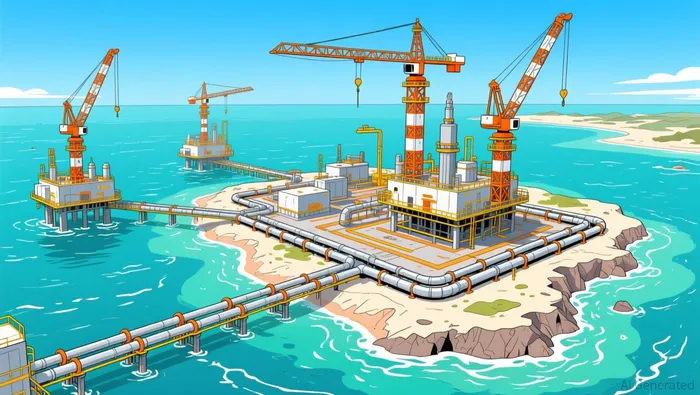 Local contractors such as Civmec will play a significant role in fabrication and installation work, supporting approximately 800 construction jobs.
The investment decision aligns with Chevron's broader strategy to maintain production and enhance energy security in Australia and the Asia-Pacific region. ChevronCVX-- Australia President Balaji Krishnamurthy emphasized the importance of the Gorgon project, noting its role in supplying reliable energy and supporting thousands of skilled jobs in Western Australia. The project also reinforces the company's commitment to carbon management, with its carbon capture and storage system capturing 3.5 million tonnes of CO2 annually.
Chevron's 2026 Capital Budget and Strategic Shift
Chevron has announced a 2026 capital expenditure budget of $18 billion to $19 billion, with a significant portion allocated to U.S. shale operations. This budget places the company at the lower end of its long-term guidance range of $18 billion to $21 billion and reflects a shift toward profitability over expansion. Approximately $17 billion of the total budget is expected to be spent on upstream operations, with nearly $6 billion directed toward U.S. shale and tight assets.
The company's focus on high-return opportunities and efficiency improvements aims to boost cash flow and earnings. A major portion of the budget will support Chevron's global offshore operations, particularly in Guyana, the Eastern Mediterranean, and the Gulf of America. The capital program also includes about $1 billion for low-carbon initiatives, reflecting Chevron's efforts to align with evolving market demands and regulatory expectations.
Chevron has also reduced its overall capital spending projections for 2026 compared to earlier guidance, signaling a more cautious approach amid softer crude prices. The company now expects capital expenditures of about $18.5 billion, placing it at the lower end of its previously projected range of $19 billion to $22 billion. This revised spending plan is part of Chevron's broader strategy to optimize returns and sustain dividends and buybacks, even in a challenging market environment.
Regional Developments and Market Implications
Chevron's expansion of the Gorgon project comes amid broader regional developments in the energy sector. In Western Australia, workers at Woodside Energy's Pluto LNG 2 facility are preparing for a potential strike after 99% of union members voted in favor of industrial action. The Offshore Alliance, representing workers at the facility, is seeking a 30% pay increase, citing wage disparities compared to similar roles at Chevron's Wheatstone LNG project. A strike could delay production timelines at Pluto 2, which aims to begin shipping LNG in the second half of 2026.
Meanwhile, Chevron has also engaged in discussions with Syria over potential oil and gas exploration projects. The U.S. energy giant met with the Syrian Petroleum Company and representatives from Qatar's UCC Holding to explore collaboration on offshore energy development. These discussions highlight Chevron's interest in expanding its global footprint, even in politically complex regions, as it seeks to diversify its resource base and strengthen international partnerships.
For investors, Chevron's strategic decisions reflect a balance between maintaining production and adapting to market dynamics. The company's emphasis on profitability and efficiency is expected to support its financial resilience amid volatile energy markets. At the same time, Chevron's investments in Australia and exploration efforts in Syria underscore its long-term vision for growth and resource security.





Comentarios
Aún no hay comentarios