
Chevron Corporation's Strategic Position in the Energy Transition: Balancing Legacy and Innovation for Shareholder Value
In the evolving landscape of global energy, Chevron CorporationCVX-- has positioned itself as a pivotal player navigating the dual imperatives of sustaining legacy operations and investing in the energy transition. As the world grapples with the realities of peak oil demand and accelerating decarbonization, Chevron's 2025 capital allocation and strategic initiatives reveal a disciplined approach aimed at preserving shareholder value while aligning with long-term environmental goals.
Capital Allocation: Discipline and Prioritization
Chevron's 2025 capital expenditure (capex) budget underscores its commitment to operational efficiency and high-return projects. The company has set an organic capex range of $14.5 to $15.5 billion and an affiliate capex range of $1.7 to $2.0 billion, reflecting a $2 billion reduction from the prior year. This adjustment signals a strategic shift toward optimizing existing assets rather than aggressive expansion. Approximately $13 billion of the 2025 budget is earmarked for the Upstream segment, with a focus on the Permian Basin and Gulf of Mexico-regions where ChevronCVX-- has demonstrated consistent operational excellence and cost control according to company reports. By prioritizing these high-margin areas, Chevron aims to sustain cash flow growth, a critical factor in maintaining dividend stability and shareholder confidence.
The Downstream segment and other operations will receive roughly $1.2 billion in 2025, with a portion allocated to reducing carbon intensity and expanding new energy businesses as outlined in the company's strategy. This balanced allocation highlights Chevron's recognition of the need to modernize its operations while avoiding overexposure to volatile markets.
Energy Transition Investments: A $10 Billion Bet on the Future
Beyond short-term profitability, Chevron has committed $10 billion through 2028 to renewable fuels, hydrogen, carbon capture, and lithium extraction according to market analysis. These investments are not merely symbolic but represent a calculated effort to diversify revenue streams and mitigate regulatory risks associated with climate change. For instance, the company's carbon capture projects align with growing demand for negative-emission technologies, while its foray into lithium-a critical component for electric vehicles-positions it to benefit from the decarbonization of the transportation sector.
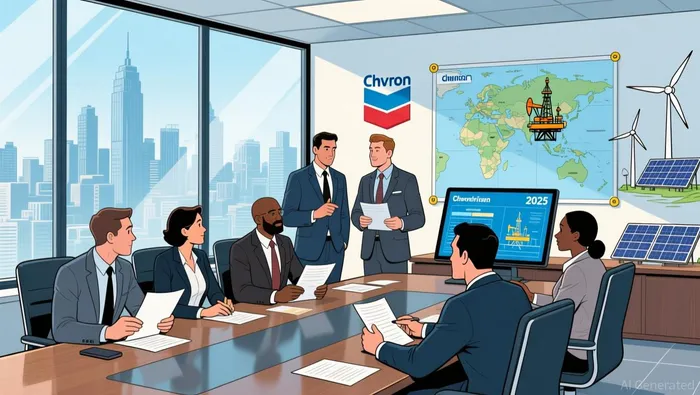
A particularly innovative initiative is Chevron's joint venture to develop up to 4 GW of natural gas-fired power plants co-located with AI data centers in the U.S. as detailed in the company's strategy. This project, expected to begin operations by 2027, leverages Chevron's expertise in energy infrastructure to meet the surging power demands of the digital economy. By aligning with the tech sector, Chevron is not only diversifying its customer base but also future-proofing its relevance in an era where energy demand patterns are rapidly shifting.
Shareholder Value in the Post-Peak Oil Era
Chevron's strategy reflects a nuanced understanding of the post-peak oil era. While the company acknowledges the eventual decline in fossil fuel demand, it remains pragmatic about the timeline. By maintaining a strong focus on Upstream profitability, Chevron ensures short- to medium-term returns for shareholders, while its energy transition investments hedge against long-term obsolescence. This dual-track approach contrasts with peers who have either overcommitted to renewables at the expense of core operations or lagged in addressing climate risks.
The absence of direct comparative data on peers like ExxonMobil or Shell does not diminish the strength of Chevron's framework. What stands out is its disciplined capital allocation-reducing spending by $2 billion in 2025 while still committing substantial resources to innovation. This balance is rare in an industry historically prone to boom-and-bust cycles. Furthermore, Chevron's net-zero-by-2050 target, though ambitious, is underpinned by concrete projects rather than vague pledges, enhancing credibility with both investors and regulators.
Strategic Positioning and Long-Term Outlook
Chevron's 2025 strategy exemplifies a company in transition, neither clinging to its oil-and-gas roots nor abandoning them in favor of unproven technologies. By allocating capital to high-return legacy assets and reinvesting profits into lower-carbon ventures, Chevron is building a resilient business model. This approach not only supports near-term shareholder value through stable cash flows but also ensures the company remains competitive in a decarbonizing world.
For investors, Chevron's trajectory offers a compelling case study in strategic adaptability. While the energy transition poses existential risks for many legacy oil firms, Chevron's measured, data-driven approach suggests it is well-positioned to navigate the challenges ahead. As the global energy system evolves, companies that can balance profitability with sustainability will emerge as leaders-and Chevron appears determined to be among them.







Comentarios
Aún no hay comentarios