
Chevron's 2026 Capex Reduction and Downgraded Earnings Estimates: A Reassessment of Long-Term Value Creation
Chevron's 2026 capital expenditure (capex) reduction and revised earnings outlook have sparked a critical debate among investors and analysts about the company's long-term value proposition. With the energy sector navigating a complex mix of commodity volatility, energy transition pressures, and evolving market dynamics, Chevron's strategic recalibration demands a nuanced evaluation. This analysis examines the implications of Chevron's $18–$19 billion capex budget for 2026, its revised earnings estimates, and the broader context of its competitive positioning and shareholder return strategy.
The Capex Cut: Prudence or Caution?
Chevron's 2026 capex budget, set at the lower end of its long-term guidance range of $18–$21 billion, reflects a disciplined approach to capital allocation. Approximately $17 billion of this budget is earmarked for upstream operations, with a significant portion-$10.5 billion-directed toward U.S. shale and tight assets in the Permian, DJ, and Bakken basins as announced. These investments aim to sustain production levels exceeding 2 million barrels of oil equivalent per day in the U.S., a core pillar of Chevron's growth strategy according to company reports.
The reduction in capex, while modest compared to historical levels, signals a shift toward prioritizing high-return projects over broad-based expansion. For instance, global offshore projects, including developments in Guyana and the Gulf of Mexico, will receive $7 billion in 2026 as detailed in the Q4 announcement. Meanwhile, $1 billion is allocated to lowering carbon intensity and advancing new energy initiatives, aligning with Chevron's stated commitment to the energy transition according to company statements. This strategic focus on efficiency and selectivity may enhance cash flow resilience, particularly in a low-commodity-price environment.
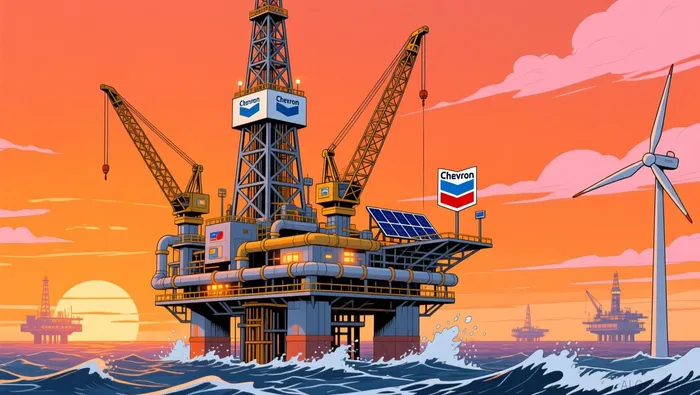 However, the capex cut also raises questions about growth potential. By scaling back investments in high-impact projects, ChevronCVX-- risks ceding ground to peers with more aggressive exploration strategies. For example, competitors like ExxonMobil and Shell have maintained higher capex budgets to secure long-term reserves, potentially outpacing Chevron in production growth over the next decade according to analyst assessments.
Earnings Downgrade: A Harbinger of Wider Sector Pressures
Chevron's revised 2026 earnings estimates, cut from $8.65 per share to $5.78 per share, underscore the challenges posed by weak oil price assumptions and operational constraints according to analyst reports. JPMorgan analyst Arun Jayaram attributed the downgrade to a $1 billion reduction in capex and strip oil prices that have fallen below $65 per barrel-a stark contrast to earlier forecasts as reported. This adjustment mirrors broader sector trends, as global demand growth slows and oversupply risks in the LNG market intensify according to industry analysis.
The earnings downgrade also highlights Chevron's exposure to commodity price volatility. While the company has historically demonstrated strong cost discipline, its ability to offset lower oil prices through operational efficiency is now being tested. For instance, Chevron's 2025 third-quarter earnings fell to $3.5 billion ($1.82 per share), a 22% decline from the same period in 2024, partly due to the $235 million net loss from the Hess acquisition integration as disclosed in the earnings release. Such headwinds suggest that Chevron's earnings resilience may be overstated in a prolonged low-price environment.
Strategic Priorities: Balancing Growth and Profitability
Chevron's 2026 strategy emphasizes disciplined capital allocation, operational efficiency, and shareholder returns. The company aims to reduce its capex and dividend breakeven point below $50 per barrel Brent by 2030, a target that hinges on cost reductions and productivity gains according to investor presentations. Additionally, Chevron plans to return cash to shareholders through increased dividends and share repurchases, with $6 billion returned in the third quarter of 2025 alone as reported in the financial results.
This focus on shareholder returns is a double-edged sword. On one hand, it aligns with investor preferences for near-term cash flow over speculative growth. On the other, it risks underinvesting in projects that could drive long-term value creation. For example, Chevron's $1 billion investment in new energy initiatives-while commendable-pales in comparison to the $7 billion allocated to U.S. shale as outlined in the Q4 announcement. In an era where renewable energy transitions are accelerating, this imbalance could leave Chevron vulnerable to stranded asset risks.
Competitive Positioning: Resilience Amid Uncertainty
Chevron's competitive positioning remains robust relative to peers, particularly in the LNG sector. The company's U.S. LNG export capacity is projected to grow to 130 million metric tons per annum by 2026, driven by expansions at Calcasieu Pass and Sabine Pass according to market forecasts. This infrastructure advantage positions Chevron to capitalize on long-term global energy demand, even as spot prices face downward pressure from oversupply as projected.
Financially, Chevron outperformed its peers in Q2 2025, with a net margin of 5.61% compared to an industry average of 2.99% according to financial data. Its disciplined approach to cost management-evidenced by $1.5 billion in Hess synergies and $3–4 billion in structural cost reductions by 2026 as detailed in investor materials-further strengthens its profitability profile. However, Chevron's recent revenue decline (-12.42% year-over-year) underscores the fragility of its business model in a volatile market according to market analysis.
Analyst Outlook: A Mixed Bag of Optimism and Caution
Analyst ratings for Chevron's stock reflect divergent views. UBS and Goldman Sachs maintain "Buy" or "Overweight" ratings, citing strong free cash flow generation and strategic initiatives like the Hess integration as reported. Conversely, Barclays and Scotiabank have adopted more cautious stances, with Barclays reducing its price target to $158 from $160 due to sector-wide adjustments according to recent forecasts.
Valuation metrics add complexity to the debate. Chevron's forward P/E ratio of 16.23 is in line with industry averages, but its median analyst price target of $173 implies a 15.3% upside from current levels as per market analysis. This suggests that while Chevron is not egregiously undervalued, its disciplined capital allocation and LNG infrastructure could justify a premium in a recovering market.
Conclusion: A Calculated Risk or a Strategic Misstep?
Chevron's 2026 capex reduction and earnings downgrade present a nuanced picture. On the one hand, the company's focus on high-return projects, cost discipline, and shareholder returns positions it to weather near-term volatility. Its LNG infrastructure and U.S. shale dominance offer durable competitive advantages. On the other, the capex cut risks underinvestment in growth and new energy initiatives, potentially leaving Chevron exposed to long-term industry shifts.
For investors, the key question is whether Chevron's current valuation reflects these trade-offs. At a forward P/E of 16.23 and with analyst price targets averaging $173, the stock appears to offer moderate upside potential, particularly if oil prices rebound or Chevron accelerates its energy transition efforts. However, the risks of prolonged low commodity prices and regulatory headwinds-such as legal challenges over the Hess acquisition in Guyana-cannot be ignored as disclosed in the earnings release.
In the end, Chevron's 2026 strategy is a bet on disciplined execution and operational resilience. Whether this bet pays off will depend on the company's ability to balance short-term profitability with long-term innovation in an increasingly uncertain energy landscape.







Comentarios
Aún no hay comentarios