
Chevron's 2025 Q2 Earnings: A Blueprint for Long-Term Value in a Shifting Energy Landscape
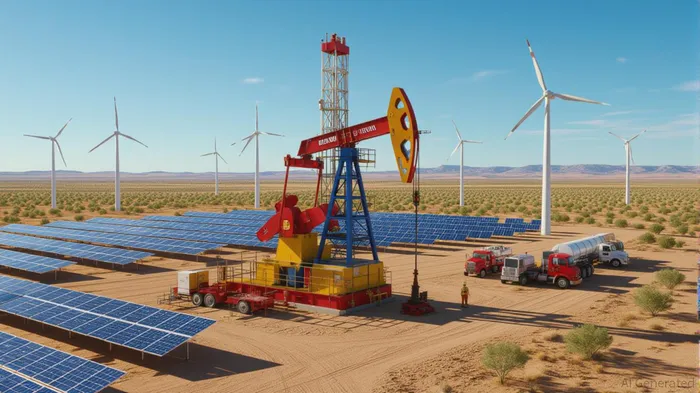
Chevron's second-quarter 2025 earnings report, released on July 31, 2025, offers a compelling case study of how a legacy energy giant is navigating the dual pressures of a maturing oil market and a rapidly evolving energy transition. Despite a 32% year-over-year decline in net income, the company's strategic discipline, operational efficiency, and bold capital allocation decisions underscore its potential to remain a cornerstone of long-term value creation in a world increasingly prioritizing decarbonization and shareholder returns.
Production Gains and Cost Discipline: The Foundation of Free Cash Flow
Chevron's Q2 results highlight a critical shift in its operational model. The company's Permian Basin production hit 1 million barrels of oil equivalent per day (BOE/d), a milestone achieved five years ahead of initial projections. This surge, coupled with a 15% quarter-on-quarter increase in free cash flow to $4.9 billion, demonstrates Chevron's ability to leverage its low-cost U.S. shale assets to generate robust returns. Organic capital expenditures of $3.5 billion—its lowest since 2023—reflect a disciplined approach to reinvestment, prioritizing high-margin projects over speculative expansion.
The integration of Hess Corporation, finalized in early 2025, further amplifies Chevron's cost advantages. By acquiring Hess's lithium-rich acreage in the U.S. and expanding its Gulf of Mexico leasehold, ChevronCVX-- is diversifying into energy transition metals while retaining its core hydrocarbon expertise. Analysts estimate $1 billion in annual synergies by year-end, a figure that could bolster both profitability and its capacity to fund green initiatives.
Strategic Positioning in a Transforming Energy Landscape
Chevron's Q2 performance must be viewed through the lens of its broader energy transition strategy. The company's LNG portfolio, now accounting for 20% of its total production, is poised to benefit from Europe's ongoing shift away from Russian gas and Asia's industrialization-driven demand. Meanwhile, its recent arbitration win in the Gulf of Mexico and the sale of non-core assets in Thailand and Malaysia signal a focus on optimizing its global footprint.
The company's $12.5 billion free cash flow target by 2026, driven by Permian growth and Hess integration, suggests a roadmap for balancing short-term shareholder returns with long-term reinvestment. At 37 consecutive years of dividend increases, Chevron's 4.51% yield remains a magnet for income-focused investors, while its undervalued P/E ratio of 17.24x hints at untapped upside.
Risks and Opportunities in the Energy Transition
Critics may argue that Chevron's reliance on fossil fuels conflicts with global net-zero goals. However, the company's foray into lithium—a critical component for EV batteries—and its commitment to reducing methane emissions by 50% by 2030 (per its 2022 sustainability roadmap) illustrate a pragmatic approach to the transition. By positioning itself as a “carbon bridge” provider, Chevron aims to serve both traditional and emerging energy needs, a strategy that could insulate it from regulatory headwinds.
Investment Implications
For long-term investors, Chevron's Q2 results validate its role as a “blue-chip” energy play in a volatile sector. Its ability to generate consistent free cash flow—$4.9 billion in Q2 alone—while expanding production and returning capital to shareholders (via its $5.5 billion in Q2 shareholder returns) positions it as a rare hybrid: a growth stock with defensive characteristics.
Historical data further supports this thesis. From 2022 to 2025, a simple buy-and-hold strategy around Chevron's earnings releases has shown a 57.14% win rate over three trading days and a 64.29% win rate over 10 trading days. The maximum observed return of 2.90% occurred 55 days after an earnings announcement, underscoring the potential for sustained upside even in a post-earnings environment. While the recent 1.71% revenue shortfall against estimates warrants caution, Chevron's operational discipline and strategic agility—evidenced by its Permian dominance, Hess integration, and energy transition bets—suggest it is well-positioned to navigate macroeconomic headwinds.
Conclusion: A Strategic Paradox in a Shifting World
Chevron's 2025 Q2 earnings reveal a company adept at straddling two realities: the enduring demand for oil and gas in the near term and the imperative to adapt to a low-carbon future. By leveraging its Permian Basin dominance, integrating Hess's assets, and allocating capital with surgical precision, Chevron is crafting a model for sustainable growth in an energy landscape defined by paradox. For investors seeking a balance of income and growth, Chevron's strategic clarity—and its track record of delivering on it—makes it a compelling long-term holding.
"""







Comentarios
Aún no hay comentarios