
Charles Schwab's Earnings Surge and Long-Term Resilience in a Post-Rate-Hike World
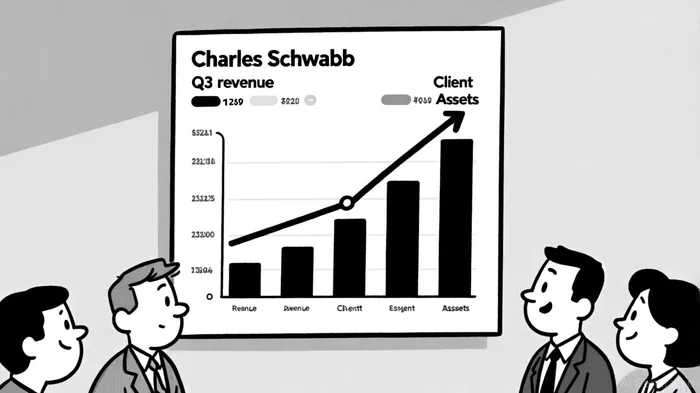
Charles SchwabSCHW-- Corporation has emerged as a standout performer in the post-rate-hike trading environment of 2025, with Q3 results underscoring its ability to capitalize on macroeconomic shifts while maintaining a competitive edge. The firm reported a 27% year-over-year surge in net revenues to $6.1 billion, driven by a 44% increase in core net new assets to $137.5 billion and a record $11.59 trillion in total client assets, according to a Schwab press release. Adjusted earnings per share (EPS) climbed to $1.31, a 70% increase compared to Q3 2024, reflecting robust cost discipline and asset monetization, as reported in an AlphaStreet earnings snapshot. These figures position Schwab as a leader in an industry grappling with the dual challenges of high interest rates and geopolitical uncertainty.
Competitive Positioning: Schwab vs. Fidelity vs. TD Ameritrade
Schwab's dominance in active trading is reinforced by its thinkorswim platform, which remains a magnet for sophisticated investors seeking advanced order types and customizable tools, according to an Investopedia comparison. However, rivals like Fidelity are tightening the competition. NerdWallet notes Fidelity's 3.96% interest on uninvested cash-far outpacing Schwab's 0.05%-has attracted cash-conscious investors, while its broader access to 25 global markets versus Schwab's 12 offers a distinct advantage for international traders (per a NerdWallet comparison). Meanwhile, Schwab's integration of TD Ameritrade's platform has expanded its appeal, particularly through thinkorswim's real-time data and paper trading features, as detailed in a Trading Critique review.
Fee structures further differentiate the players. Schwab's no-commission model for stocks and ETFs aligns with industry standards, but Fidelity's waiver of broker-assisted fees for select trades and its 0.00% expense ratio index funds provide a compelling alternative for cost-sensitive clients, according to a DividendPower comparison. Yet Schwab's broader selection of no-transaction-fee mutual funds (8,000 vs. Fidelity's 3,900) and its "bank-lite" balance sheet strategy-reducing supplemental funding needs by $12.9 billion in Q3-highlight its operational efficiency, per the Schwab Mid-Year Outlook.
Navigating Macro Risks and Industry Trends
The post-rate-hike environment has amplified volatility, with Schwab's 17% year-over-year growth in client assets reflecting resilience amid tariff-driven inflation and fiscal imbalances, as shown in CSIMarket data. Analysts credit Schwab's focus on diversification and prudent wealth management, as outlined in its 2025 Mid-Year Outlook and its 2025 Market Outlook, which anticipates a "bumpy ride" for fixed income but strong fundamentals in corporate bonds.
Technological innovation is another pillar of Schwab's strategy. The firm's AI-powered Schwab Assistant, enabling voice-command-driven portfolio management, and its integration of TD Ameritrade's advanced analytics tools, position it at the forefront of digital transformation, according to a StockBrokers review. Meanwhile, Fidelity's emphasis on ESG investing and robo-advisory services (Fidelity Go, with fees as low as 0.00%) underscores a contrasting approach to client engagement, as noted in an Unbiased outlook.
Long-Term Growth and Analyst Optimism
Schwab's long-term prospects are bolstered by analyst projections and strategic initiatives. A Benzinga report projects 48% year-over-year EPS growth to $1.08 and $5.67 billion in Q4 revenues, driven by net interest income (NII) expansion and crypto platform launches. Goldman Sachs and Keefe, Bruyette & Woods have raised price targets to $106.35, implying a 12.97% upside from current levels, citing Schwab's capital return program ($8.5 billion year-to-date) and its 32.22% net margin, according to a NASDAQ article.
However, challenges persist. Schwab's Q2 2025 market share in investment services dipped to 6.34% from 6.65%, reflecting pressure from larger players like Morgan Stanley (19.39%) and JPMorgan Chase (17.70%), per Schwab's own sector outlook. Analysts caution that sweeping tariffs and prolonged inflation could dampen client activity, though Schwab's balance sheet strength-evidenced by a debt-to-equity ratio of 1.15-provides a buffer, in a Yahoo Finance analysis.
Conclusion: A Resilient Contender
Charles Schwab's Q3 2025 results and strategic adaptability affirm its position as a top-tier player in the post-rate-hike era. While Fidelity's fee advantages and international reach pose challenges, Schwab's technological depth, asset growth, and disciplined capital returns offer a compelling value proposition. As the financial sector navigates macroeconomic crosscurrents, Schwab's blend of innovation and operational rigor positions it to outperform in the long term-provided it continues to address market share erosion and evolving client expectations.





Comentarios
Aún no hay comentarios