
The Challenges of ETFs in Municipal Bond Markets
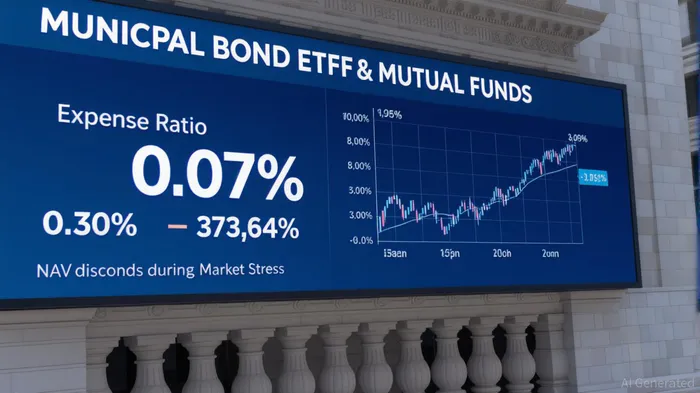
The municipal bond market has long been a cornerstone for tax-advantaged income, but the rise of exchange-traded funds (ETFs) has introduced a new layer of complexity. While ETFs offer compelling cost advantages, their structural and performance trade-offs against mutual funds demand closer scrutiny.
Cost Efficiency: A Double-Edged Sword
Municipal bond ETFs consistently outperform mutual funds in expense ratios. Vanguard’s municipal bond ETFs, for instance, average just 0.07%, far below the industry ETF average of 0.34% and the 0.70% typical of mutual funds [1]. This cost efficiency stems from passive management, operational scale, and tax advantages like lower capital gains distributions [2]. However, these savings come with caveats. Active ETFs, while cheaper than their mutual fund counterparts (0.37% vs. 0.71% expense ratios), still face scrutiny over their ability to replicate the nuanced strategies of actively managed mutual funds [3].
Complexity and Liquidity Risks
The liquidity of ETFs is both a strength and a vulnerability. Unlike mutual funds, which settle trades at end-of-day net asset value (NAV), ETFs trade intraday, offering real-time pricing. Yet this flexibility can backfire. During the March 2020 market dislocation, investment-grade municipal bond ETFs traded at a 5% discount to NAV, exposing investors to liquidity mismatches [4]. Similarly, in 2025, a $3.3 billion outflow from municipal ETFs in a single week highlighted their susceptibility to panic selling [5]. In contrast, mutual funds, despite holding minimal cash reserves (1.55% of assets), can more easily rotate out of underperforming positions [6].
Performance Trade-Offs in Volatile Markets
While lower fees enhance risk-adjusted returns for ETFs, their performance during market stress reveals cracks. The Bloomberg Municipal Bond Index lost -0.12% in Q2 2025, underperforming broader fixed-income benchmarks [7]. ETFs, however, faced sharper declines in high-grade segments due to technical headwinds like heavy issuance and tax-season selling [8]. Mutual funds, though less tax-efficient, demonstrated resilience in absorbing large redemptions without forced asset sales, a critical advantage in illiquid markets [9].
Conclusion
Municipal bond ETFs are undeniably cost-effective, but their structural challenges—liquidity mismatches, NAV volatility, and performance under stress—cannot be ignored. For investors prioritizing tax efficiency and low fees, ETFs remain a compelling choice. Yet in turbulent markets, the operational flexibility of mutual funds may offer a safer harbor. As the municipal bond landscape evolves, understanding these trade-offs is essential for building resilient portfolios.
Source:
[1] Get targeted municipal exposure with low-cost Vanguard ETFs [https://advisors.vanguard.com/insights/article/get-targeted-municipal-exposure-with-low-cost-vanguard-etfs]
[2] Bond ETFs vs Bond Mutual Funds: Save With ETFs [https://www.ssga.com/us/en/intermediary/insights/how-to-save-more-with-lower-fee-bond-etfs]
[3] Active ETF vs Mutual Fund: Similarities and Differences [https://wealthtender.com/insights/investing/etfs/archive-active-etf-basics-active-etf-vs-mutual-fund/]
[4] When Selling Becomes Viral: Disruptions in Debt Markets [https://pmc.ncbi.nlm.nih.gov/articles/PMC7928582/]
[5] Municipal Quarterly Review and Outlook 2Q 2025 [https://am.gs.com/en-us/advisors/insights/article/municipal-quarterly-review-and-outlook]
[6] Investor flows, performance, and fragility of U.S. municipal bond mutual funds [https://www.sciencedirect.com/science/article/abs/pii/S1572308924000524]
[7] Municipal market commentary [https://www.nuveenSPXX--.com/en-us/insights/municipal-bond-investing/municipal-market-update]
[8] Municipal Bonds: Mid-Year 2025 Outlook [https://www.schwab.com/learn/story/municipal-bond-outlook]
[9] Do municipal bond exchange-traded funds improve market [https://www.brookings.edu/articles/do-municipal-bond-exchange-traded-funds-improve-market-quality/]







Comentarios
Aún no hay comentarios