
Can Chainlink's Supply Management Counteract Leverage-Driven Volatility?
In the volatile world of crypto, structural supply reduction strategies have emerged as a critical tool for stabilizing token prices. ChainlinkLINK-- (LINK), a cornerstone of blockchain infrastructure, has implemented mechanisms like staking, whale accumulation, and reserve growth to reduce circulating supply. But can these strategies counteract the chaos of leverage-driven speculative demand?
Structural Supply Reduction: A Foundation for Stability
Chainlink's v0.2 staking upgrade in November 2023 expanded the staking cap to 45 million LINK, introducing variable reward rates tied to protocol fill levels. This modular design not only incentivizes long-term participation but also locks up a significant portion of the token supply, reducing liquidity. By Q4 2025, the Chainlink Reserve had added nearly 90,000 LINK, pushing total holdings above 1.32 million. These actions signal a deliberate effort to align tokenomics with scarcity, a strategy mirrored by projects like OKB through large-scale token burns.
Whale accumulation has further tightened supply. Large holders withdrew over 329,000 LINK from exchanges in late 2025, reducing liquid supply to levels not seen since 2022. This behavior suggests long-term positioning rather than speculative trading, with whale wallets amassing hundreds of thousands of tokens at weak price levels. The result? A shrinking pool of available LINKLINK-- for short-term selling, which could theoretically reduce downward pressure on the price.
Speculative Demand and Leverage: The Wild Card
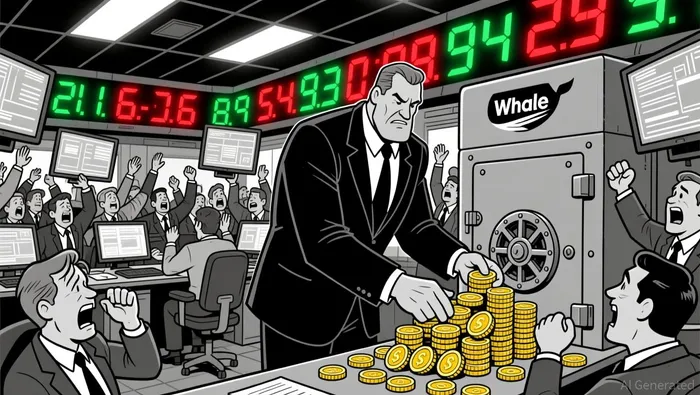
Despite these structural efforts, speculative demand remains a double-edged sword. In 2025, the broader crypto market saw a shift toward institutional adoption, but altcoins like LINK still faced volatility from retail leverage. For instance, LINK's price remained range-bound around $12–$16 despite bullish on-chain signals like declining exchange reserves. This disconnect highlights the tension between structural supply constraints and speculative forces.
Leverage-driven volatility is particularly pronounced in crypto. When traders use borrowed capital to amplify gains, even minor price swings can trigger cascading liquidations. For example, privacy tokens like ZcashZEC-- (ZEC) outperformed in Q4 2025, partly due to their appeal in a privacy-conscious market. However, such momentum often collapses under macroeconomic stress, as seen in 2022's market-wide selloff. Chainlink's structural strategies may mitigate this risk, but they cannot fully insulate the token from systemic shocks.
The Interplay: Can Supply Reduction Win?
The key lies in how structural supply reduction interacts with speculative demand. Staking and whale accumulation reduce circulating supply, creating a floor for demand. Meanwhile, speculative activity-driven by leverage and market sentiment-can amplify price swings.
A case study from late 2024 illustrates this dynamic: the top 100 LINK wallets added 20.46 million tokens ($263 million) since November, while 30 new wallets withdrew 6.26 million LINK ($116.7 million) by October 2025. This accumulation coincided with LINK's rebound toward $20, suggesting that structural supply constraints can support price resilience. However, the token's failure to break above $14.65-a historical distribution pivot-shows that speculative demand still holds sway.
Comparative analysis with other infrastructure tokens reveals mixed results. Supply chain tokens gained traction as diversification tools during volatility, tied to real-world industries like logistics. Yet, their performance hinged on macroeconomic stability, underscoring the limits of structural strategies alone.
The Road Ahead: Balancing Act
Chainlink's long-term prospects hinge on its ability to balance structural supply reduction with demand-side growth. Its dominance in the oracleADA-- market (62% share) and expanding role in real-world asset (RWA) tokenization position it for sustained adoption. However, price volatility will persist until speculative demand aligns with fundamentals.
Analysts project LINK could reach $45–$100 by 2030, assuming continued leadership in oracle services. For now, the token's structural strategies-staking, whale accumulation, and reserve growth-provide a buffer against leverage-driven chaos. But investors must remain cautious: structural supply reduction is a tool, not a panacea.






Comentarios
Aún no hay comentarios