
Chainlink's Strategic Partnership with Saudi Awwal Bank and Its Impact on LINK's Valuation Potential
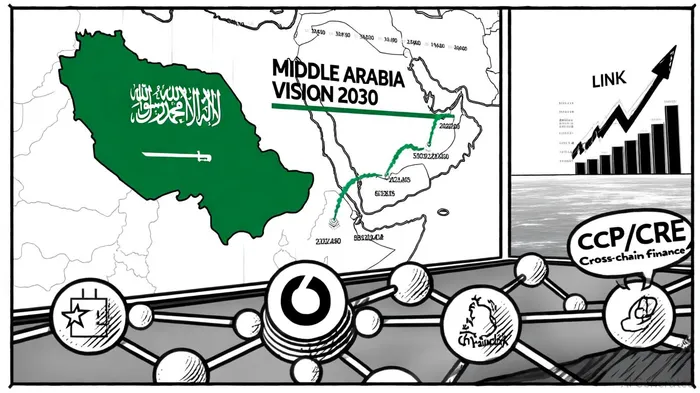
The recent partnership between Chainlink and Saudi Awwal Bank (SAB) marks a pivotal moment in the convergence of blockchain technology and traditional finance, particularly in emerging markets. As one of Saudi Arabia's largest banks with over $100 billion in assets, SAB's adoption of Chainlink's Cross-Chain Interoperability Protocol (CCIP) and ChainlinkLINK-- Runtime Environment (CRE) signals a shift toward institutional-grade blockchain infrastructure. This collaboration not only aligns with Saudi Arabia's Vision 2030 initiative but also underscores the growing credibility of blockchain-banking partnerships in regions seeking economic diversification and digital transformation[1].
A Blueprint for Institutional Blockchain Adoption
The partnership leverages Chainlink's CCIP to enable secure cross-chain data and asset transfers, while CRE provides a robust environment for deploying blockchain-based financial tools[2]. These technologies are critical for SAB's goals of tokenizing assets, streamlining cross-border payments, and integrating decentralized systems with traditional banking infrastructure[3]. By doing so, SAB is positioning itself as a leader in the Middle East's blockchain finance ecosystem, a market projected to grow at a 65.5% CAGR through 2033[4].
This move mirrors broader trends in emerging markets, where blockchain is being adopted to address systemic inefficiencies. For example, in Southeast Asia, blockchain-based payment systems are reducing reliance on intermediaries, while in Latin America, digital assets are serving as hedges against inflation[5]. Saudi Arabia's strategic focus on tokenization—particularly in its $2.3 trillion capital markets—further amplifies the potential for blockchain to drive financial innovation[6].
Valuation Implications for LINK
The partnership's impact on Chainlink's native token, LINK, is equally compelling. Institutional adoption of blockchain infrastructure often correlates with token price appreciation, as seen in prior collaborations between Chainlink and European and North American banks[7]. Notably, LINK's exchange reserves have plummeted to multi-year lows, indicating accumulation by long-term holders and signaling reduced short-term selling pressure[8]. Analysts project a potential price target of $52 by year-end, driven by SAB's regulatory-compliant use cases and Chainlink's expansion into AI infrastructure[9].
Regulatory Credibility and Long-Term Value
The credibility of blockchain-banking collaborations in emerging markets hinges on regulatory alignment. Saudi Arabia's approach—combining Vision 2030's digital transformation goals with a sandboxed regulatory framework—provides a model for balancing innovation and compliance[10]. This contrasts with fragmented regulatory environments in the U.S. and Europe, where enforcement actions against crypto exchanges have created uncertainty[11]. SAB's partnership with Chainlink, which adheres to Saudi Central Bank (SAMA) standards, reinforces the viability of blockchain in regulated financial ecosystems[12].
Comparative case studies further validate this trend. In sub-Saharan Africa, blockchain-driven mobile money platforms have expanded financial inclusion for millions, while in Eastern Europe, blockchain is being explored to modernize cross-border transaction systems[13]. These examples highlight a common theme: blockchain's long-term value in banking is maximized when it addresses specific regional challenges—such as Saudi Arabia's need for capital market tokenization or Africa's demand for low-cost remittances.
Conclusion: A Catalyst for Global Blockchain Finance
Chainlink's partnership with Saudi Awwal Bank is more than a technical integration; it is a strategic catalyst for blockchain adoption in emerging markets. By demonstrating how decentralized infrastructure can coexist with regulatory frameworks, the collaboration sets a precedent for other institutions seeking to harness blockchain's potential. For investors, the alignment of institutional demand, regulatory progress, and LINK's shrinking supply creates a compelling case for long-term value creation. As emerging markets continue to drive global blockchain growth—projected to reach $1.4 trillion by 2030—the SAB-Chainlink partnership may well be a harbinger of a new era in on-chain finance[14].






Comentarios
Aún no hay comentarios