
Chainlink's (LINK) Volatility and Whale Activity: A Deep Dive into On-Chain Sentiment and Market Psychology
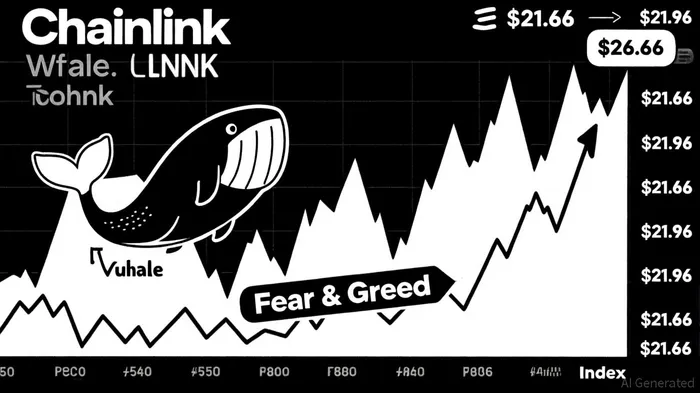
Chainlink (LINK) has become a focal point in the cryptocurrency market, driven by a confluence of whale activity, technical indicators, and shifting investor sentiment. As on-chain data reveals a surge in large transactions and institutional adoption, the token's price volatility has sparked debates about whether this is a prelude to a breakout or a warning of instability.
Whale Activity and Its Implications
Whale transactions have dominated Chainlink's narrative in 2025. According to a report by The Financial Analyst, whale activity in LINK reached its highest level since December 2023, with transactions exceeding $100,000 increasing by 32% in a single 24-hour period [1]. This surge includes a notable $21.46M sell-off by a single whale, which created short-term selling pressure as the price traded near $23.81 [1]. However, this was offset by strategic accumulation: over 1.6 million LINK tokens were added to whale portfolios in two weeks, signaling bullish intent [3].
The duality of whale behavior—selling and buying—reflects a tug-of-war between profit-taking and long-term positioning. For instance, a crypto whale recently purchased 506,226 LINK using 7.1 million USDCUSDC--, while another withdrew $41.6M in LINK from Bybit to unknown wallets, hinting at potential accumulation [1][2]. Such activity often precedes significant price movements, though the direction remains uncertain without clearer signals.
On-Chain Metrics and Price Volatility
Chainlink's price has oscillated between $21.96 and $26.66 in recent weeks, with technical indicators suggesting a potential breakout. Santiment analysts noted a cup-and-handle pattern and a 6.72% rise in Open Interest to $1.65B, both pointing to growing speculative demand [1]. Yet, the token's 5.08% volatility over 30 days underscores its unpredictability [2].
A critical factor is the ChainlinkLINK-- reserve's expansion to over 280,000 LINK, which acts as a stabilizing force by signaling institutional confidence [4]. Meanwhile, the launch of the Cross-Chain Interoperability Protocol (CCIP) has enhanced Chainlink's utility, enabling seamless value transfers across blockchains and attracting new use cases [3].
Market Psychology and Sentiment Indicators
Investor sentiment for LINK remains a mixed bag. The Fear & Greed Index, a composite of price momentum, social media, and trading volume, stood at 53 in early September 2025, indicating neutral sentiment [2]. This contrasts with a 3.3-to-1 ratio of bullish to bearish comments on social platforms, suggesting underlying optimism [3].
However, broader market psychology leans slightly bearish, with the index at 38% as of late September [2]. This tension between technical optimism and cautious sentiment highlights the risks of overreliance on whale-driven narratives. For example, while whale accumulation in August 2025 drove a 52% price gain, it also concentrated 45% of the supply in whale hands, amplifying volatility risks [1].
Institutional Adoption and Future Outlook
Institutional adoption is a key differentiator for Chainlink. The establishment of a dedicated LINK reserve and partnerships like the recent collaboration with Polymarket have bolstered confidence in the token's utility [2][4]. Additionally, over 2 million LINK tokens have been withdrawn from exchanges in 48 hours, a bullish sign of investors moving assets to long-term storage [3].
Analysts remain cautiously optimistic, with price targets ranging from $25.87 (a 7.77% increase from current levels) to $30.86 if the $26.66 resistance is breached [1][2]. However, the $22 support level is critical; a breakdown could trigger a short-term correction, while a hold would validate the bullish case.
Conclusion
Chainlink's price volatility and whale activity are intertwined with broader market psychology and on-chain dynamics. While whale accumulation and institutional adoption suggest a strong foundation, the concentration of supply in large hands and mixed sentiment indicators caution against complacency. Investors must monitor key levels like $22 and $26.66, alongside whale transaction trends, to navigate this high-stakes environment.






Comentarios
Aún no hay comentarios