
Chainlink (LINK) as the Quiet Infrastructure Powerhouse Driving the Next Era of Tokenized Finance
The financial system is undergoing a quiet but profound transformation, driven by the convergence of traditional finance (TradFi) and blockchain technology. At the heart of this evolution lies ChainlinkLINK-- (LINK), a decentralized infrastructure protocol that has emerged as the backbone for tokenized finance. While much of the crypto market remains fixated on speculative cycles, Chainlink's institutional-grade solutions-spanning decentralized oracles, cross-chain interoperability, and real-world asset (RWA) tokenization-are quietly reshaping the architecture of global finance. This article examines how strategic institutional adoption, growing DeFi dependency, and macroeconomic tailwinds position LINKLINK-- as a long-term play on the modernization of financial systems.
Institutional Adoption: Bridging TradFi and Blockchain
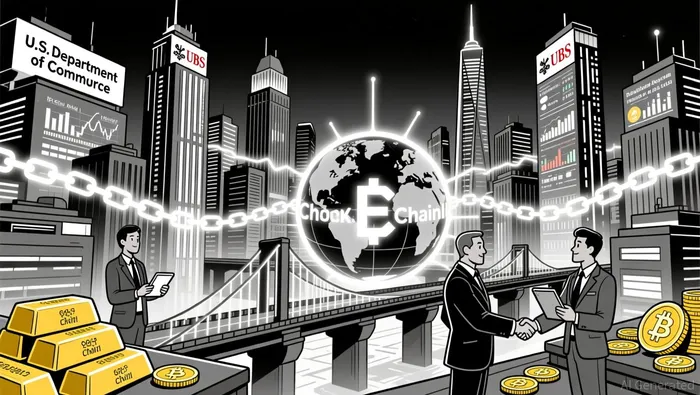
Chainlink's dominance in on-chain finance is underscored by its partnerships with governments, banks, and financial market infrastructures. In 2025, the U.S. Department of Commerce partnered with Chainlink to publish macroeconomic data on-chain via Chainlink Data Feeds, sourced from the Bureau of Economic Analysis. This initiative exemplifies how blockchain can democratize access to critical financial data while ensuring immutability and transparency.
Banks and asset managers are also leveraging Chainlink's infrastructure to tokenize traditional assets. UBS executed the world's first live, end-to-end tokenized fund workflow using Chainlink's Digital Transfer Agent (DTA) standard, enabling seamless on-chain subscription and redemption events triggered by Swift messages. Similarly, J.P. Morgan, in collaboration with Ondo Finance and Kinexys, completed a cross-chain Delivery versus Payment transaction involving tokenized U.S. Treasuries, demonstrating the feasibility of blockchain-based settlement systems.
Financial market infrastructures like DTCC, Euroclear, and SWIFT have further solidified Chainlink's role by integrating its Cross-Chain Interoperability Protocol to streamline corporate actions processing and cross-chain settlements. These partnerships highlight Chainlink's ability to act as a universal bridge between legacy systems and decentralized networks, ensuring compliance, security, and scalability.
Infrastructure Utility: Oracles, CCIP, and the Future of Finance
Chainlink's infrastructure extends beyond data feeds to encompass a suite of tools that power tokenized finance. Its decentralized oracleADA-- networks provide real-world data to smart contracts, while CCIP enables secure, cross-chain asset and message transfers. In 2025, CCIP processes $27.4 billion daily across 70+ blockchain networks, evolving from a simple interoperability protocol to a foundational layer for global finance.
CCIP's v1.5 upgrade introduced the Cross-Chain Token (CCT) standard, allowing developers to make tokens cross-chain compatible in minutes without liquidity pools. This innovation is critical for institutional-grade transactions, where zero-slippage and privacy are paramount. For instance, ANZ Bank and Fidelity International use CCIP for tokenized asset movements, while J.P. Morgan employs it for cross-border settlements according to Chainlink documentation.
Chainlink's role in RWA tokenization is equally transformative. Platforms like Ondo Finance and Tangible leverage Chainlink Proof of Reserve to tokenize real-world assets such as U.S. Treasuries and physical gold, ensuring transparency and trust. Meanwhile, DeFi protocols like Gearbox and Echo Protocol rely on Chainlink Data Feeds for secure lending and Bitcoin liquidity aggregation. These use cases underscore Chainlink's dual utility in both decentralized and institutional ecosystems.
Market Dynamics: Whale Accumulation, ETFs, and Technical Indicators
Institutional confidence in Chainlink is reflected in on-chain activity and market developments. Data from 2024-2025 reveals that large investors have accumulated over 8 million LINK tokens, with strategic buying concentrated in a single hour (272,979 LINK for $3.67 million) and sustained accumulation since December according to market analysis. This whale activity contrasts with retail selling, pushing the Exchange Supply Ratio to its lowest level ever.
The launch of the Bitwise Chainlink ETF (CLNK) on the DTCC platform marks another milestone, signaling growing institutional access to LINK despite regulatory hurdles. Meanwhile, technical indicators suggest a bullish setup: LINK trades above the 20-period EMA, with RSI in neutral territory and price near the upper Bollinger Band range according to technical analysis. A breakout above $14.24 could propel the token toward $15.01, aligning with its expanding infrastructure utility.
DeFi Dependency: Powering the Decentralized Ecosystem
Chainlink's ecosystem now supports over 2,600 projects, including DeFi derivatives platforms, stablecoin protocols, and institutional-grade lending infrastructure according to Chainlink documentation. Specific examples include:- Ampleforth: Uses Chainlink oracles to dynamically adjust token supply based on real-world data.- CACHE Gold: Relies on Chainlink Proof of Reserve to monitor physical gold reserves.- Poundtoken: Employs Chainlink for collateral transparency in its GBP-backed stablecoin.
These projects highlight Chainlink's role in securing DeFi's infrastructure, ensuring that decentralized applications can operate with the same reliability as traditional systems. As DeFi matures, its dependency on Chainlink's oracles and CCIP will only deepen, reinforcing the token's long-term value proposition.
Conclusion: A Long-Term Play on Financial Modernization
Chainlink's strategic partnerships, institutional-grade infrastructure, and growing DeFi dependency position LINK as a cornerstone of the tokenized finance era. Unlike speculative assets tied to crypto market cycles, LINK's value is derived from its utility in bridging real-world finance with blockchain. As governments, banks, and enterprises continue to adopt Chainlink's solutions, the token's role in financial system modernization will become increasingly irreplaceable. For investors, this represents a unique opportunity to bet on the infrastructure that will underpin the next decade of financial innovation.






Comentarios
Aún no hay comentarios