
Chainlink (LINK) Market Volatility: Whale Activity and Bearish Signals
The ChainlinkLINK-- (LINK) token has entered a period of heightened volatility in Q4 2025, driven by conflicting signals from whale activity, declining network demand, and bearish technical patterns. While institutional-grade infrastructure upgrades and a $41.5 million inflow into the Grayscale Chainlink Trust ETF suggest long-term optimism, on-chain data reveals a more nuanced picture. Whale selling, reduced TVL in DeFi applications, and a fragile NVT ratio point to potential further downside, even as strategic contrarian entry points emerge for investors willing to navigate the uncertainty.
Whale Activity: Accumulation vs. Selling Pressure
Whale behavior has been a double-edged sword for LINKLINK--. On one hand, large investors have accumulated $19.8 million worth of LINK on Binance, with newly created wallets purchasing 1.567 million tokens on Binance. This aligns with historical patterns observed before major rallies in 2019-2020 and 2022-2023 indicating strategic positioning, suggesting strategic positioning for future price action. However, recent data indicates a 2% drop in whale-held balances over the past week, coupled with increased exchange inflows of 445,000 LINK ($5.57 million) a sign of potential short-term selling pressure. Such movements often precede short-term selling pressure, particularly when combined with a 11.25 million LINK unlock from a non-circulating supply wallet in late December.
The mixed signals are further complicated by negative exchange netflows of -384.9k LINK over three days, which typically indicate accumulation by long-term holders. Yet, the broader context of a 16% price drop over the past month and a bearish double-top pattern on the weekly chart suggests market skepticism suggests that even whale-driven buying may struggle to offset broader market skepticism.
Network Demand: A Tale of Two Metrics
Chainlink's network demand metrics tell a story of divergence. On the positive side, Total Value Enabled (TVE) has surged to $27.47 trillion, and Total Value Secured (TVS) rose to $46.03 billion in Q4 2025. These figures underscore Chainlink's role as a critical infrastructure layer for tokenized finance, particularly with its Cross-Chain Interoperability Protocol (CCIP) now live on 65+ networks. Institutional partnerships, such as the U.S. Department of Commerce's onchain macroeconomic data initiative, further reinforce its utility.
However, demand for Chainlink's oracle services has waned. Total Value Locked (TVL) in Chainlink-based DeFi applications plummeted from $1.13 billion in August to $545 million, while smart contract call volume-despite an 89% quarter-over-quarter increase-fails to offset declining retail participation. This divergence highlights a key risk: while institutional adoption is robust, retail and speculative demand remain subdued, leaving the network vulnerable to bearish momentum.
On-Chain Metrics: NVT Ratio and Bearish Technicals
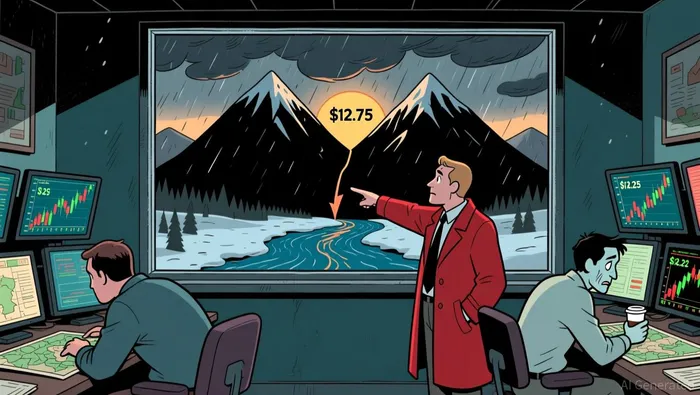
The Network Value to Transaction (NVT) ratio-a critical on-chain valuation metric-has trended bearish in Q4 2025. Open Interest (OI) in Chainlink derivatives has collapsed to $511 million, down from $1.95 billion in August, signaling reduced speculative activity. Meanwhile, the token trades within a descending channel, with sellers maintaining control near the $12–$13 support zone. A close below the 50 EMA at $12.75 could trigger a test of the $12.22 support level, potentially accelerating a 50% price drop if the bearish double-top pattern completes according to technical analysis.
Contrarian indicators, however, offer glimmers of hope. Whale outflows from Binance-valued at $5.57 million-mirror pre-rally patterns, and the Grayscale ETF's debut has injected institutional liquidity. These factors suggest that while the short-term outlook is bearish, the network's foundational upgrades such as Confidential Compute in 2026 could catalyze a reversal if demand stabilizes.
Strategic Entry Points for Contrarian Investors
For investors seeking to capitalize on volatility, key support levels and whale-driven trends present opportunities. The $12.25 support level is critical; a break below this could trigger a short-term downtrend but may also attract bargain hunters. Historical data shows that whale accumulation often precedes rallies by 3–6 months a pattern observed in past market cycles, and the current 40 million-token increase in whale holdings implies long-term conviction.
A contrarian strategy would involve entering near $12.25 with a stop-loss below $12.00, while monitoring TVS growth and CCIP adoption. If the price recovers above $12.60 and sustains above $12.80–$12.90 according to technical analysis, it could signal a shift in sentiment. Conversely, a breakdown below $12.25 would validate the bearish case, necessitating a reevaluation of risk exposure.
Conclusion
Chainlink's Q4 2025 narrative is defined by a tug-of-war between institutional optimism and retail skepticism. Whale activity and network demand metrics highlight both accumulation and selling pressure, while technical indicators suggest a fragile equilibrium. For contrarian investors, the path forward hinges on disciplined risk management and a focus on long-term infrastructure upgrades. As the market awaits Confidential Compute and CCIP v1.5 in 2026, the coming months will test whether LINK can stabilize its on-chain fundamentals or succumb to a deeper bearish cycle.





Comentarios
Aún no hay comentarios