
Chainlink's (LINK) Long-Term Price Potential: A Deep Dive into Blockchain Interoperability and Oracle Network Adoption
The OracleADA-- Layer of Web3: Chainlink's Strategic Position
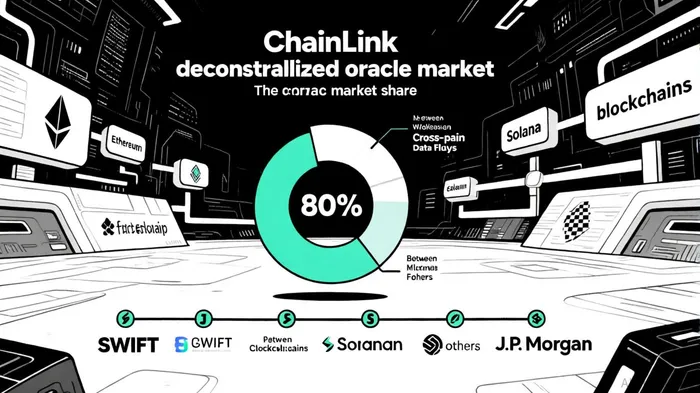
Blockchain's promise of trustless systems hinges on its ability to interact with real-world data—a challenge solved by decentralized oracle networks. ChainlinkLINK-- (LINK), the market leader, has cemented its role as the backbone of this infrastructure. According to a report by Disruption Banking, Chainlink now powers 84% of Ethereum DeFi applications and holds 80% of the decentralized oracle market share[1]. This dominance is not accidental but a result of relentless innovation and strategic partnerships that position it as a critical player in both decentralized and traditional finance.
Market Share and Total Value Secured: Metrics of Trust
Chainlink's total value secured (TVS) has surged past $93 billion across multiple blockchains as of August 2025[4], a testament to its reliability in securing smart contracts. This growth is driven by its ability to bridge on-chain and off-chain ecosystems, enabling applications ranging from DeFi lending protocols to tokenized real-world assets (RWAs). For context, competitors like Pyth NetworkPYTH-- and Band Protocol collectively hold less than 20% of the oracle market[1], underscoring Chainlink's technological and network advantages.
The network's expansion into cross-chain interoperability via the Chainlink Cross-Chain Interoperability Protocol (CCIP) further solidifies its value proposition. CCIP allows seamless data and token transfers between chains like EthereumETH--, SolanaSOL--, and PolkadotDOT--, addressing a key bottleneck in blockchain scalability[3]. This capability is critical as multi-chain ecosystems mature, creating a compounding effect on Chainlink's utility.
Institutional Partnerships and Capital Market Integration
Chainlink's institutional adoption is accelerating. A notable example is its partnership with Turkey's Misyon Bank, which leverages Chainlink's oracles to tokenize real-world assets and streamline cross-border payments[3]. Meanwhile, collaborations with global giants like SWIFT, J.P. Morgan, and Mastercard are unlocking access to trillions in traditional financial assets[4]. These partnerships are not merely symbolic; they represent a structural shift toward blockchain-based infrastructure in capital markets.
The U.S. White House's recognition of Chainlink as foundational infrastructure for digital assets[3] adds another layer of credibility. This aligns with a broader regulatory environment that increasingly views blockchain as a tool for financial inclusion and innovation. For investors, this signals reduced regulatory risk and long-term institutional demand for Chainlink's services.
Technological Edge: Data Streams and Runtime Environment
Chainlink's product roadmap is equally compelling. The launch of Data Streams in 2025 enables real-time price feeds for U.S. equities and ETFs, bridging the gap between traditional and crypto markets[3]. Simultaneously, the Chainlink Runtime Environment (CRE), entering general availability in 2025, empowers developers to build modular, composable workflows[2]. These tools lower the barrier to entry for enterprises and developers, accelerating adoption across sectors.
Regulatory Tailwinds and Ecosystem Resilience
The regulatory landscape, often a wildcard for crypto projects, appears favorable for Chainlink. Its role in securing high-value financial systems—such as tokenized bonds and derivatives—has drawn attention from regulators seeking to balance innovation with oversight. The White House's endorsement[3] and partnerships with legacy institutions suggest Chainlink is navigating this space adeptly, avoiding the pitfalls that have plagued other protocols.
Long-Term Price Projections: A Case for Optimism
While short-term price movements are volatile, Chainlink's fundamentals point to sustained growth. With over 1,500 partnerships and a TVS exceeding $93 billion[4], the network's value accrual is self-reinforcing. As blockchain interoperability becomes a standard requirement for global enterprises, demand for Chainlink's services—and by extension, its native token LINK—will likely outpace supply.
Analysts project that LINK's price could see multi-year gains if the TVS metric continues to grow at a 30% annualized rate, driven by RWA tokenization and cross-chain adoption. However, investors should monitor competition and macroeconomic factors, though Chainlink's first-mover advantage and institutional trust provide a buffer.
Conclusion: A Cornerstone of the Web3 Ecosystem
Chainlink's trajectory reflects its role as a foundational infrastructure layer for blockchain. Its dominance in decentralized oracles, institutional partnerships, and regulatory alignment position it as a long-term holder of value in the crypto space. For investors seeking exposure to blockchain interoperability, LINK offers a compelling case—backed by data, partnerships, and a robust technological ecosystem.







Comentarios
Aún no hay comentarios