
Chainlink (LINK) vs. Layer Brett: Institutional Adoption and DeFi Infrastructure in a $5,000 Ethereum World
The Institutional Edge: Chainlink's Dominance in DeFi Infrastructure
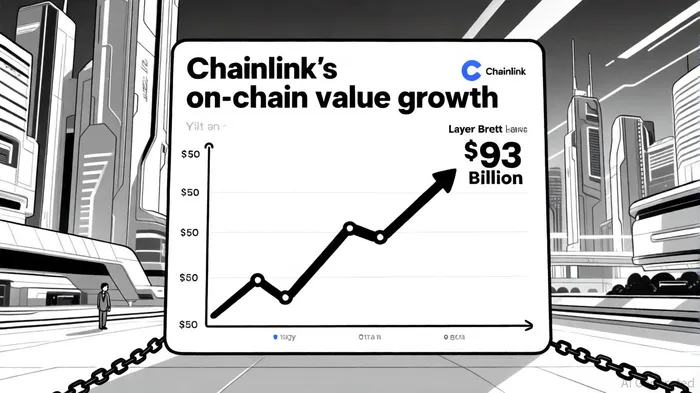
In a $5,000 EthereumETH-- environment, institutional adoption and DeFi infrastructure become critical levers for blockchain asset valuation. ChainlinkLINK-- (LINK) has emerged as a clear leader in this space, securing $93 billion in on-chain value across ecosystems by mid-2025, with a 67% share of the oracle market—a 20-point lead over its nearest competitors[1]. This dominance is underpinned by strategic partnerships with financial giants like Mastercard, SWIFT, and JPMorgan, which have integrated Chainlink's decentralized oracleORCL-- network (DON) to bridge traditional finance (TradFi) and blockchain systems[3]. For instance, Mastercard's June 2025 collaboration with Chainlink enabled 3.5 billion cardholders to purchase crypto directly on-chain, reducing friction and expanding institutional-grade access to digital assets[4].
Chainlink's Cross-Chain Interoperability Protocol (CCIP) further solidifies its infrastructure relevance. By expanding to 60+ blockchains, CCIP has unlocked cross-chain use cases for enterprises and DeFi protocols alike. Notably, the protocol's integration with Aptos allowed DeFi platforms like AaveAAVE-- to deploy tokenized assets (e.g., GHO) across ecosystems, amplifying liquidity and composability[3]. This scalability is critical in a $5,000 Ethereum world, where institutional capital seeks seamless value transfer across chains.
Deflationary Tailwinds and Institutional Liquidity
Chainlink's tokenomics also favor long-term holders. The Chainlink Reserve mechanism has removed 237,014 LINK tokens from circulation, generating $5.5 million in deflationary pressure as of Q3 2025[3]. This scarcity model, combined with Grayscale's filing to convert its Chainlink Trust into an ETF, signals growing institutional confidence. Such ETF conversions would democratize access to LINKLINK--, enabling both institutional and retail investors to gain exposure without navigating the complexities of crypto custody[3].
In contrast, a hypothetical Layer Brett—a speculative layer-1 or cross-chain protocol—lacks comparable institutional validation. While it might tout novel consensus mechanisms or EVM compatibility, its absence from major enterprise partnerships and oracle market share (estimated at <5% in 2025[1]) positions it as a high-risk, high-reward play. Without proven use cases in capital markets or tokenized asset settlement, Layer Brett's value proposition remains untested in a $5,000 Ethereum environment.
DeFi's Next Frontier: Tokenized Assets and Regulated Infrastructure
Chainlink's role in tokenized asset infrastructure further differentiates it. Collaborations with DigiFT and UBS under Hong Kong's Cyberport pilot have created a regulated framework for tokenized product distribution, enabling investors to submit orders via smart contracts[4]. This aligns with Ethereum's $5,000 price trajectory, where tokenized real-world assets (RWAs) and institutional-grade DeFi protocols gain traction. For example, UBS's tokenized products, secured by Chainlink oracles, now offer automated settlement and lifecycle management, reducing counterparty risk[4].
Layer Brett, by contrast, would need to replicate these partnerships from scratch. While it might offer lower gas fees or novel sharding models, its lack of real-world data integration (e.g., ICE's crypto payroll platform[4]) and enterprise-grade security (e.g., U.S. Department of Commerce data onboarding[1]) limits its appeal to risk-averse institutions.
Conclusion: Institutional Adoption as a Moat
In a $5,000 Ethereum world, Chainlink's first-mover advantage, institutional partnerships, and deflationary tokenomics create a formidable moat. Its dominance in the oracle market (67% share[1]) and cross-chain infrastructure (60+ blockchains[3]) positions it as the backbone of DeFi 2.0. Meanwhile, a hypothetical Layer Brett—despite potential technical innovations—lacks the institutional credibility and proven use cases to compete. For investors prioritizing capital preservation and scalable infrastructure, Chainlink remains the superior bet.





Comentarios
Aún no hay comentarios