
Chainlink (LINK) Faces Bearish Crossroads: Technical Breakdowns and Institutional Pressures Signal High-Risk Scenario
Chainlink (LINK) has entered a critical juncture in October 2025, where technical fragility and institutional selling pressures converge to create a high-risk environment for investors. Despite lingering long-term bullish fundamentals, the token's recent price action-dropping 4% to a seven-day low of $21.30-reveals a market grappling with divergent signals. This analysis dissects the bearish breakdown risks, institutional dynamics, and volatility trends shaping LINK's trajectory.
Technical Weakness: A Fragile Foundation
The immediate technical picture for LINKLINK-- is precarious. A breakdown below the $21.86 pivot point would invalidate the near-term bullish thesis, as the token would face a critical test at $19.82, a confluence of support levels and the 20-day SMA, according to a Coindesk report. If this level fails, the next target becomes $19.32, with a potential retest of the $17.38 200-day SMA acting as a final long-term floor, per a Blockchain.News analysis.
While the RSI remains in neutral territory, the MACD hints at early bullish divergence, suggesting short-term buyers may still be active, as the Coindesk report also noted. However, the token's position below both the 20-day and 50-day SMAs underscores ongoing short- and medium-term bearish pressure, according to Traders Union. A failure to reclaim $23.73-a key resistance level-could trigger a cascade of stop-loss orders, accelerating the downward spiral, as the Blockchain.News analysis warned.
Institutional Selling: A Catalyst for Volatility
Institutional activity has been a double-edged sword for LINK. The ChainlinkLINK-- Reserve's recent purchase of 45,729 tokens has done little to offset the selling pressure, as the price now trades below the reserve's average cost basis of $22.44, the Coindesk report observed. Meanwhile, exchange inflows have surged, with 2.23 million LINK tokens moved to exchanges in two weeks-a clear bearish signal according to Santiment data, as covered in a TradingView report.
Large-scale institutional moves have further amplified volatility. On February 26, 2025, 610,000 LINK tokens were transferred to exchanges in a single day, intensifying downward momentum, as that TradingView piece documented. While whale accumulation in August 2025-8 million tokens worth $177 million-suggested bullish conviction, recent outflows indicate a shift in sentiment, according to a CoinMarketCap forecast. This tug-of-war between institutional demand and token inflation could determine LINK's fate in the coming months.
Volatility and Breakdown Scenarios
The token's volatility has spiked to 5% in recent sessions, a level that could exacerbate breakdown risks. If LINK fails to hold the $21.65–$22.15 support zone, a pullback toward $19.82 becomes likely, the Blockchain.News analysis suggested. A breakdown below this level would invalidate the bullish case and open the door to a retest of the $20.05 lower Bollinger Band or even a dip to $17.89, the same analysis added.
Conversely, a successful rebound above $22.68 could reignite bullish momentum, targeting $24.89 and eventually the 52-week high of $26.79, per the Blockchain.News analysis. However, given the current market environment-characterized by broader crypto weakness and elevated institutional selling-this scenario appears contingent on external catalysts, such as a macroeconomic turnaround or renewed adoption in tokenized asset markets, as the CoinMarketCap forecast notes.
Conclusion: A High-Risk, High-Reward Proposition
Chainlink's technical and market dynamics in October 2025 reflect a fragile equilibrium. While the token's position above the 200-day SMA and whale accumulation activity provide a floor for long-term optimism, the immediate risks of a breakdown below $19.82 cannot be ignored. Investors must closely monitor institutional flows, key support/resistance levels, and broader market conditions. For now, LINK remains a high-risk, high-reward asset, where a single session's price action could redefine its trajectory.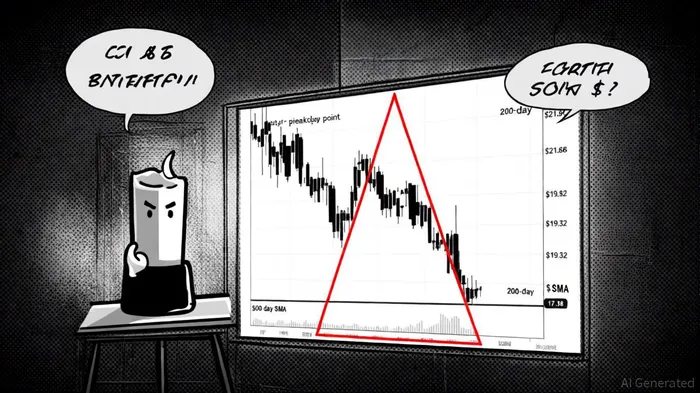






Comentarios
Aún no hay comentarios