
Chainlink's Emerging Role in Government Digital Infrastructure: Decentralized Oracles as a Catalyst for Secure On-Chain Governance
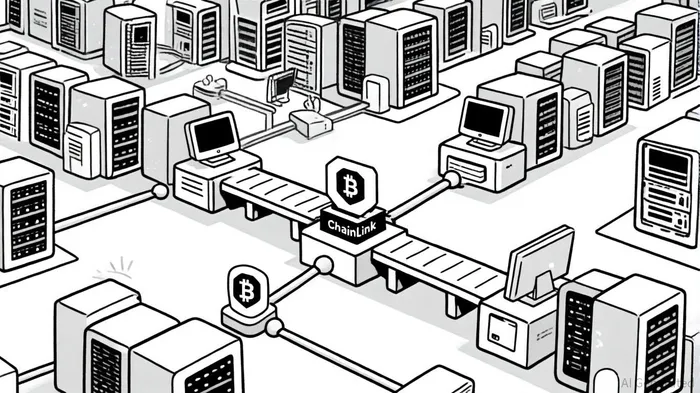
In 2025, ChainlinkLINK-- has emerged as a pivotal player in bridging traditional government data with blockchain ecosystems, catalyzing a new era of digital infrastructure. The U.S. Department of Commerce's partnership with Chainlink to bring macroeconomic indicators—such as Real GDP and the PCE Price Index—onto blockchains like EthereumETH-- and Arbitrum marks a landmark shift in how public data is integrated into decentralized systems [1]. This collaboration not only democratizes access to institutional-grade data but also lays the groundwork for on-chain governance frameworks that prioritize transparency and verifiability.
Decentralized Oracles: The Backbone of Trustless Governance
Chainlink's decentralized oracleORCL-- networks (DONs) have long been the backbone of DeFi, enabling protocols like AaveAAVE-- and MakerDAO to access tamper-proof price feeds [2]. However, their potential extends far beyond financial applications. By ensuring real-world data is securely and accurately ingested into smart contracts, Chainlink oracles address a critical vulnerability in on-chain governance: the reliance on centralized data sources. For instance, in decentralized autonomous organizations (DAOs), governance decisions often hinge on external metrics such as market conditions or regulatory thresholds. Chainlink's infrastructure eliminates single points of failure, ensuring that these decisions are informed by immutable, auditable data [3].
The U.S. Department of Commerce partnership exemplifies this potential. By onboarding economic data onto blockchains, Chainlink enables automated policy execution and real-time compliance checks. Imagine a scenario where inflationary trends trigger algorithmic adjustments to monetary policy simulations or where supply chain disruptions automatically initiate contingency protocols. These use cases underscore how oracles can transform governance from reactive to proactive, data-driven systems [4].
Beyond Economic Data: Governance Use Cases on the Horizon
While concrete examples of Chainlink oracles in government voting systems remain nascent, the technology's foundational capabilities suggest a path toward broader adoption. For instance, Estonia's e-Estonia initiative has already demonstrated the viability of blockchain for secure governance, leveraging tamper-proof records for public services [5]. Chainlink's Verifiable Random Function (VRF) could further enhance such systems by enabling random sample voting, mitigating centralization risks in token-based governance models [6].
In regulatory compliance, Chainlink oracles could automate checks for investor eligibility or enforce adherence to policy frameworks. For example, a blockchain-based procurement system could use oracles to verify supplier credentials in real time, reducing fraud and ensuring compliance with public procurement laws [7]. Similarly, in environmental governance, oracles could track emissions data or resource usage, enabling dynamic policy adjustments based on real-world metrics [8].
Challenges and the Path Forward
Despite these opportunities, challenges persist. Political will remains a significant barrier, as highlighted by Chainlink co-founder Sergey Nazarov, who noted that “the technology exists, but adoption depends on institutional readiness” [9]. Additionally, ensuring voter anonymity in blockchain-based elections requires advanced cryptographic solutions, which are still in experimental stages. Flash loan attacks and oracle manipulation risks also demand robust mitigation strategies, such as multi-oracle aggregation and threshold cryptography [10].
Investment Implications
Chainlink's strategic position as a bridge between legacy institutions and decentralized systems positions it as a key infrastructure provider for the next phase of digital governance. With data feeds now available on ten major blockchains and growing institutional partnerships, the company is well-placed to capitalize on the $1.2 trillion global blockchain market [11]. For investors, this represents not just a play on DeFi's evolution but a bet on the broader adoption of blockchain in public administration—a sector ripe for disruption.
As governments worldwide accelerate their digital transformation, Chainlink's oracles will likely become indispensable tools for ensuring data integrity, transparency, and trust. The question is no longer whether blockchain can reshape governance but how quickly institutions will embrace it.






Comentarios
Aún no hay comentarios