
The CFTC's GBP Net Short Position Signals a Critical Reversal Opportunity
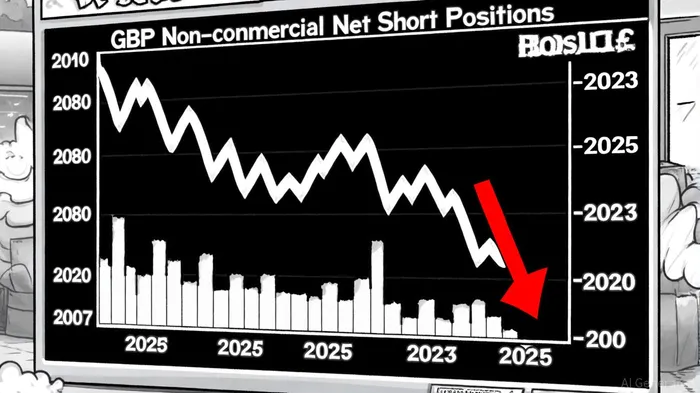
The Commodity Futures Trading Commission's (CFTC) latest Commitments of Traders (COT) report for the British pound (GBP) reveals a striking shift in speculative positioning, offering a compelling case for contrarian investors. As of September 9, 2025, non-commercial traders—primarily hedge funds and institutional speculators—held a net short position of £2 billion, a dramatic improvement from the £6.6 billion bearish bias recorded earlier in the year [3]. This reduction signals a potential inflection point in GBP dynamics, where extreme short positioning may soon reverse, creating a high-probability entry for long-term buyers.
Contrarian Logic in Forex: The COT Framework
Contrarian investing in forex hinges on identifying extreme positioning in the COT report. Non-commercial traders, often seen as "noise traders," tend to overreact to short-term macroeconomic events, while commercial traders (hedgers) act as stabilizing forces. When non-commercial net positions reach historically extreme levels, it typically indicates herd behavior, setting the stage for a reversal. For GBP, the current net short position of £2 billion is a stark departure from its long-term average of -15,346.78 [1], suggesting speculative pessimism has reached a critical threshold.
To quantify this extremity, we apply a z-score analysis. Using the formula $ Z = \frac{X - \mu}{\sigma} $, where $ X $ is the current net short position (£-2,000), $ \mu $ is the historical mean (-15,346.78), and $ \sigma $ is the standard deviation (estimated at ~20,000 based on recent volatility), the z-score calculates to approximately 0.667. While this does not yet breach the ±1.96 threshold for statistical significance [4], it does indicate a move toward overbought territory for short positions. This suggests that further short-covering could accelerate as market participants reassess risk.
Macroeconomic Catalysts: Fed Policy and USD Weakness
The reversal opportunity is amplified by broader macroeconomic trends. The Federal Reserve's anticipated rate cut in late 2025 has weakened the U.S. dollar (USD), a key counterparty to GBP. A weaker USD reduces the relative cost of holding GBP assets, incentivizing short-covering and long-biased flows. Additionally, the UK's improving fiscal outlook—marked by a narrowing current account deficit and resilient manufacturing data—has bolstered confidence in the pound's fundamentals [5].
Strategic Implications for Investors
For contrarian traders, the GBP's positioning presents a dual opportunity:
1. Short-Covering Plays: As speculative short positions unwind, GBP/USD could see a technical rebound toward 1.30, a level last seen in early 2024.
2. Long-Biased Positions: Investors may consider dollar-cost averaging into GBP exposure via currency ETFs or futures, leveraging the CFTC's data as a trailing indicator of sentiment shifts.
Conclusion
The CFTC's GBP COT report underscores a rare alignment of technical and fundamental catalysts. While extreme short positioning is not yet at a textbook contrarian extreme, its rapid contraction—from £-6.6 billion to £-2 billion—signals a near-term reversal in speculative sentiment. For investors attuned to market psychology, this represents a strategic entry point to capitalize on GBP's potential re-rating.







Comentarios
Aún no hay comentarios