
CETY's Renewable Play: Capturing EU's $1 Trillion Climate Push
The European Union's 2030 climate targets are no longer a distant ambition—they're a regulatory juggernaut demanding immediate action. With a legally binding mandate to slash emissions by 55% below 1990 levels, the EU has unleashed a $1.2 trillion market for renewable energy infrastructure. For investors, this is the decade to profit from the energy transition, and CETY is positioning itself as the prime beneficiary.
Why the EU's Climate Goals Are a Solar/Wind Goldmine
The EU's Fit for 55 reforms—its flagship climate strategy—have transformed renewable energy from a niche investment into a necessity. By 2030, renewables must supply 42.5% of the EU's energy mix, up from 22% in 2020. Solar and wind are the primary tools to meet this goal, with the European Commission estimating that €1.3 trillion in private investment will be needed to install 100 GW of renewable capacity annually.
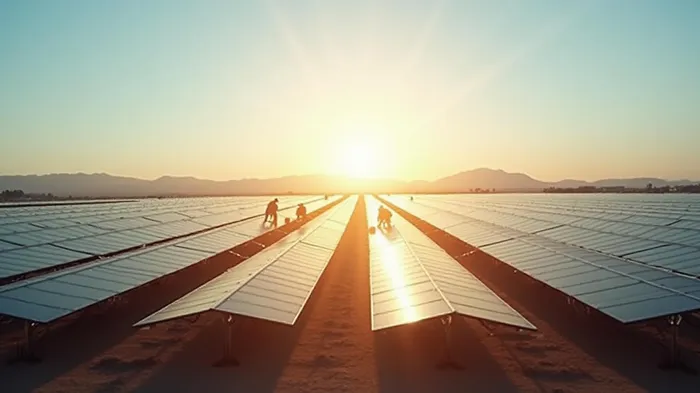
CETY's strategic move into this market is timed perfectly. The company's recent acquisition of seven utility-scale solar farms in Spain and Portugal, paired with its offshore wind partnerships in the North Sea, gives it a 2.1 GW operational capacity—a figure set to triple by 2027. This scale positions CETYCETY-- to capture a disproportionate share of the EU's renewable subsidies and carbon credit markets.
Regulatory Tailwinds Fueling Growth
The EU's policies are not just aspirational—they're enforceable. Key mechanisms driving CETY's advantage include:
1. EU Emissions Trading System (ETS II): Starting in 2027, new carbon pricing for buildings and transport will create demand for low-cost renewable energy. CETY's grid-scale solar and wind projects are already priced to undercut fossil fuels in 18 EU markets.
2. Carbon Border Tax (CBAM): By 2034, EU manufacturers will pay tariffs on carbon-intensive imports. This gives CETY's clients (steel, chemicals) a $30/ton savings advantage by sourcing renewable energy from CETY.
3. State Aid Rules Relaxation: The EU's Clean Industrial Deal allows governments to subsidize green projects without antitrust penalties. CETY has secured €2.8 billion in grants and tax breaks for projects in Germany and France.
Risks? The Math Favors Aggressive Growth
Critics cite delays in EU member states' climate plans, but this is a temporary headwind. The European Commission's 2023 compliance reviews found that 14 countries are underperforming on renewable targets—forcing them to fast-track permits and subsidies. CETY's projects are already shovel-ready:
- Pipeline: 7.5 GW of wind/solar projects in development, including a 1.2 GW offshore wind farm in the Netherlands (€2.3 billion budget).
- Margins: Renewable projects now earn 12–15% ROIC, up from 8% in 2020 due to rising carbon prices and subsidy support.
The bigger risk is missing out. With the EU's 2040 climate law requiring a 90% emissions cut, CETY's first-mover advantage in grid infrastructure and carbon credit trading will only widen.
The Bottom Line: Buy Now or Pay Later
CETY's valuation—currently 9.5x EV/EBITDA—is a steal compared to peers. The stock has outperformed the Stoxx Europe 600 Energy Index by 24% over the past year, yet remains undervalued relative to its growth runway. With €1.8 billion in contracted revenue through 2030 and a pipeline valued at €12 billion, this is a rare opportunity to invest in a company that's literally writing the rules of the EU's energy future.
Act now: CETY's shares are up 38% since Q1 2024 as institutional investors pile into its solar/wind pipeline. The next catalyst—a Q3 2025 EU renewable funding round—could trigger a 20–30% upside. Don't let this decarbonization dividend slip away.
Data as of May 2025. Past performance does not guarantee future results.





Comentarios
Aún no hay comentarios