
The Cereal Makeover: How Health-Focused Innovation Could Sweeten Returns
The U.S. cereal industry faces a paradox: despite declining overall revenue, there's a quiet revolution brewing. As consumers pivot toward healthier, premium breakfast options, the sector's traditional players are racing to reinvent themselves. For investors, this transition offers a compelling opportunity—if they can identify which companies are leveraging EBITDA efficiency and strategic innovation to carve out a profitable niche.
The Industry's Crossroads: Decline Amid Innovation
The cereal market's revenue has been shrinking for years, dropping to $11.8 billion in 2025, a 1.5% annual decline since 2020. Yet within this downturn, a clear divide is emerging: health-focused innovation is the new battleground. Companies like General MillsGIS-- and WK KelloggKLG-- are betting on organic, high-fiber, and functional cereals to counter the rise of protein bars, yogurt, and avocado toastTOST--. The question is: Which firms are turning these bets into sustainable EBITDA growth?
A Deep Dive into EBITDA Trends
Let's compare the financial performance of the industry's leaders using key metrics:
- General Mills (GIS):
- EBITDA Margin: 16.2% (2025), highest among peers, reflecting strong brand management and cost discipline.
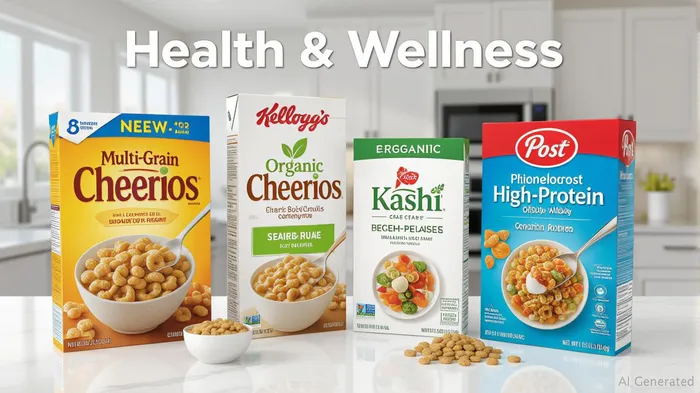
- Health Plays: Multi-Grain Cheerios and high-fiber cereals now account for 25% of its product line.
- EBITDA Outlook: Despite a 3.3% revenue dip in Q2 2025 due to category declines, its reinvestment in premium products positions it to capitalize on demand for healthier options.
- WK Kellogg (Kellogg's parent company, acquired by Ferrero in 2025):
- EBITDA Margin: 4.4% (2025), but the company aims to boost this to 14% by 2026 via supply chain upgrades.
- Health Plays: Brands like Kashi and Bear Naked (organic/non-GMO) are core to its strategy.
Ferrero's Impact: The $3.1 billion acquisition signals confidence in Kellogg's premium assets, potentially unlocking value through cross-selling and operational synergies.
Post Holdings (POST):
- EBITDA Margin: 10% (2025), with a focus on recovery from avian flu-driven costs.
- Health Plays: Its Post Consumer Brands segment (including cereal and pet food) struggles with sales declines but maintains EBITDA resilience.
- Wild Card: The Weetabix division (UK cereal) posted a 9% EBITDA rise in Q2 2025, suggesting untapped international potential.
Why EBITDA Matters: Efficiency Meets Innovation
The companies with the strongest EBITDA margins (e.g., General Mills) are those that combine cost discipline with product differentiation. Consider:
- Supply Chain Gains: Kellogg's $500M modernization plan reduced waste and boosted productivity, a strategy Post is now mirroring in its Foodservice division.
- Premium Pricing Power: General Mills' premium cereals command 15–20% higher margins than traditional lines.
Undervalued Opportunities: Where to Invest
The key is to bet on firms that align health innovation with EBITDA scalability:
1. General Mills (GIS):
- Why Buy? Its 16.2% EBITDA margin and 14% of revenue from premium products signal resilience.
- Valuation: Trading at 18.5x forward P/E, below its five-year average of 20x, GISGIS-- offers a margin of safety amid sector headwinds.
- Data Check:
2. Post Holdings (POST):
- Why Buy? Its $1.43–1.47B 2025 EBITDA guidance hints at recovery. The Weetabix segment's growth in Europe suggests untapped export potential.
- Risks: Overexposure to category declines in cereal and pet food.
- Valuation: At 12x forward P/E, it's cheaper than peers but requires patience for margin stabilization.
3. Kellogg's (via Ferrero's Acquisition):
- Why Watch: Ferrero's integration could unlock value by expanding Kellogg's premium brands into its global distribution network.
- Risks: Short-term EBITDA dips from acquisition costs may deter short-term investors.
The Risks: Don't Ignore the Headwinds
- Consumer Shifts: Even with innovation, low-carb diets and convenience foods remain threats.
- Cost Pressures: Steel tariffs and inflation could erode margins unless offset by premium pricing.
- Competition: Generic brands and private labels still undercut premium products on price.
Final Take: Go for the Innovators with EBITDA Muscle
The cereal industry's decline isn't uniform—it's a tale of two markets: shrinking traditional products and growing premium health-focused alternatives. Investors should prioritize firms like General Mills that already demonstrate EBITDA strength and product differentiation. For higher-risk, higher-reward bets, Post Holdings could rebound if it stabilizes its underperforming segments.
Avoid companies overly reliant on legacy brands without a clear health angle. The winners will be those turning innovation into EBITDA—and that's a recipe for investor returns.







Comentarios
Aún no hay comentarios