
Centrica's Strategic Leadership Shift: Implications for Energy Transition and Shareholder Value
The energy transition is no longer a distant horizon but an immediate imperative. For companies like Centrica plc, navigating this shift requires not just capital and technology but a boardroom steeped in ESG expertise. In late 2024, Centrica announced a significant leadership overhaul, with Kevin O'Byrne succeeding Scott Wheway as Chair and Jo Harlow appointed as Senior Independent Director[1]. These changes signal a recalibration of governance priorities, raising critical questions: Does the new board possess the ESG acumen to steer Centrica through the complexities of decarbonization? And how might this influence shareholder value in an era where sustainability and profitability are increasingly intertwined?
Governance Reimagined: A Board for the Energy Transition
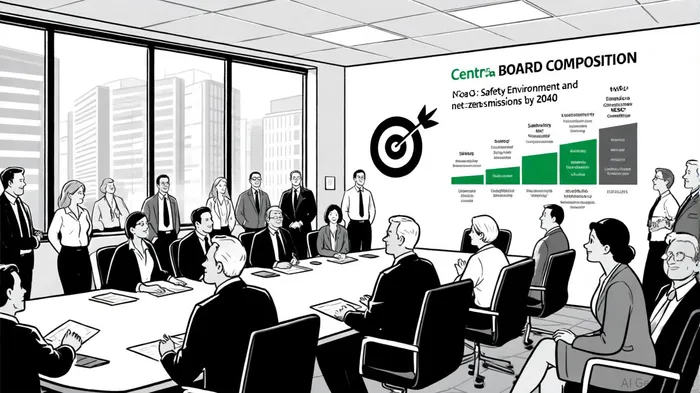
Centrica's new board, now chaired by O'Byrne, includes a mix of seasoned executives and independent directors, with a deliberate emphasis on ESG governance. The board oversees operations through a unitary structure and five committees, including the Safety, Environment, and Sustainability Committee (SESC), which directly aligns with the company's net-zero ambitions[4]. While detailed professional backgrounds of individual directors like Jo Harlow, Heidi Mottram, and Amber Rudd remain opaque[5], the board's collective focus on sustainability is evident in its strategic priorities.
The company's 2024 Annual Report underscores this alignment, highlighting investments in hydrogen infrastructure—such as the £2 billion redevelopment of the Rough gas storage facility into Europe's largest hydrogen hub—and expanded renewable capacity in Ireland[1]. These projects are not merely operational pivots but reflections of a governance framework that prioritizes long-term environmental impact over short-term gains. As O'Byrne noted in the report, Centrica's strategy hinges on “innovation and support for customers through the energy transition,” a vision that demands boardroom expertise in both technical and regulatory dimensions of decarbonization[1].
ESG as a Value Driver: Metrics and Milestones
Centrica's ESG roadmap is ambitious. By 2030, the company aims to achieve 48% female representation in senior leadership, 18% ethnic diversity, and 20% disability inclusion, alongside net-zero operational emissions by 2040[3]. These targets are not aspirational but operationalized through committees like SESC, which likely scrutinize progress and risk mitigation. The board's commitment to diversity, equity, and inclusion (DE&I) is equally critical, as a heterogeneous leadership team can foster innovation in solving the energy transition's thorniest challenges.
However, the absence of granular data on individual board members' ESG track records remains a caveat. While Centrica's governance page touts “diverse expertise in sustainability and corporate governance,” it does not specify how directors like Amber Rudd or Heidi Mottram have previously advanced ESG agendas in their careers[4]. This opacity could concern investors seeking to assess whether the board's composition directly supports its strategic goals.
Shareholder Value in the ESG Era
The energy transition is as much a financial reckoning as it is an environmental one. Centrica's leadership changes must be evaluated through the lens of shareholder returns, particularly as the company pivots from traditional gas operations to renewable assets. Russell O'Brien, the CFO, has emphasized financial resilience and shareholder returns in both the 2024 Annual Report and 2025 Interim Results[5], suggesting that ESG investments are being balanced with profitability. Yet, the long-term success of this strategy depends on the board's ability to manage risks—such as regulatory shifts or technological obsolescence—that could erode margins.
A key test will be Centrica's hydrogen and renewable projects. The Rough facility's transformation, for instance, requires navigating technical hurdles and securing regulatory approvals. If the board lacks deep expertise in these areas, delays or cost overruns could undermine investor confidence. Conversely, successful execution could position Centrica as a leader in the UK's net-zero economy, attracting ESG-focused capital and enhancing valuation multiples.
Conclusion: A Board in Transition
Centrica's leadership changes reflect a strategic pivot toward ESG-aligned governance, but the jury is still out on whether the board's collective expertise matches the scale of the challenge. The appointment of O'Byrne and Harlow, coupled with the SESC's oversight, signals a commitment to sustainability. Yet, without transparency on individual directors' ESG credentials, investors must rely on the company's track record and institutional safeguards.
For now, Centrica's bets on hydrogen and renewables—backed by a governance structure that prioritizes long-term value—suggest a board attuned to the realities of the energy transition. Whether this translates into sustained shareholder value will depend on execution, regulatory tailwinds, and the board's ability to adapt as the ESG landscape evolves.







Comentarios
Aún no hay comentarios