
Centralized Exchange Risk in the Crypto Ecosystem: Liquidity and Systemic Exposure for Institutional Investors
The crypto ecosystem has long been a double-edged sword for institutional investors: a high-risk, high-reward arena where innovation and volatility collide. Centralized exchanges (CEXs), the backbone of crypto trading, have become both a lifeline and a liability. Recent crises, such as the 2022 FTX implosion and the 2020 Black Thursday crash, have exposed systemic vulnerabilities in liquidity and governance, forcing institutional players to recalibrate their risk management frameworks.
Liquidity Risks: The Fragile Foundation of CEXs
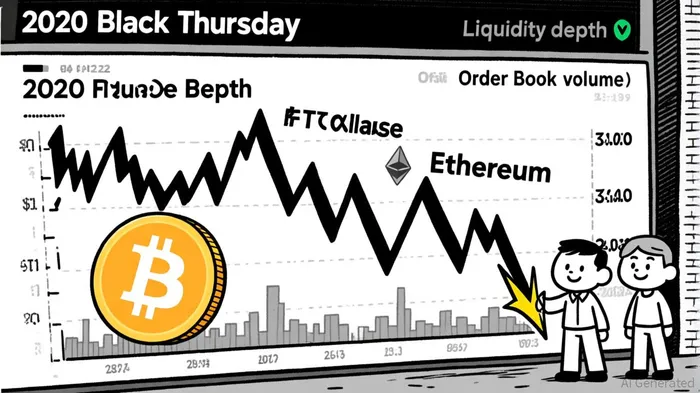
Liquidity-the ability to buy or sell assets without causing significant price swings-is a critical concern for institutional investors in crypto. According to a 2025 CoinLaw report, 72% of institutional investors have enhanced risk management strategies specifically for crypto assets, with 53% implementing liquidity stress testing frameworks to address risks in thinly traded assets. Yet, the reality remains stark: during the 2020 Black Thursday crash, BitcoinBTC-- lost nearly 50% of its value in a single day, exacerbated by cascading liquidations on leveraged platforms like BitMEX, according to a Clometrix analysis. Similarly, the 2022 FTX collapse triggered a 25% drop in Bitcoin and a 30% fall in EthereumETH-- prices, with over $700 million in liquidations, the Clometrix analysis noted.
The problem lies in the fragmented nature of crypto liquidity. A 2022 ScienceDirect study found that implicit costs-such as slippage and price deviations-can accumulate to over 26% annually for institutional investors, particularly in large-volume trades. This is compounded by the fact that major CEXs like Binance and Kraken have historically relied on order book consolidation and partnerships with external liquidity providers to stabilize trading conditions, as noted in the CoinLaw report. However, these solutions are not foolproof. For instance, the exodus of trading firms like Jane Street and Jump Trading from crypto markets post-2022 further reduced liquidity, creating a self-reinforcing cycle of instability, according to a TradeDog analysis.
Systemic Risk: Governance Failures, Not Inherent Market Flaws
While liquidity crises are often framed as inherent risks of crypto markets, recent research suggests otherwise. A 2023 paper analyzing systemic risk using the CATFIN measure found that systemic risk levels during the FTX crisis were lower than during earlier events like the 2021 regulatory tightening in China, according to the ScienceDirect study. This implies that liquidity shocks are more attributable to governance and regulatory failures than to the crypto market itself. For example, FTX's collapse was driven by internal mismanagement and opacity, not a systemic breakdown of the broader market, as the Clometrix analysis highlighted.
Nonetheless, the interconnectedness of CEXs means that localized failures can have cascading effects. The 2020 crash, for instance, was amplified by global macroeconomic panic and overleveraged positions on platforms with thin order books, as detailed by Clometrix. Institutional investors, who often hold large, leveraged positions, are particularly vulnerable. A 2025 TradersDNA analysis noted that slippage rates for Ethereum reached 4.96% during high-volatility periods, underscoring the fragility of execution environments.
Institutional Investor Adaptation: From Risk Mitigation to Strategic Retreat
Faced with these challenges, institutional investors have adopted a dual strategy: risk mitigation through stablecoins and decentralized alternatives, and strategic retreat from overleveraged CEXs. For example, post-2022, many institutions shifted funds to hardware wallets and decentralized exchanges (DEXs), driven by a loss of trust in centralized platforms, according to the TradeDog analysis. This trend has fragmented trading volumes, with DEXs experiencing significant growth.
Simultaneously, institutions have embraced technological solutions to navigate liquidity risks. Platforms like Binance and Kraken have implemented smart order routing systems (e.g., Athena) to merge order books across exchanges, reducing implicit costs, as discussed in the ScienceDirect study. Additionally, automated market makers (AMMs) and liquidity pools-borrowed from DeFi-have been adopted to stabilize trading for lower-liquidity tokens, per the TradeDog analysis. These innovations, however, come with their own risks, such as impermanent loss in liquidity pools, which require advanced hedging strategies, as the Clometrix analysis warns.
Post-Crisis Mitigation: A New Era of Exchange Resilience?
In response to liquidity crises, CEXs have deployed a mix of market-making strategies, regulatory compliance tools, and incentive programs. For instance, delta-neutral hedging and arbitrage across exchanges have become standard practices to minimize price discrepancies, according to Clometrix. Regulatory compliance has also taken center stage, with 84% of institutional investors prioritizing it in 2025, per the CoinLaw report. This includes navigating the fallout from U.S. enforcement actions, such as Binance's $4.3 billion fine, which reshaped market dynamics, as highlighted in the CoinLaw report.
Yet, the road to stability remains fraught. A 2023 report by CryptoPulpit noted that while trading volumes rebounded to $10 trillion in early 2023, this recovery was uneven, with emerging platforms like Bybit and Bitget gaining traction at the expense of established players-a trend the CoinLaw report also referenced. This fragmentation risks creating new liquidity bottlenecks, particularly for fiat-to-crypto pairs like EUR-USDC, which lag behind BTC-USDT in depth, as described in the TradersDNA analysis.
Conclusion: A Delicate Balance
Centralized exchanges remain pivotal to the crypto ecosystem, but their risks-liquidity fragility and systemic exposure-demand constant vigilance. For institutional investors, the path forward lies in a combination of robust risk management frameworks, strategic diversification across CEXs and DEXs, and advocacy for regulatory clarity. While post-crisis innovations like AMMs and smart order routing offer promise, they cannot fully offset the inherent volatility of a market still grappling with its identity. As the crypto landscape evolves, the key challenge will be balancing innovation with resilience-a task that will define the next chapter of institutional participation in digital assets.






Comentarios
Aún no hay comentarios