
Central London's Commercial Real Estate Correction and the Rise of Secondary UK Urban Centers
The commercial real estate landscape in Central London is undergoing a significant correction, marked by divergent performance across sectors and a growing shift of capital toward secondary UK urban centers. While prime office and logistics markets in London remain resilient, broader economic pressures-including high vacancy rates in non-prime assets and rising operational costs-are accelerating capital reallocation. This trend is particularly evident in secondary cities like Manchester, Birmingham, Edinburgh, and Sheffield, where logistics and tech sectors are attracting robust investment.
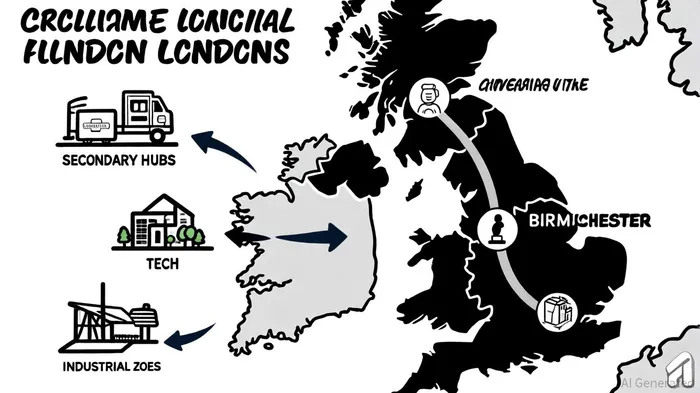
Central London: A Market in Transition
Central London's commercial real estate market has shown mixed signals in 2024–2025. Office leasing activity has surged, with Q1 2025 take-up reaching 3.11 million square feet-a 27.5% increase from Q1 2024-driven by pre-let agreements in high-grade spaces, according to the BNP Paribas report. Prime rents in the City of London rose by 9.68% to £85 per sq ft, reflecting strong demand for ESG-compliant, modern office assets, as the BNP Paribas report also notes. However, the broader market faces challenges: vacancy rates remain elevated at 9.2% citywide, with non-prime assets struggling to attract tenants, notes the LSH report.
The retail sector, while recovering, lags behind pre-pandemic levels. Core West End prime ZA rents are 15.7% below 2019 benchmarks, despite a 6.8% year-on-year increase in Q3 2023, according to Savills Q3 2023 analysis. Investment activity in retail remains subdued due to high debt costs, with only 11 transactions in Q2–Q3 2023, per the same Savills analysis. These dynamics underscore a market correction where prime assets thrive, but secondary and tertiary properties face declining value.
Capital Reallocation: Drivers and Opportunities
The reallocation of capital from London to secondary cities is driven by three key factors: economic diversification, ESG imperatives, and interest rate dynamics.
- Economic Diversification and Cost Efficiency
Secondary cities are emerging as hubs for logistics and tech sectors, offering lower costs and strategic advantages. For instance, Birmingham's Bruntwood SciTech invested £50 million in innovation-focused workspaces, attracting high-growth tech and life science businesses, as highlighted by BNP Paribas. Similarly, Manchester's £5 billion digital ecosystem has solidified its position as the UK's top non-London tech city, according to a Knight Frank report.
The logistics sector, in particular, is seeing a surge in investment. In 2024, UK logistics investment volumes hit £8.2 billion-the fourth-highest on record-driven by demand for high-quality, last-mile assets, per the LSH report. Blackstone's £200 million acquisition of 18 logistics assets in Manchester and Birmingham exemplifies this trend, with the firm targeting urban hubs for refurbishment and long-term value creation, as reported by LSH.
ESG and Sustainable Development
Investors are increasingly prioritizing assets with low EPC ratings and sustainable infrastructure. Secondary cities are capitalizing on this shift. For example, Edinburgh's logistics market is seeing demand for energy-efficient warehouses, supported by government incentives under the Modern Industrial Strategy 2025, as reported by Logistics Manager. Meanwhile, Manchester's tech sector is focusing on AI and cloud infrastructure, aligning with global decarbonization goals, according to the Knight Frank report.Interest Rate Dynamics and Yield Differentials
The Bank of England's anticipated 100-basis-point rate cuts in 2025 are expected to reduce borrowing costs, making secondary markets more attractive, the BNP Paribas report suggests. Prime office yields in London's West End range from 4.00–4.25%, while secondary cities like Sheffield and Nottingham offer higher yields (5.5–6.0%) in logistics and industrial assets, per the Knight Frank report. This differential is drawing institutional capital, particularly from US and Asian investors seeking growth opportunities, as noted in the LSH report.
Sector-Specific Opportunities in Secondary Cities
Logistics and Industrial Real Estate
The logistics sector in secondary cities is outperforming London. In 2024, occupier take-up in the UK's logistics market reached 26.3 million sq ft, with 60% driven by manufacturing, retail, and 3PLs, according to Logistics Manager. Manchester and Birmingham are leading this charge, with GXO securing 885,000 sq ft in Avonmouth and M&S leasing 400,000 sq ft in the West Midlands, per the Knight Frank report. The UK government's £600 million investment in logistics infrastructure further underscores the sector's potential, as Logistics Manager reports.
Tech Hubs and Innovation
Secondary cities are becoming innovation powerhouses. Birmingham's diverse economy and growing tech scene have attracted £50 million in investments for innovation hubs, noted by BNP Paribas. Glasgow and Edinburgh are also rising, with Glasgow's focus on AI and Edinburgh's life sciences sector drawing startups and institutional capital, the Knight Frank report observes. Manchester's 2025 Sector Insights Report highlights challenges like funding constraints but emphasizes opportunities in AI adoption and strategic M&A, as discussed in the LSH report.
Future Outlook and Investment Recommendations
The reallocation of capital to secondary cities is set to accelerate in 2025–2026. Key drivers include:
- Government Policy: The UK's 10-Year Infrastructure Strategy and Freeport initiatives will boost logistics and industrial development in secondary cities, supported by the Modern Industrial Strategy and reported by Logistics Manager.
- Tech Sector Growth: With the UK tech ecosystem valued at $1.2 trillion, secondary cities like Sheffield and Dundee are positioned to benefit from AI and fintech investments, according to the Knight Frank report.
- Interest Rate Cuts: Lower borrowing costs will spur development in high-yield sectors, particularly logistics and ESG-aligned assets, per BNP Paribas.
Investors should prioritize:
1. High-Grade Logistics Assets: Target urban last-mile hubs in Birmingham, Manchester, and Edinburgh.
2. Tech-Driven Commercial Real Estate: Invest in innovation parks and co-working spaces in cities with growing digital ecosystems.
3. ESG-Compliant Developments: Focus on retrofitting older assets to meet ESG standards, particularly in secondary markets.
Conclusion
Central London's commercial real estate correction is reshaping the UK's investment landscape. While prime assets in the capital remain valuable, secondary cities are emerging as engines of growth, driven by logistics demand, tech innovation, and favorable yield differentials. As capital continues to reallocate, investors who align with these trends will be well-positioned to capitalize on the next phase of the UK's real estate evolution.







Comentarios
Aún no hay comentarios