
Central Bank Transparency and Market Volatility: Navigating the Fed's 2025 Decisions to Reshape Investor Strategy
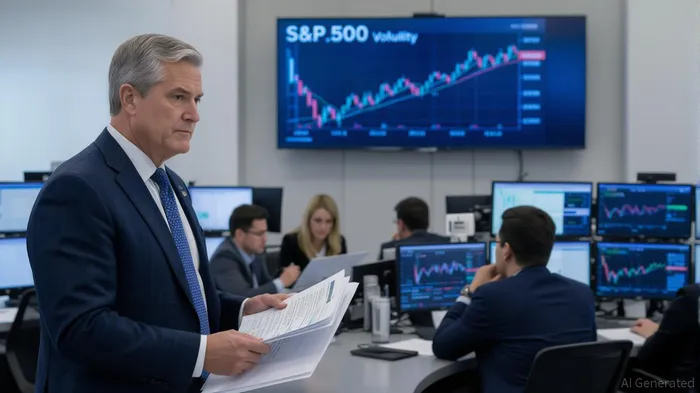
The Federal Reserve’s 2025 policy decisions and transparency measures have become a double-edged sword for investors. On one hand, the Fed’s detailed communication of its monetary framework and inflation targets has provided clarity in an era of geopolitical and economic uncertainty. On the other, the central bank’s delayed responses to inflationary pressures and political pressures have exacerbated market volatility, forcing investors to recalibrate their strategies in real time.
The Fed’s Balancing Act: Transparency vs. Uncertainty
The Fed’s 2025 transparency efforts, including revised communication protocols and updated policy statements, aimed to anchor inflation expectations and stabilize markets. However, these measures collided with a volatile macroeconomic backdrop. Tariff-driven inflation, particularly from China and Europe, and a fragile labor market created a “toxic mix” of uncertainty [1]. For instance, the S&P 500’s worst monthly drop since December 2022 in March 2025 occurred amid fears of prolonged inflation and trade wars [1]. Conversely, a temporary de-escalation in U.S.-China trade tensions in May 2025 allowed the index to rebound, reaching record highs by June [1].
The Fed’s July 2025 FOMC minutes revealed a nuanced stance: while policymakers emphasized a data-dependent approach, internal dissent over rate cuts highlighted the tension between inflation control and labor market fragility [6]. Governor Christopher Waller’s advocacy for a 25-basis-point cut in September 2025, citing slowing job creation, contrasted with concerns about inflation expectations becoming unanchored [2]. This divergence underscored the Fed’s challenge in balancing transparency with real-time decision-making under political and economic pressures [6].
Investor Strategies in a Shifting Landscape
Investors have responded to the Fed’s 2025 policy environment by adopting dynamic portfolio adjustments. With markets pricing in 1–2 rate cuts by year-end, asset allocations have shifted toward shorter-duration bonds, real assets, and U.S. large-cap equities [1]. BlackRockBLK-- advised overweighting the “belly” of the yield curve (bonds with maturities under 7 years) to capitalize on moderate rate cuts while avoiding long-term bonds, which face underperformance risks [1]. Similarly, Morgan StanleyMS-- recommended diversifying into gold and real estate investment trusts (REITs) as hedges against inflation and geopolitical risks [2].
Equity strategies have also evolved. The S&P 500’s resilience in 2025, despite trade tensions, has led to a focus on U.S. large-cap quality stocks, particularly in technology and communication services [6]. However, consumer sentiment surveys, such as the University of Michigan’s 4.9% inflation expectations, have prompted caution in discretionary sectors [5]. Investors are increasingly prioritizing active stock selection over broad market exposure, reflecting skepticism about the Fed’s ability to manage stagflation risks [2].
Political Pressures and the Erosion of Credibility
A critical wildcard in 2025 has been the politicization of the Fed. Former President Donald Trump’s public demands for rate cuts and his criticism of Fed officials, including calls for the resignation of Governor Lisa Cook, have raised concerns about the central bank’s independence [5]. This erosion of credibility has amplified market volatility, as investors question the Fed’s ability to act purely on economic data [4]. For example, the U.S. dollar’s decline against the euro and yen in 2025—partly attributed to foreign confidence in U.S. monetary policy—was exacerbated by these political tensions [3].
Conclusion: Adapting to a New Normal
The 2025 Fed policy environment underscores the importance of agility in investor strategies. While transparency remains a cornerstone of central banking, its effectiveness is contingent on the Fed’s ability to navigate political pressures and inflationary shocks. Investors must remain attuned to real-time data, such as labor market indicators and trade developments, while diversifying across asset classes to mitigate risks. As the Fed inches toward a rate-cutting cycle, the key will be balancing the potential benefits of lower borrowing costs with the long-term stability of the global economy.
Source:
[1] Market Volatility in Early 2025: An Overview [https://www.etftrends.com/etf-strategist-channel/market-volatility-early-2025-overview/]
[2] Speech by Governor Waller on the economic outlook [https://www.federalreserve.gov/newsevents/speech/waller20250828a.htm]
[3] Financial markets in 2025: Setting the stage for more volatility [https://realeconomy.rsmus.com/financial-markets-in-2025-setting-the-stage-for-more-volatility/]
[4] Fed Independence Under Siege: How Politicization ... [https://www.ainvest.com/news/fed-independence-siege-politicization-threatens-global-financial-stability-2508/]
[5] Market Volatility in 2025: Tariffs, Inflation and the Consumer ... [https://www.diamond-hill.com/insights/a-780/articles/market-volatility-in-2025-tariffs-inflation-and-the-consumer-impact/]
[6] Fed minutes August 2025 [https://www.cnbc.com/2025/08/20/fed-minutes-august-2025.html]







Comentarios
Aún no hay comentarios