
Central Bank Policy Shifts and Political Influence: How Partisan Fed Confirmations Undermine Credibility and Spur Market Volatility
The Federal Reserve's independence has long been a cornerstone of U.S. economic stability. Yet, as political pressures intensify, the confirmation of Fed nominees has become a battleground for partisan influence, with profound implications for monetary policy credibility and financial market volatility. Recent events, including President Donald Trump's aggressive efforts to reshape the Fed's leadership, underscore a growing risk: the erosion of the Fed's institutional independence could trigger a credibility crisis, destabilizing both inflation expectations and investor confidence.
Partisan Confirmations and the Erosion of Credibility
The Fed's credibility hinges on its perceived insulation from political interference. However, partisan confirmations—where nominees are selected based on alignment with executive branch priorities rather than economic expertise—threaten this foundation. For instance, Trump's public campaign to remove Fed Governor Lisa Cook, citing unproven allegations of mortgage fraud, has raised alarms about the politicization of monetary policy[2]. Such actions signal to markets that the Fed may prioritize short-term political goals over long-term economic stability, undermining trust in its ability to manage inflation and employment mandates[3].
Historical research reinforces this concern. Studies show that periods of partisan alignment between the Fed and the executive branch correlate with more expansionary policies and lower interest rates relative to apolitical benchmarks[1]. This “partisan business cycle” risks distorting the Fed's dual mandate, as political pressures could lead to inconsistent policy frameworks. Former Fed Chair Paul Volcker once noted that presidents frequently attempt to sway the Fed's decisions, particularly before elections[3], a dynamic that intensifies during confirmation battles.
Market Volatility and the VIX Spike of 2025
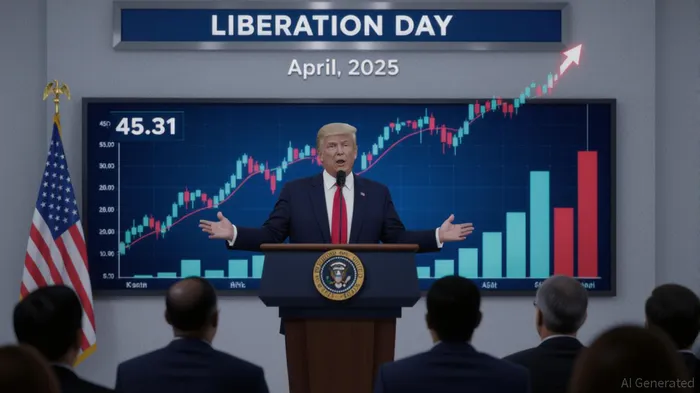
The consequences of politicized Fed governance are not abstract. In April 2025, Trump's announcement of sweeping “Liberation Day” tariffs on imports triggered a sharp spike in the VIX volatility index, which closed at 45.31—the highest level since the 2020 stock market crash[3]. This volatility was exacerbated by retaliatory measures from China, including a 34% tariff on U.S. goods, and the rapid unwinding of the yen carry trade[4]. While the VIX later declined to 14 by August 2025, analysts warned that low volatility often precedes turbulence[4], a pattern consistent with the uncertainty generated by Trump's erratic trade policies.
Inflation expectations also surged during this period. Consumer inflation expectations rose from 4.5% to 4.9% in August 2025, reflecting widespread anxiety over the administration's tariff-driven economic strategy[2]. The Economic Policy Uncertainty Index reached its highest level since the pandemic, further amplifying market jitters[4]. These developments highlight how political interference in Fed governance can indirectly fuel inflationary pressures, even as the central bank maintains a cautious stance on interest rates[2].
Policy Confidence and Long-Term Risks
Public trust in the Fed is another casualty of partisan confirmations. A new measure of trust in central banking, derived from analyzing 4 million tweets, reveals that trust declines by 11 percentage points with a one-standard-deviation increase in the Fed funds rate[2]. This sensitivity underscores the importance of transparent communication in maintaining credibility. However, when Fed leadership is perceived as politically motivated—such as nominees with prior White House ties—public confidence erodes[1].
Former Treasury Secretary Larry Summers has warned of a potential “credibility crisis” if political interference continues[2]. Such a crisis could disrupt the Fed's ability to anchor inflation expectations, leading to higher long-term borrowing costs and a weaker dollar[3]. For investors, this translates to increased risk premiums and reduced returns on traditionally safe assets like U.S. Treasuries[1].
Conclusion: Navigating the Risks for Investors
The interplay between partisan Fed confirmations, monetary policy credibility, and market volatility presents a complex challenge for investors. While the Fed's technocratic independence has historically insulated it from political pressures, recent events suggest this buffer is fraying. Investors must remain vigilant to the risks of policy uncertainty, particularly as confirmation battles intensify. Diversifying portfolios to hedge against inflationary shocks and geopolitical volatility—such as through commodities, short-duration bonds, or international equities—may offer protection in an era of eroding central bank credibility.







Comentarios
Aún no hay comentarios