
Central Bank Policy Effectiveness: Navigating Consumer Spending, Inflation Resilience, and Tightening Trade-Offs
Central Bank Policy Effectiveness: Navigating Consumer Spending, Inflation Resilience, and Tightening Trade-Offs
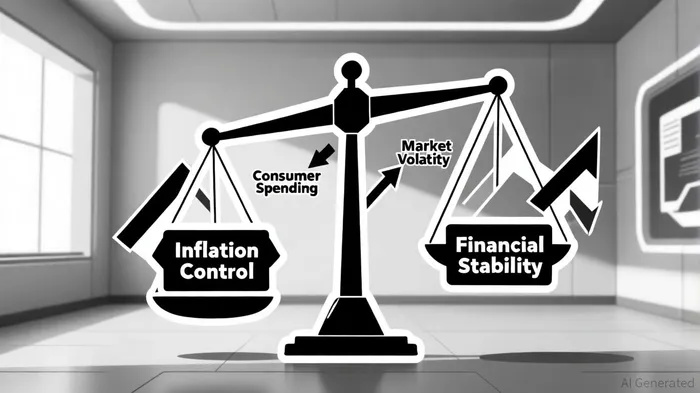
Central banks in 2025 face a paradox: while aggressive monetary tightening has curbed inflation, it has also exposed vulnerabilities in financial stability and consumer spending resilience. The post-pandemic era, marked by supply-side shocks and geopolitical tensions, has forced policymakers to navigate a complex landscape where the effectiveness of rate hikes depends on the source of inflation-demand-driven or supply-driven. For investors, understanding these dynamics is critical to assessing risk and opportunity in an evolving macroeconomic environment.
The Resilience of Consumer Spending Amid Tightening
Consumer spending, which accounts for nearly 70% of U.S. GDP, has defied expectations in 2025. Despite higher interest rates and weak consumer sentiment, spending has remained robust, driven largely by high-income households with lower credit card debt levels compared to pre-pandemic times, according to a Boston Fed analysis. This resilience, however, masks growing disparities: low-income consumers have seen a sharp rise in credit card debt, limiting their ability to spend, the analysis finds.
The Federal Reserve's 2025 Monetary Policy Report highlights that inflation has edged closer to the 2% target, with the PCE index rising 2.6% year-over-year, as noted in the Fed report. Yet core PCE inflation remains stubbornly elevated at 2.8%, underscoring the uneven nature of disinflation. This persistence has led central banks to adopt a cautious approach, balancing the need to anchor inflation expectations with the risk of stifling economic growth.
The Trade-Off Between Inflation Resilience and Financial Stability
Recent empirical studies reveal a critical nuance: the impact of monetary tightening varies depending on inflation's root cause. When inflation is supply-driven-such as from energy shocks or supply chain disruptions-financial stress tends to rise sharply after rate hikes, a BIS working paper finds. Conversely, demand-driven inflation sees more stable or even declining financial stress, as tighter policy effectively cools excess demand.
This dichotomy creates a tension for central banks. For instance, the Bank of Thailand and the Reserve Bank of New Zealand cut rates in 2025 to counteract economic slowdowns, while the Federal Reserve and Bank of Canada maintained hawkish stances to combat persistent inflation, the paper notes. The challenge lies in avoiding over-tightening, which could trigger financial instability, while ensuring inflation does not become entrenched.
Implications for Investors
Investors must consider how central banks' dual mandate-price stability and financial stability-shapes market outcomes. Historical data shows that rapid tightening in response to supply-side inflation can lead to large excess increases in the price level, as seen in the post-pandemic period, according to a San Francisco Fed letter. This phenomenon, coupled with high central bank credibility, has anchored inflation expectations, mitigating some adverse effects.
Moreover, public perceptions of central bank credibility have evolved. A 2025 San Francisco Fed Economic Letter notes that professional forecasters now expect a more aggressive policy response to inflation, reflecting heightened trust in central banks' ability to manage economic cycles. This shift could enhance the transmission of monetary policy to financial markets, where investors increasingly price in future rate paths and inflation trajectories.
Conclusion
Central banks in 2025 are operating in a high-stakes environment where the effectiveness of monetary policy is contingent on inflation's drivers and the broader economic context. While tightening has succeeded in reducing demand-driven inflation, it has also exposed vulnerabilities in financial systems and consumer behavior. For investors, the key takeaway is to monitor not only headline inflation metrics but also the structural factors-such as income inequality and debt levels-that shape spending resilience. As central banks continue to walk the tightrope between inflation control and financial stability, adaptability will be paramount.







Comentarios
Aún no hay comentarios