
Central Bank Integrity and Market Stability: The Hidden Cost of Political Manipulation
The integrity of central banks has long been a cornerstone of global financial stability. Yet, as political pressures increasingly infiltrate economic data collection and monetary policy, the consequences for markets and long-term investment returns are becoming impossible to ignore. From Turkey's currency crisis to the Trump administration's erosion of U.S. statistical credibility, the manipulation of economic data by governments is not merely a theoretical risk-it is a destabilizing force with measurable financial impacts.
The Erosion of Central Bank Independence
Political interference in central banking often begins with subtle actions: public criticism of interest rate decisions, the dismissal of independent economists, or the restructuring of advisory bodies. In Turkey, repeated demands by populist leaders for lower interest rates led to a 40% depreciation of the lira against the U.S. dollar between 2020 and 2025, while inflation surged to over 80% in 2023, according to an NPR analysis. Similarly, Argentina's central bank lost credibility after years of political meddling, resulting in a hyperinflationary spiral that eroded investor confidence and triggered capital flight, as noted in a VoxEU column.
The U.S. case is equally concerning. The Trump administration's disbanding of the Federal Economic Statistics Advisory Committee in 2024, coupled with proposed changes to GDP calculation methodologies, has raised alarms about "statistical censorship," according to an HGBr report. As Erica Groshen, a former Federal Reserve official, warns, such actions risk distorting economic reality and undermining the ability of businesses and investors to make informed decisions, a point explored in an NPR Illinois piece.
Spillovers to Emerging Markets and Investor Returns
The consequences of compromised central bank independence extend far beyond national borders. Emerging markets, which rely heavily on global capital flows, are particularly vulnerable. A 2025 Kansas City Fed study found that U.S. monetary tightening-often amplified by political uncertainty-led to sharper capital outflows and currency depreciation in countries like Brazil and Mexico. For instance, when the Federal Reserve raised rates in 2024, Mexico's peso fell 15% against the dollar within six months, increasing borrowing costs for local firms and reducing investor returns by an estimated 8–12%, according to a ScienceDirect paper.
Quantitative data further underscores the risks. In China, research using satellite night light data revealed that 9.59% of city-year observations over-reported GDP to meet political targets between 2000 and 2018, inflating growth by 2.6% annually in a night-light study. While this practice has diminished in recent years, the legacy of mistrust persists. Foreign direct investment (FDI) in China declined by 11% in 2024 after adjusting for volatile financial flows, with global FDI stagnating at $1.5 trillion amid rising geopolitical tensions, as reported in a Forbes article. Political instability, whether through data manipulation or policy reversals, deters FDI by creating unpredictable business environments, a trend documented in a ResearchGate paper.
Market Volatility and the Cost of Uncertainty
Political manipulation of economic data also amplifies stock market volatility. The VIX, a key gauge of investor anxiety, spiked to 45.3 in 2025 during the "Liberation Day" trade war escalation between the U.S. and China, a 113% increase from its pre-event level of 21.5, according to a CBOE analysis. Similarly, the 2024 U.S. presidential election saw abnormal volatility across asset classes, with the S&P 500 dropping 7% in a single week due to policy uncertainty, as documented in an academic study.
The Economic Policy Uncertainty (EPU) Index, which tracks political risk, explains 24% of VIX fluctuations on average and up to 47% during high-uncertainty periods like 2004–2007, according to a Springer chapter. This volatility directly impacts long-term investment returns. A 2023 survey by the Capital+Constitution project found that 90% of institutional investors view rising political risks as a material threat, with less than 30% confident in companies' preparedness to manage these challenges, based on a Harvard Law post.
The Path Forward: Institutional Safeguards and Investor Caution
Restoring trust in economic data requires reinforcing institutional safeguards. Countries like New Zealand and Germany, which maintain strict central bank independence, have demonstrated resilience to political pressures, with inflation rates below 3% in 2025 despite global turbulence, as highlighted in the NPR analysis. Conversely, nations with weak institutional frameworks face a "credibility trap," where rebuilding trust in data and policy takes years of consistent, transparent governance, a point previously noted in the VoxEU column.
For investors, the lesson is clear: portfolios must account for political risk as a material factor. Diversification into markets with strong institutional frameworks, hedging against currency volatility, and engaging with companies that prioritize political risk management are critical strategies, as argued in an Israilov analysis.
Conclusion
Political manipulation of economic data is not a distant threat but a present-day reality with profound implications for market stability and investment returns. As governments increasingly prioritize short-term political gains over long-term economic credibility, the burden falls on investors to navigate a landscape where trust in data is eroding. The path to resilience lies in institutional integrity-and for those who ignore it, the costs will be measured in both financial losses and systemic instability.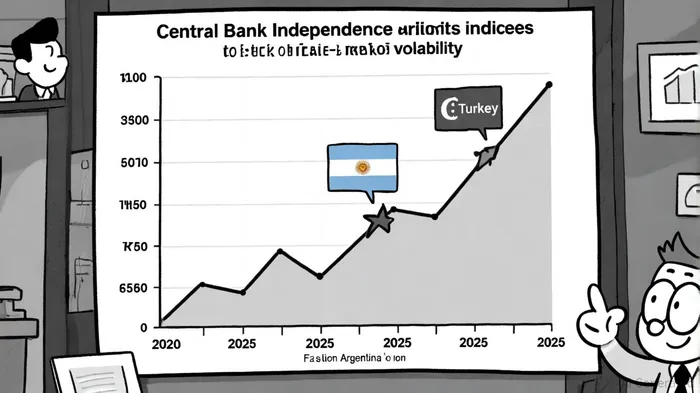







Comentarios
Aún no hay comentarios